
Impact plates are central wear components in crushing equipment, so controlled inspection and timely replacement protect product size, throughput, and machine availability. This guide explains how to recognize meaningful wear, decide when a changeout is justified, and specify replacement parts that suit mining and engineering machinery. It also outlines practical quality, safety, and planning checks for custom orders.
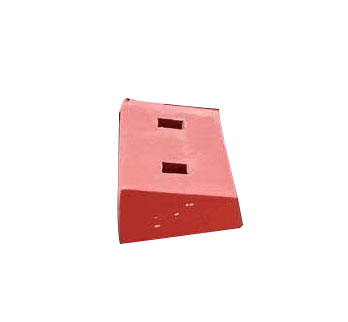
How to Analyze Impact Plates Wear in Service
Read the Wear Pattern Before It Becomes a Failure
In service, Impact Plates generally wear fastest where feed first strikes the crushing cavity. Look for thinning, grooves, rounded impact faces, local cracking, and deformation around mounting points. A smoothly polished surface may be normal; asymmetric loss that changes the material path is more important. Record photographs from the same angle during each inspection so progressive change, rather than a single visual impression, drives the maintenance decision.
Measure Thickness, Profile, and Mounting Areas
With the crusher safely isolated, measure Impact Plates at several defined locations rather than at one convenient point. Thickness readings, edge condition, hole elongation, and backing contact should be recorded on a simple inspection sheet. Compare the results with the approved drawing, minimum wall requirement, and previous inspection records. This practical approach helps maintenance teams identify uneven wear before retention features or crusher clearances are affected.
Connect Wear Data With Operating Conditions
Wear data becomes more valuable when it is linked to feed size, material hardness, moisture, throughput, and crusher settings. Impact Plates exposed to oversized feed or uneven chamber loading may show concentrated wear in one area. If product grading becomes less consistent, review the plate profile together with operating parameters. A proper diagnosis avoids replacing parts without addressing the conditions that caused accelerated wear in the first place.
When Should Impact Plates Be Replaced?
Use Drawing Limits and Service History to Set the Threshold
There is no single replacement point for every crusher. Impact Plates should be replaced when their remaining thickness, mounting condition, or impact profile no longer meets the approved drawing and operating requirements. Do not wait for a complete fracture or severe deformation. A planned changeout based on wear history helps preserve crusher performance, supports predictable maintenance budgets, and reduces the risk of an unexpected shutdown during demanding production periods.
Watch for Changes in Crushing Performance
Changes in throughput, material flow, vibration patterns, or final particle size can indicate that Impact Plates need closer inspection. These signs do not automatically prove that a plate is worn, but they justify checking the crushing chamber and fastening areas. When the plate surface no longer guides material as intended, crushing force can be distributed unevenly. Early inspection supports more stable operation and more uniform material sizing.
Plan Replacement Around Shutdown Windows
A planned shutdown is the best time to change Impact Plates because the crusher can be cleaned, measured, and reassembled carefully. Keep a verified drawing, part number, and service record available before requesting a quotation. Delivery timing should be confirmed after drawing and process review. Standard repeat orders are often easier to arrange, while custom castings may require a longer schedule when drawings need repeated confirmation or special production processes are required.
How to Specify Replacement Impact Plates Correctly
Match the Approved Geometry and Working Conditions
A reliable replacement starts with correct dimensions, mounting-hole positions, thickness, surface profile, and installation orientation. Impact Plates must match the crusher drawing and the actual duty of the machine, including feed characteristics and expected production load. For non-standard mechanical parts, a worn sample can be useful, but clear drawings and measured dimensions remain the strongest basis for manufacturing a part that fits properly and performs consistently.
Review Related Wear Parts as a Complete Assembly
Impact Plates work within a crushing system, so adjacent wear components should also be reviewed during maintenance planning. For hammer-crusher projects, Xian Huan-Tai can provide customizable bimetallic composite hammerheads with a hard, wear-resistant head and a strong handle section to reduce breakage concerns. An optimized structural design across the crushing assembly can support strong crushing force and more uniform material particle size. Impact Plates remain engineered according to their own equipment drawing and duty.
Choose a Manufacturer With Process Control
For mining, quarrying, and engineering machinery, Impact Plates require more than basic casting capability. The supplier should review drawings, confirm technical requirements, control production steps, and inspect critical dimensions before dispatch. Xian Huan-Tai Technology and Development Co., Ltd. focuses on customized non-standard mechanical parts for industrial equipment, rather than precision electronic equipment. This engineering-focused approach helps customers obtain parts suited to real operating conditions, not generic catalog assumptions.
Conclusion
Effective Impact Plates management combines routine inspection, accurate measurement, replacement planning, and correct technical specifications. By monitoring wear patterns and working with an experienced manufacturer, crusher operators can maintain stable material flow, protect equipment availability, and order customized replacement parts with greater confidence in fit, quality, and delivery coordination.
FAQ
Q: How often should Impact Plates be inspected?
A: Inspect them during planned shutdowns and after major changes in feed size, throughput, or product grading. Service records should determine the most suitable interval.
Q: Can worn Impact Plates be rebuilt?
A: Rebuilding may be possible in some cases, but the decision should be based on remaining thickness, mounting condition, geometry, and the manufacturer’s technical assessment.
Q: What should a quotation request include?
A: Provide drawings, dimensions, photographs, material requirements, equipment model, operating conditions, and the quantity of Impact Plates required.
Q: Can you supply other crusher wear components?
A: Yes. Xian Huan-Tai supports customized mechanical parts for mining and engineering machinery, including selected crusher wear and structural components.
Q: Why choose custom-made plates?
A: Custom Impact Plates can match non-standard dimensions, mounting details, working loads, and specific crusher designs more accurately than generic alternatives.
Get Customized Impact Plates Solutions from Experts
Bring us your drawing, worn-part sample, or operating concern, and Xian Huan-Tai Technology and Development Co., Ltd. will help turn it into a practical Impact Plates proposal. With 30 years of industry experience, excellent service, professional production and inspection teams, and technical support for customized performance requirements, we help customers manage quality from drawing review through delivery planning. Contact our team today at inquiry@huan-tai.org.
References
- ASTM International. ASTM G81: Standard Test Method for Jaw Crusher Gouging Abrasion Test.
- ASTM International. ASTM G65: Standard Test Method for Measuring Abrasion Using the Dry Sand/Rubber Wheel Apparatus.
- Peterson, M. B., and Winer, W. O. Wear Control Handbook. ASME, 1980.
- Wills, B. A., and Finch, J. Wills’ Mineral Processing Technology: An Introduction to the Practical Aspects of Ore Treatment and Mineral Recovery. Butterworth-Heinemann, 2016.
- Gupta, A., and Yan, D. S. Mineral Processing Design and Operations: An Introduction. Elsevier, 2016.
