
Custom hammer head designs solve breakage by separating two conflicting demands: a hard, wear-resistant striking face and a tough, shock-absorbing handle. Bimetallic composite casting delivers both in one part, while model-specific dimensions and balanced weight sets remove the stresses that snap standard hammers at the eye.
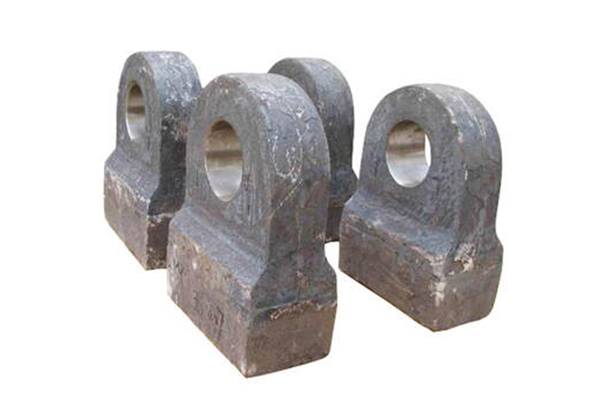
The Breakage Problem: Where Off-the-Shelf Hammer Heads Give Up
Hammer crushers ask a single component to do two contradictory jobs. Buyers who chase the lowest unit price usually discover the hidden cost within a few hundred operating hours.
Hardness and Toughness Pull in Opposite Directions
A uniformly hard Hammer Head resists abrasion beautifully but behaves like glass under impact, cracking at the pin hole. A uniformly tough one survives shock yet mushrooms and rounds off within weeks. Single-alloy castings force you to choose one weakness or the other, which is precisely why breakage keeps repeating on the same machines.
The Eye Is Where Most Hammers Die
Look at any pile of scrapped hammers and the pattern is obvious: the majority failed through the pin hole, not the working face. That region carries the full centrifugal and impact load with the least cross-section. Any casting porosity, sharp corner or hardness spike in a Hammer Head handle becomes the crack starter, long before the striking face is worn out.
Generic Dimensions Never Quite Fit
Rebuilt rotors, replacement discs and mixed-brand parts mean few crushers still match catalogue drawings. A Hammer Head with the wrong eye diameter or thickness rattles on the shaft, wears the pin holes oval and throws the rotor out of balance. From there, breakage becomes a matter of time rather than probability.
The Bimetallic Answer: Hard Face, Strong Handle, One Casting
Our customizable bimetallic composite hammerhead was developed specifically to end this trade-off. Two metals, metallurgically bonded during casting, let each zone do only the job it is good at.
Two Materials, One Component
The striking end uses a high-hardness wear-resistant alloy — high chromium type material — to fight abrasion at the rock face. The handle is cast in a tough, impact-absorbing steel that flexes rather than fractures. Because the bond forms during pouring rather than by welding, the finished Hammer Head behaves as one piece instead of two parts bolted together.
Proven Where Feed Is Punishing
Limestone, gypsum, coal, construction waste and slag all attack hammers differently. In abrasive, dusty circuits the hard face carries the workload; in shock-heavy recycling duty the tough handle earns its keep. A bimetallic Hammer Head performs in both, which is why operators running mixed feed report fewer emergency stops to replace snapped hammers.
Heat Treatment Locks In the Properties
Casting chemistry alone proves nothing. Each Hammer Head passes through a controlled heat treatment cycle matched to its grades, developing the hardness gradient and core toughness the design depends on. Hardness readings are recorded batch by batch, so you can compare one delivery against the previous order instead of trusting a vague “wear-resistant” note on a quotation.
Beyond Material: Design, Balance and Fit
Metallurgy fixes half the problem. The rest is geometry and assembly discipline — areas where customization pays back fastest.
Optimised Structure for Force and Product Size
Our optimised structural design concentrates crushing force where it does useful work while keeping the section modulus generous around the eye. The result is a Hammer Head that hits harder and produces a more uniform particle size, reducing recirculating load. Better product gradation and longer hammer life usually arrive together, because energy goes into the rock, not into flexing metal.
Matched Weights Keep the Rotor Steady
Fitting new hammers alongside worn ones is the fastest way to destroy a rotor. Imbalance creates cyclic bending that punishes shafts, bearings and every remaining Hammer Head. We supply hammers in weight-matched sets and mark them accordingly, so your fitters can assemble a balanced rotor without spending a shift on the weighing scale.
Made for Your Machine, Not a Catalogue
Because production follows your crusher model or your drawing, the parts suit various types of equipment, including older and rebuilt machines. Send a worn Hammer Head and our engineers measure the eye, thickness, profile and weight, then issue a confirmation drawing for approval before tooling begins. Correct fit eliminates play — and play is what turns normal wear into sudden breakage.
Ordering, Inspection and Lead Time
Every batch leaves with chemical composition analysis, hardness testing and dimensional inspection against the approved drawing, with non-destructive testing added where duty demands it. Repeat items with existing patterns move relatively quickly. Fully customized work naturally takes longer, since drawing confirmation, pattern making, pouring, heat treatment and machining each add time — and repeated drawing revisions extend it further. We give an honest window upfront so parts land before your planned shutdown.
Conclusion
Crusher hammer breakage is an engineering problem, not bad luck. A bimetallic composite Hammer Head with a hard face and tough handle, correct dimensions for your rotor, weight-matched sets and documented heat treatment together turn a recurring failure into a predictable maintenance item.
FAQ
What makes a bimetallic hammer head different?
The striking face is hard and wear-resistant; the handle is tough and impact-absorbing, bonded during casting into one component.
Why do my hammers keep breaking at the pin hole?
Usually brittle handle material, casting defects, or loose fit causing play and rotor imbalance.
Can you produce hammers without an original drawing?
Yes. Send the worn Hammer Head or crusher model and we reverse-engineer it, confirming a drawing with you first.
Do you supply weight-matched sets?
Yes, hammers are supplied matched and marked so rotors stay balanced during assembly.
What quality documents are provided?
Chemical analysis, hardness reports, dimensional inspection records and NDT results on request.
Stop Replacing the Same Broken Hammer
Send us a photo of your failed Hammer Head, your drawing, or simply the crusher model — our technical team will tell you why it broke and what to change. Xi’an Huan-Tai brings 30 years of experience in customized non-standard mechanical parts, a production team controlling quality from moulding to final inspection, and service that treats your uptime as the deliverable. Write to inquiry@huan-tai.org and get a real answer.
References
- Wills, B. A., & Finch, J. A. — Wills’ Mineral Processing Technology, Butterworth-Heinemann.
- Gupta, A., & Yan, D. S. — Mineral Processing Design and Operations: An Introduction, Elsevier.
- Beeley, P. R. — Foundry Technology, Butterworth-Heinemann.
- Bhadeshia, H. K. D. H., & Honeycombe, R. W. K. — Steels: Microstructure and Properties, Elsevier.
- Stachowiak, G. W., & Batchelor, A. W. — Engineering Tribology, Butterworth-Heinemann.
