
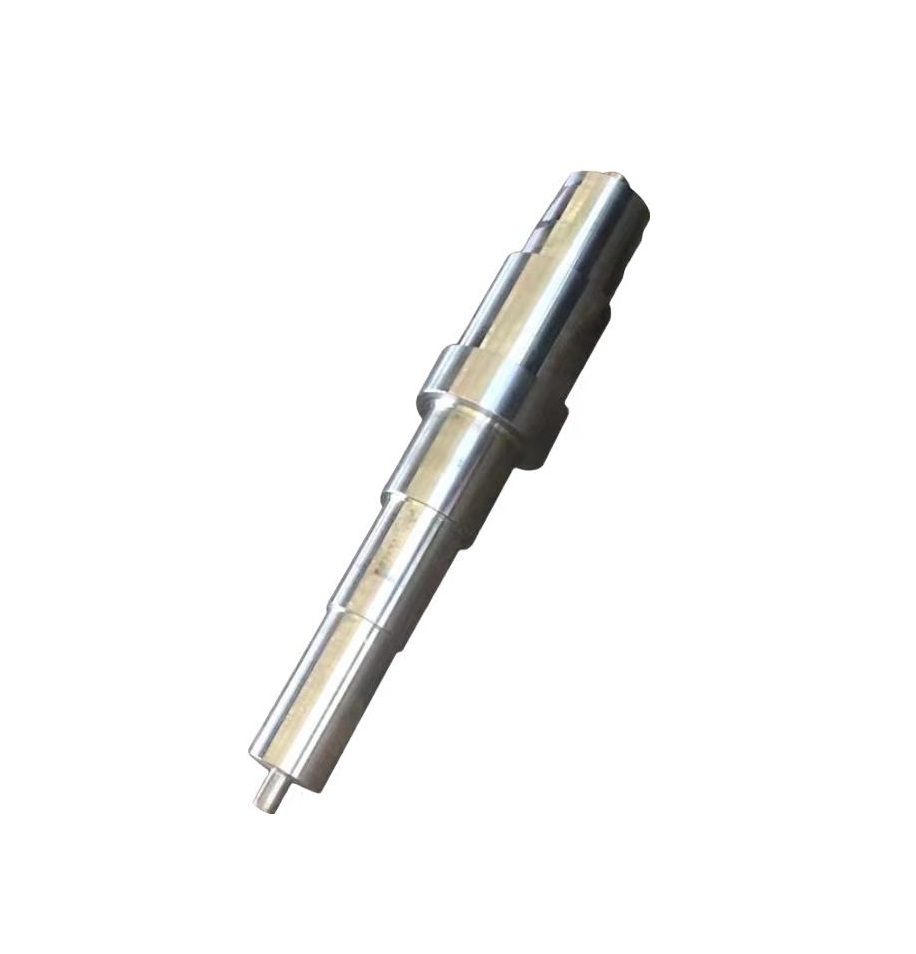
The eccentric shaft is the mechanical core of a jaw crusher — the component that converts rotational input from the flywheel into the reciprocating motion of the swing jaw. Without a functioning eccentric shaft, there is no crushing action. Its geometry determines stroke length, its material and manufacturing process determine fatigue life, and its condition at any given point in service determines whether the crusher runs smoothly or begins accumulating secondary damage across the entire drive assembly.
The Mechanical Function of the Eccentric Shaft in Jaw Crushing
Converting Rotation Into Crushing Stroke
The eccentric shaft sits off-centre within its bearing housings by a precisely machined offset dimension. As it rotates, this offset translates into a back-and-forth movement at the pitman — the component connecting the eccentric shaft to the swing jaw. Each rotation produces one complete crushing stroke: jaw open, material drops; jaw closes, material is compressed and fractured. The stroke amplitude is determined directly by the eccentric shaft’s offset, making its geometry central to crusher capacity and product size.
Transmitting Load Through the Bearing Assembly
During every crushing cycle, the eccentric shaft transmits the full crushing force through its journal surfaces into the main bearing housings. These bearing loads are among the highest dynamic forces in the entire crusher — particularly when processing hard rock or encountering tramp material. The eccentric shaft must maintain dimensional integrity across these repeated high-load events throughout its service life. Any loss of journal surface quality or shaft straightness translates directly into bearing wear and crusher vibration.
Setting the Rhythm of the Entire Crushing Process
The rotational speed of the eccentric shaft defines the crushing frequency — how many impact events occur per minute. This frequency, combined with stroke length and the jaw’s nip angle, determines both throughput capacity and the efficiency with which material is reduced. An eccentric shaft running at the correct speed for the application and feed material delivers consistent output gradation and stable power draw. Maintaining the eccentric shaft in sound condition is maintaining the fundamental rhythm of the crusher’s production cycle.
Why Forging Is the Right Manufacturing Process for the Eccentric Shaft
Grain Structure and Fatigue Resistance
The eccentric shaft in a jaw crusher is produced through forging — not casting. Forging aligns the metal grain structure along the shaft’s length and through its critical cross-sections, producing a component with significantly better fatigue resistance than a cast equivalent. Given the cyclic nature of the loads the eccentric shaft carries — millions of stress cycles over a typical service life — this grain structure integrity is what separates a shaft that performs reliably for years from one that develops fatigue cracking under heavy mining conditions.
Dimensional Stability Under Operational Stress
Forged eccentric shaft components maintain their dimensional accuracy under sustained dynamic loading in a way that cast parts cannot reliably match. The journal diameters, offset geometry, and overall straightness of a forged eccentric shaft hold closer to their original specification through years of service in demanding mining and aggregate applications. This dimensional stability protects the bearing housings, reduces vibration, and extends the maintenance interval before shaft inspection and replacement become necessary.
Material Selection to Match Operating Demands
Jaw crusher eccentric shafts are typically manufactured from alloy steel, selected for the combination of core strength and surface hardness that high-cycle dynamic loading demands. The specific alloy grade and heat treatment applied are matched to the shaft’s size, operating load, and application environment. An eccentric shaft sourced from a manufacturer with proper material qualification and heat treatment capability performs reliably across the full design service life — which is exactly what high-utilisation mining operations need from this critical component.
Maintaining the Eccentric Shaft for Long-Term Crusher Reliability
Bearing Lubrication as a Primary Protection Measure
The eccentric shaft journals run in bearing housings that depend entirely on a clean, continuous lubrication supply to prevent metal-to-metal contact. Maintaining lubrication system condition — clean oil, correct viscosity, adequate pressure, and functioning seals — is the single most direct action maintenance teams can take to protect eccentric shaft journal surfaces. Lubrication failure is the leading cause of premature eccentric shaft and bearing damage in jaw crusher applications across mining and engineering service.
Inspection Intervals and Wear Monitoring
Eccentric shaft journal diameter and surface condition should be measured at defined inspection intervals, with results recorded against a baseline established at installation or last overhaul. Progressive journal wear narrows the running clearance with the bearing and changes the dynamic behaviour of the crusher. Catching this wear trend before it reaches a critical threshold allows the eccentric shaft to be serviced or replaced on a planned schedule rather than under breakdown conditions that carry much higher total repair costs.
Sourcing Replacement Eccentric Shafts to Specification
When an eccentric shaft’s useful life is up, it needs to be replaced with a new one that is the same size and made of the same material. It is possible to get new eccentric shaft parts for popular jaw crusher types within a reasonable amount of time. Custom or non-standard shafts take longer to make because they need to be confirmed by drawings, the casting process needs to be planned, and heat treatment needs to be scheduled. This is especially true for older machines or changed crusher setups. Early on in the process, work with a provider that has clear technical skills to make sure the new shaft fits the requirements your crusher was built to meet.
Conclusion
Every part of the jaw crusher works because of the eccentric shaft, including the stroke, the capacity, the grading of the product, and the spread of structural load. It is made by pressing alloy steel together, and it is designed to last millions of high-load cycles in harsh mining and building settings. The crusher stays at the center of your operation instead of being the center of an unexpected stop if you protect it with regular cleaning, systematic wear tracking, and replacement at the right time.
FAQ
Q1: Why is the jaw crusher eccentric shaft made by forging rather than casting?
Forging aligns the metal grain structure along the shaft’s critical load paths, producing far better fatigue resistance than casting. This is essential for a component that undergoes millions of stress cycles in heavy mining service.
Q2: What material is a jaw crusher eccentric shaft typically made from?
Alloy steel is the standard material, selected for its combination of core toughness and surface hardness under high-cycle dynamic loading. The specific alloy grade is matched to shaft size and operating conditions.
Q3: How does eccentric shaft wear affect crusher performance?
Journal wear changes running clearance with the bearings, increases vibration, and can alter the effective stroke length — all of which affect throughput, product gradation, and secondary wear on the bearing assembly.
Q4: Can eccentric shafts be custom-manufactured for older or non-standard jaw crushers?
Yes. Experienced manufacturers can produce eccentric shafts to customer drawings or dimensional data. Lead times for custom shafts depend on drawing confirmation, forging scheduling, and heat treatment requirements.
Q5: How do I know when the eccentric shaft needs replacing?
Progressive journal diameter reduction, increased crusher vibration, abnormal bearing temperature, or visible surface damage at inspection are all indicators that the eccentric shaft has reached or is approaching its replacement threshold.
Precision-Manufactured Crusher Components — Built to Last
At Xian Huan-Tai Technology and Development Co., Ltd., we have spent over 30 years supplying forged and machined mechanical components to mining and engineering operations worldwide. Our technical team works from your drawings or specifications, and our production team manages every stage — from forging and heat treatment through to final dimensional inspection. Whether you need an eccentric shaft for a standard jaw crusher or a fully custom component for a non-standard machine, we deliver with the quality and consistency your operation demands. Send your inquiry to inquiry@huan-tai.org today.
References
- Wills, B. A., & Finch, J. A. (2015). Wills’ Mineral Processing Technology: An Introduction to the Practical Aspects of Ore Treatment and Mineral Recovery (8th ed.). Elsevier.
- Bearman, R. A., & Briggs, C. A. (1998). The active use of crushers to control product requirements. Minerals Engineering, 11(9), 849–859.
- Shigley, J. E., & Mischke, C. R. (2001). Mechanical Engineering Design (6th ed.). McGraw-Hill.
- Bloch, H. P., & Geitner, F. K. (2012). Practical Machinery Management for Process Plants: Machinery Failure Analysis and Troubleshooting (4th ed.). Elsevier.
- Napier-Munn, T. J., Morrell, S., Morrison, R. D., & Kojovic, T. (1996). Mineral Comminution Circuits: Their Operation and Optimisation. JKMRC Monograph Series in Mining and Mineral Processing, University of Queensland.
