
A shift fork is the mechanical component inside a tractor gearbox that physically moves the sliding gear or synchronizer sleeve along the shaft to engage or disengage a gear ratio. When the driver moves the gear lever, that motion is transmitted through the gear selector mechanism to the shift fork, which then pushes or pulls the gear sleeve into mesh. Without a correctly functioning shift fork, the gearbox cannot reliably hold a gear or complete a clean gear change — making it one of the more operationally critical components in the transmission.
How a Shift Fork Works Inside a Tractor Gearbox
The Physical Connection Between Lever and Gear
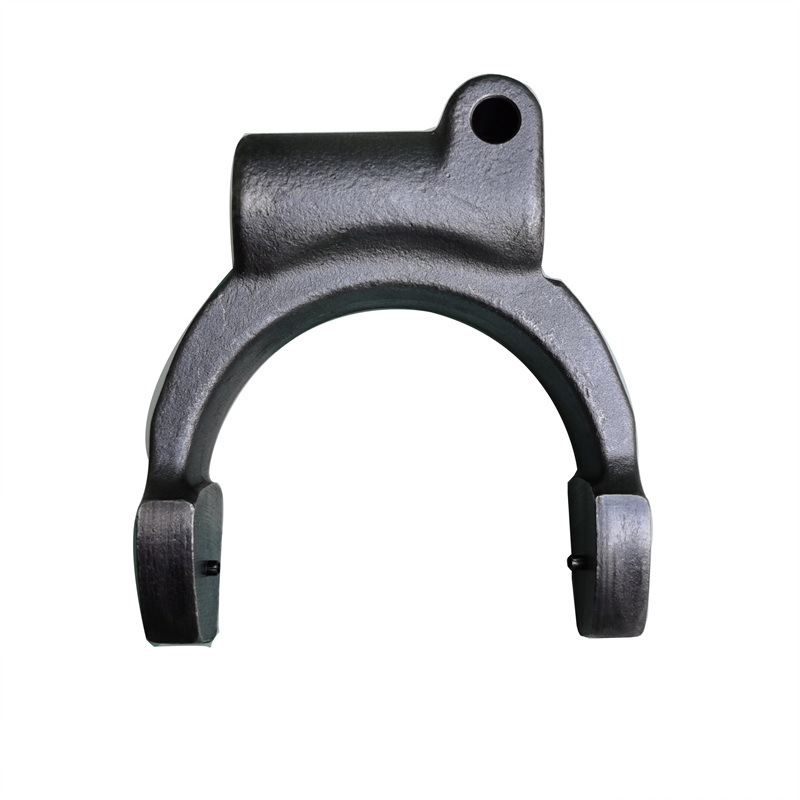
The shift fork sits on a selector rail and is actuated either directly by a mechanical linkage from the gear lever or by a hydraulic cylinder in more modern transmissions. Its two arms reach around the outer groove of the sliding gear or sleeve, maintaining contact at the pad surfaces on each side. When the fork moves along the selector rail, the arms carry the gear sleeve with it, sliding it along the shaft splines until the gear teeth mesh with the target gear. The shift fork translates what the driver intends into a precise mechanical movement inside the gearbox.
The Pad Contact Zone and Its Role in Accuracy
The pads or fingers at the tips of the shift fork arms are the surfaces that bear directly against the gear sleeve groove throughout every gear change. The accuracy of gear engagement depends on the pad geometry remaining correct — the right width to fit the groove without slop, and the correct contact surface profile to move the sleeve squarely without cocking it to one side. A shift fork with worn or damaged pads allows the sleeve to sit slightly off-position in the engaged state, which concentrates load at the edges of the gear teeth and accelerates wear in both the fork and the gears it serves.
Interaction with the Detent and Interlock System
Tractor gearboxes use a detent and interlock system alongside the shift fork arrangement to keep gears fully engaged during operation and prevent two gears from being selected simultaneously. The detent — typically a spring-loaded ball bearing — locates in a groove on the selector rail to hold the shift fork in the engaged position with positive retention. The interlock prevents adjacent rails from moving when one is already displaced. The shift fork must align correctly with these systems for the gearbox to hold gear under load and shift cleanly between ratios.
What Material Is a Shift Fork Made From and Why It Matters
Alloy Steel as the Standard Material
Shift forks in tractor gearboxes are manufactured from alloy steel, which provides the combination of tensile strength, toughness, and machinability that this application demands. The fork must be strong enough to transmit gear engagement forces without bending under peak load, tough enough to absorb the occasional shock from a missed-gear engagement without cracking, and dimensioned accurately enough to maintain correct pad geometry across a reasonable service life. Alloy steel, heat-treated to the appropriate hardness profile, delivers all three requirements in a component that can be produced consistently at a practical cost.
Heat Treatment for Wear Resistance at the Pad Surface
The contact pad surfaces of the shift fork experience repetitive sliding contact against the gear sleeve groove throughout every gear change over the transmission’s service life. Without adequate surface hardness, this contact wears the pad dimensions down relatively quickly, introducing the slop and misalignment that degraded shift quality. Heat treatment — typically case hardening applied to the contact faces — achieves the surface hardness needed to resist this wear while keeping the core of the fork tough and resistant to bending loads. The combination is what gives a correctly manufactured shift fork its service life.
Dimensional Accuracy Determines Fit and Function
Beyond material specification, the dimensional accuracy of the shift fork determines how well it functions in the gearbox assembly. The bore that locates on the selector rail, the pad-to-pad width, the pad contact profile, and the overall arm geometry must all conform to tight tolerances for the fork to engage gears cleanly and hold them securely. A shift fork produced with loose dimensional control — even in the correct material — will introduce slop into the gear engagement that cannot be corrected without replacement. For OEM production or critical repair applications, requesting dimensional inspection reports confirms that the supplied parts meet specification.
Sourcing Replacement Shift Forks for Tractor Gearboxes
Identifying the Correct Specification
Shift forks are gearbox-specific components — dimensions vary between tractor models, gearbox generations, and gear positions within the same transmission. When sourcing a replacement shift fork, providing the tractor model, gearbox serial number, and if possible the gear position the fork serves gives the supplier the information needed to supply a correctly matching component. Where original drawings are available, supplying them eliminates the risk of dimensional mismatch that arises from relying on verbal description or part number cross-referencing alone.
Custom Production for Non-Standard Applications
Older tractor models and specialist machines frequently require shift fork components that are no longer available through standard distribution. In these cases, a replacement shift fork can be produced from the original engineering drawing or from a dimensional survey of the worn component. The review process — covering bore diameter, arm profile, pad geometry, and overall dimensions — is essential before production begins. Lead times for custom shift fork production depend on complexity and how straightforward the drawing confirmation process is; parts requiring multiple review rounds will naturally take longer, so early inquiry is always advisable.
Pre-Installation Verification
Before fitting a replacement shift fork, checking pad width, bore diameter, and arm geometry against the original specification confirms the part will perform correctly once installed. For procurement teams managing a fleet of machines, keeping a record of shift fork replacement history — including the supplier, material certification, and inspection data — builds a useful reference for future maintenance planning and helps identify whether a pattern of premature wear points to an operating condition that needs to be addressed alongside the parts replacement.
Conclusion
The shift fork is a straightforward but mechanically essential component whose condition directly determines gear engagement quality in a tractor gearbox. Alloy steel construction, correct heat treatment, and dimensional accuracy are what separate a shift fork that delivers its expected service life from one that introduces transmission problems prematurely. For maintenance teams and procurement buyers, understanding what the component does and what it requires makes sourcing decisions more straightforward and repair outcomes more predictable.
FAQ
Q1: What does a shift fork do in a tractor gearbox?
The shift fork moves the sliding gear or synchronizer sleeve along the shaft to engage or disengage gear ratios, translating the driver’s gear lever input into a precise mechanical action inside the gearbox.
Q2: What material is a tractor shift fork made from?
Shift forks are manufactured from alloy steel, heat-treated to provide surface wear resistance at the contact pads and core toughness to handle bending and shock loads.
Q3: How do I know when a shift fork needs replacing?
Difficulty selecting gears, gear slip, grinding during engagement, and audible looseness when the shaft is rocked manually are reliable indicators of shift fork wear or damage.
Q4: Can a shift fork be sourced for an older tractor model?
Yes. Custom shift forks can be produced from original drawings or dimensional surveys for models where standard replacements are no longer available. Lead times vary with complexity.
Q5: Does a worn shift fork damage other gearbox components?
Yes. A worn shift fork causes incomplete or misaligned gear engagement, which accelerates wear on gear teeth, synchronizer rings, and selector rail components throughout the gearbox.
Need a Reliable Replacement Shift Fork? Contact Huan-Tai
Xian Huan-Tai Technology and Development Co., Ltd. has over 30 years of experience manufacturing customized non-standard mechanical components for agricultural, engineering, and heavy equipment applications. Our technical team works from your drawings or samples to produce shift forks and other gearbox components built to your exact specification, with professional quality control throughout production. If you are sourcing replacement or custom transmission parts and need a supplier who delivers consistency and technical depth, reach out today. Contact us: inquiry@huan-tai.org.
References
- Shigley, J. E., Mischke, C. R., & Budynas, R. G. (2004). Mechanical Engineering Design (7th ed.). McGraw-Hill.
- Naunheimer, H., Bertsche, B., Ryborz, J., & Novak, W. (2011). Automotive Transmissions: Fundamentals, Selection, Design and Application (2nd ed.). Springer.
- Goering, C. E., Stone, M. L., Smith, D. W., & Turnquist, P. K. (2003). Off-Road Vehicle Engineering Principles. American Society of Agricultural and Biological Engineers.
- Mott, R. L. (2014). Machine Elements in Mechanical Design (5th ed.). Pearson Education.
- Hunt, D. (2001). Farm Power and Machinery Management (10th ed.). Iowa State University Press.
