
Impact plates are the replaceable liners mounted inside an impact crusher’s aprons and housing. They absorb the violent rebound of rock thrown by the blow bars, direct material back into the crushing chamber for further size reduction, and shield the machine body from wear — making impact plates central to both crushing efficiency and equipment life.
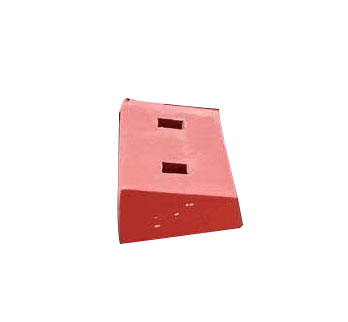
The Working Role of Impact Plates Inside the Crushing Chamber
Redirecting Material for Secondary Breakage
When the rotor throws stone at high velocity, the material must strike a surface hard enough to fracture it again. That surface is the impact plate. Well-shaped impact plates bounce feed back toward the blow bars repeatedly, so a single pass through the machine produces several breakage events. This rebound action is what gives impact crushers their cubical product shape and high reduction ratio.
Protecting the Crusher Frame and Aprons
Without liners, abrasive rock would grind directly against the welded housing, and a damaged frame is far more expensive to repair than a bolt-on wear part. Impact plates take that punishment instead. Operators simply rotate or replace them on a planned schedule, keeping the structural body of the crusher intact through many wear cycles and avoiding costly unplanned downtime in quarry or mining operations.
Controlling Product Size and Chamber Geometry
The gap between the impact plates and the rotor determines output gradation. As impact plates wear, that gap widens and product becomes coarser, which is why crews adjust apron settings or swap liners on schedule. Precise casting dimensions matter here — poorly toleranced impact plates create uneven gaps, inconsistent product, and localized wear that shortens the life of the entire set.
Materials and Casting Methods Behind Durable Impact Plates
Choosing the Right Alloy for the Application
Impact plates are produced from high-manganese steel, alloy steel, high-chromium cast iron, or composite materials, and the choice depends on the feed. High-manganese work-hardens under repeated blows, making it ideal for hard, blocky stone. High-chromium cast iron resists abrasion better in finer, highly abrasive feeds. Composite impact plates combine a chrome working face with a tougher backing for demanding mixed conditions.
Casting Processes That Guarantee Dimensional Accuracy
We cast impact plates using the lost-wax method, resin sand, and the V-process, each selected according to part size, weight, and tolerance requirements. Resin sand and V-method suit large, heavy liners with clean surfaces and stable dimensions, while lost-wax handles more intricate profiles. Accurate casting means impact plates bolt straight into the apron without shimming, grinding, or field modification.
Heat Treatment and Impact Resistance
Raw castings alone will not survive a crushing chamber. Controlled heat treatment develops the microstructure that gives impact plates their excellent resistance to fracture and impact force, suiting them to high-load, high-strength working environments. We verify hardness, chemical composition, and internal soundness before shipment, because a plate that cracks mid-shift costs an operator far more than the part itself.
Selecting and Sourcing Impact Plates for Your Equipment
Matching Plates to Blow Bars and Machine Model
Blow bars are the rotor-mounted wear parts of an impact crusher, cast from high-manganese steel, alloy steel, or high-chromium cast iron. Impact plates work in partnership with them, and the two should be specified together so that hardness levels and wear rates are balanced. We manufacture to your drawings, samples, or existing worn parts, covering both OEM-equivalent and fully customized impact plates for mining and construction machinery.
Customization, Drawings, and Lead Times
Every enquiry begins with engineering review. Our technical team checks wall thickness, mounting holes, alloy selection, and machining allowances before tooling starts. Standard patterns move quickly; genuinely custom impact plates may take longer, as drawing confirmation, pattern making, and process planning all add time. We keep customers informed at each stage rather than promising dates the shop floor cannot realistically hold.
Quality Control From Melt to Packing
Consistency is what separates a reliable supplier from a cheap one. Spectrometer analysis controls chemistry at the melt, dimensional inspection follows casting and cleaning, and hardness testing confirms heat treatment. Non-destructive testing is available where contracts require it. Every batch of impact plates is documented, so repeat orders arrive with the same performance the maintenance team experienced last time.
Conclusion
Impact plates absorb rebound energy, shape the crushing chamber, and protect the crusher body. Choosing the correct alloy, accurate casting, and proper heat treatment directly determines wear life, product gradation, and the total operating cost of your impact crusher.
FAQ
1. What material is best for impact plates?
High-manganese steel suits hard, blocky feed; high-chromium cast iron suits abrasive material. Alloy steel and composite designs cover mixed conditions.
2. How often should impact plates be replaced?
It depends on feed hardness, tonnage, and settings. Most crews inspect during routine maintenance and replace before the gap widens noticeably.
3. Can you produce impact plates from my drawings?
Yes. We manufacture from drawings, 3D files, samples, or worn originals, including non-standard profiles.
4. Are impact plates and blow bars the same thing?
No. Blow bars mount on the rotor; impact plates line the aprons and housing. They are matched, not interchangeable.
5. Which casting processes do you use?
Lost-wax, resin sand, and V-method, chosen according to part size, tolerance, and surface requirements.
Work With a Manufacturer That Knows Wear Parts
Xi’an Huan-Tai Technology and Development Co., Ltd. has spent 30 years customizing non-standard mechanical parts for mining, engineering, and heavy equipment builders worldwide. Our production team controls quality through every stage, and our engineers translate your performance targets into castings that hold up in the field. Send us your drawings, sample photos, or wear problems — we will reply with a practical solution and a clear quotation. Contact us at inquiry@huan-tai.org.
References
- Wills, B. A., & Finch, J. A. Wills’ Mineral Processing Technology.
- Gupta, A., & Yan, D. S. Mineral Processing Design and Operations: An Introduction.
- Davis, J. R. ASM Specialty Handbook: Cast Irons.
- Bhadeshia, H. K. D. H., & Honeycombe, R. W. K. Steels: Microstructure and Properties.
- Beeley, P. R. Foundry Technology.
