
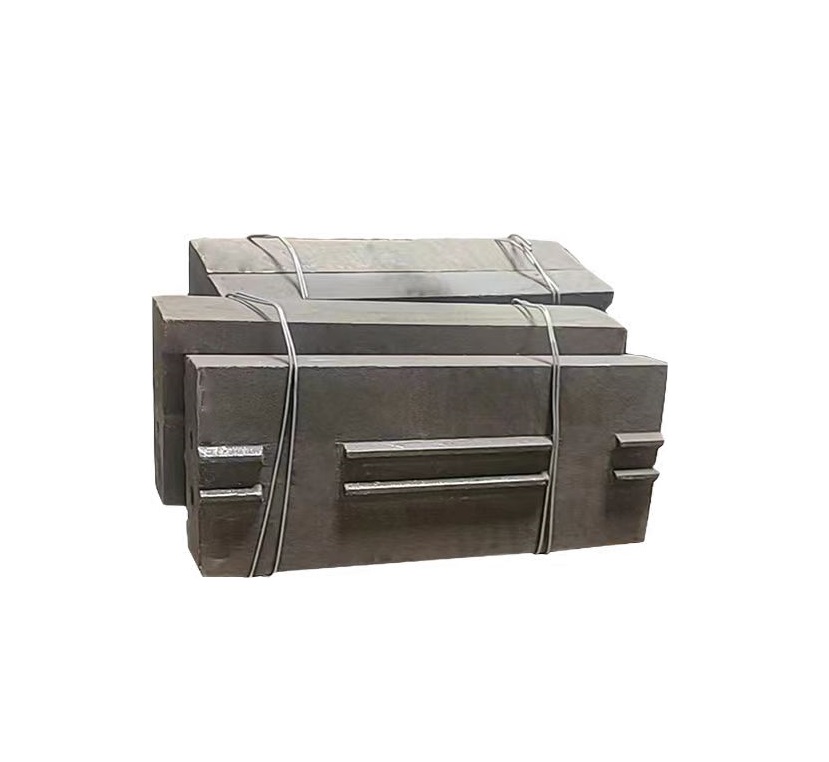
Composite blow bars have a hard working face that doesn’t wear down easily and a tough body that absorbs shock. Because of this, wear parts in impact crushers last a lot longer and don’t crack when heavy loads are applied. This means that they don’t need to be replaced as often, the machine is less likely to break down, and it lasts longer overall.
Why Composite Construction Outperforms Single-Alloy Wear Parts
The Hardness Versus Toughness Trade-Off
The problem is the same for all foundries. High-chromium cast iron is very hard to wear down, but it can break easily when hit hard. It is tough and work-hardens, but fine gritty feed makes it wear out faster. To fix this, composite blow bars have manganese or alloy steel bodies that absorb shock and ceramic or chrome inserts that go where the rock hits.
How the Working Face Wears Evenly
In service, the softer backing material erodes slightly faster than the hardened inserts, leaving a naturally serrated cutting profile. That self-sharpening effect keeps composite blow bars biting into material instead of glazing over. Operators typically report steadier throughput deeper into the wear cycle, because the crushing geometry stays closer to its original shape for far longer than a plain casting would.
Fewer Change-Outs, Less Downtime
Downtime is where crushing profits disappear. Swapping a set of blow bars means stopping the line, opening the housing, and handling heavy parts safely. When each set runs substantially longer, those interruptions drop sharply across a season. For contract crushing operations working to tight production schedules, that predictability is often worth more than the unit price of the wear part itself.
How Casting Quality Determines Real-World Blow Bar Life
Material Selection Starts With Your Feed
We cast blow bars from high-manganese steel, alloy steel, high-chromium cast iron, and composite combinations. Limestone, granite, river gravel and recycled concrete all wear differently, so we ask about feed hardness, silica content, feed size and rotor speed before recommending a grade. Matching the alloy to the application does more for service life than any single manufacturing trick.
Casting Methods That Hold Tolerances
Dimensional accuracy is not cosmetic — it decides whether blow bars seat correctly in the rotor. We use lost-wax casting, resin sand and the V-process depending on part weight and profile complexity. Properly seated bars transmit impact force into the rotor evenly, preventing the vibration and hammering that loosens wedges and causes premature cracking in the field.
Heat Treatment and Structural Soundness
Composite blow bars only deliver their promised life when the insert-to-matrix bond and the surrounding metal are sound. Controlled heat treatment develops excellent resistance to fracture and impact force, suiting these parts to high-load, high-strength working environments. We check chemistry by spectrometer, verify hardness, and inspect castings for internal defects before anything leaves the plant.
Getting Better Value From Your Wear Part Programme
Balancing Blow Bars With Impact Plates
Blow bars sit on the rotor of an impact crusher, while impact plates line the aprons. Both wear together, and mismatched hardness pushes the wear burden onto one side. We supply both from the same foundry so the set ages predictably. Separately, hammer heads belong to hammer crushers — a different machine with its own part specification entirely.
Custom Profiles From Drawings or Samples
Many customers come to us with an obsolete machine or an OEM part that is expensive and slow to source. Send a drawing, a 3D file, or even a worn original, and our engineers will reverse-engineer the geometry, confirm mounting dimensions, and propose a composite layout. We regularly produce non-standard blow bars that no catalogue supplier lists.
Lead Times, Tooling and Repeat Orders
Where patterns already exist, production moves briskly. Genuinely custom composite blow bars take longer, since drawing confirmation, tooling, insert placement and process trials each add time — and we would rather set a realistic schedule than miss one. Once the first batch is approved, repeat orders run faster and arrive with documented, consistent performance every time.
Conclusion
Composite blow bars deliver the abrasion resistance of hard alloys with the toughness needed to survive heavy impact. Correct material selection, accurate casting and proper heat treatment turn that design advantage into genuinely longer crusher service life and lower operating cost.
FAQ
1. What are composite blow bars made of?
A hard chrome or ceramic working insert cast into a tough high-manganese or alloy steel body.
2. Do they really last longer than standard bars?
In most abrasive applications, yes — the self-sharpening face maintains crushing geometry far deeper into the wear cycle.
3. Can you make blow bars for older or obsolete crushers?
Yes. We work from drawings, 3D models, or worn sample parts to reproduce the exact profile.
4. Which casting process do you use?
Lost-wax, resin sand or V-method, selected according to part size, weight and tolerance requirements.
5. Should I replace impact plates at the same time?
Usually yes. Matched wear rates keep the chamber geometry balanced and protect the rotor.
Let’s Talk About Your Crushing Application
Xi’an Huan-Tai Technology and Development Co., Ltd. has customized non-standard mechanical parts for mining and engineering machinery since the mid-1990s. Our production team controls quality at every stage, and our engineers turn your performance targets into castings that survive real job sites. Tell us your feed material, crusher model and current wear life — we’ll come back with a practical recommendation and a clear quotation. Email us at inquiry@huan-tai.org.
References
- Wills, B. A., & Finch, J. A. Wills’ Mineral Processing Technology.
- Gupta, A., & Yan, D. S. Mineral Processing Design and Operations.
- Davis, J. R. ASM Specialty Handbook: Cast Irons.
- Beeley, P. R. Foundry Technology.
- Budinski, K. G. Friction, Wear, and Erosion Atlas.
