
A custom grid plate improves cone crusher performance because it matches your exact frame geometry, feed material and duty cycle. Correct fit stops movement and dust ingress, the right alloy resists abrasion, and proper heat treatment holds hardness — together delivering steadier throughput and fewer unplanned shutdowns.
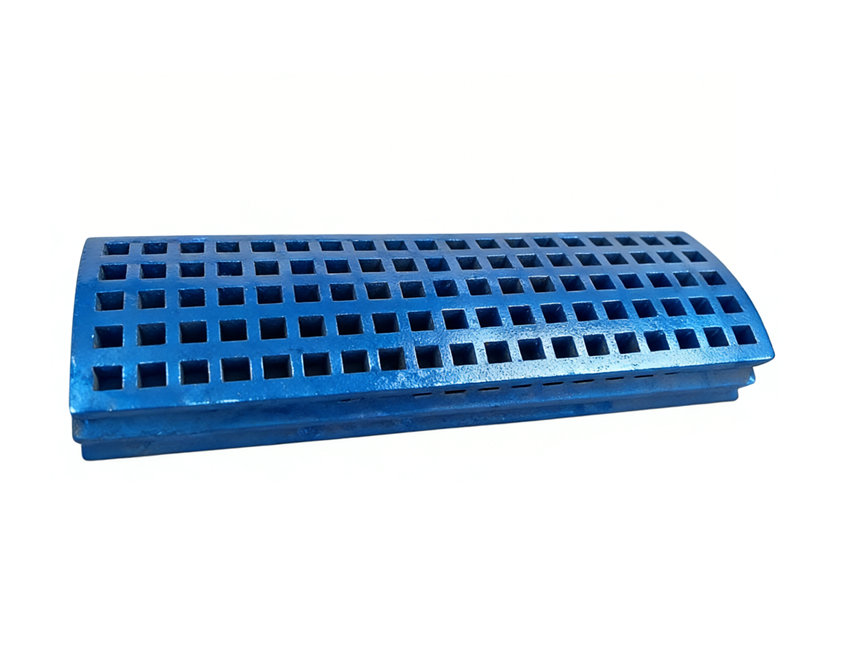
Where Standard Grid Plate Falls Short in Real Operations
Catalogue parts are built for an average machine, and few crushers on a working site are still average. After years of rebuilds, shim changes and mixed-brand replacements, “close enough” starts costing money in wear, vibration and lost hours.
Small Fit Gaps Turn Into Big Wear
A Grid Plate that sits a couple of millimetres loose will shift under load. That movement hammers the seating face, elongates bolt holes and lets fines work their way into places they were never meant to reach. Once the plate starts moving, wear accelerates on everything around it, and a cheap part quickly becomes an expensive one.
Feed Material Changes the Rules
Hard granite, river gravel and recycled concrete each attack the Grid Plate differently. Impact-dominated circuits need toughness; dry, silica-heavy fines need surface hardness. A single standard grade cannot serve both well. Choosing the alloy around your actual feed — not around what a distributor happens to stock — is the simplest performance gain available.
Downtime Costs More Than the Casting
Purchasing managers naturally compare unit prices, but the real number is cost per operating hour. A Grid Plate that lasts through a full liner cycle removes one shutdown from the calendar. For most mining and aggregate operations, a single avoided stoppage outweighs the price difference between a generic casting and a properly customized one.
The Metallurgy That Makes a Grid Plate Last
Performance is decided in the foundry long before the part reaches your site. Clean metal, the right chemistry and a disciplined heat treatment cycle are what separate a casting that survives a season from one that cracks early.
High Manganese Steel or High Chromium Alloy Steel
Wear-facing crusher components such as the Grid Plate are usually cast in high manganese steel or high chromium alloy steel. High manganese steel work-hardens under repeated impact, which suits hard rock and shock-loaded duty. High chromium alloy steel holds up better against fine abrasive scouring, making it the sensible pick for dusty, dry aggregate circuits.
Alloying That Fights Sand Sticking and Sand Clamping
Surface quality matters more than most buyers expect. In our foundry, the bushing and related castings — including the Grid Plate — are enhanced with additions such as manganese and potassium, which noticeably improve anti-sand-sticking and sand-clamping performance. The payoff is a cleaner casting skin, fewer inclusions, less grinding rework and a measurably longer service life in the field.
Special Heat Treatment for Genuine Hardness
Chemistry alone proves nothing. Key components go through a dedicated heat treatment cycle — solution treatment, quenching and tempering matched to the grade — to build the hardness-toughness balance a Grid Plate needs under continuous crushing loads. We log hardness readings batch by batch, so you can compare one delivery against the last instead of trusting a vague “wear-resistant” label.
How Customization Is Actually Carried Out
Customization sounds vague until you see the workflow behind it. Ours is deliberately simple: confirm the geometry, agree the material, then control every stage in-house so results repeat order after order.
Start With the Model, Drawing or Worn Sample
We produce the Grid Plate according to the crusher model or the customer’s own drawing, which gives a far better fit with the equipment than a generic replacement. When drawings have been lost — common on older or rebuilt machines — send the worn part. Our engineers measure it, reverse-engineer the geometry and issue a confirmation drawing for your approval first.
Machining and Inspection Before Anything Ships
Castings distort slightly during heat treatment, so seating faces and bolt holes are machined afterwards to keep contact even and mounting true. Each Grid Plate is then checked for chemical composition, hardness and dimensional accuracy against the approved drawing, with non-destructive testing added where internal soundness is critical. Quality is managed through the whole process, not inspected at the gate.
Plan Lead Time Around Your Shutdown
Repeat items with existing patterns move relatively quickly. A fully customized Grid Plate takes longer, because drawing confirmation, pattern making, pouring, heat treatment and machining each add time — and repeated drawing revisions stretch the schedule further. We give an honest window at quotation and update you at each milestone, so parts arrive before your planned maintenance window, not during a breakdown.
Conclusion
A custom grid plate improves cone crusher performance through three linked factors: precise fit to your machine, an alloy chosen for your feed material, and controlled heat treatment backed by real inspection data. Together they reduce wear, protect surrounding components and keep production running predictably.
FAQ
Q1: Why choose a custom Grid Plate over a standard one?
Because rebuilt or mixed-brand crushers rarely match catalogue dimensions. Custom fit eliminates movement, uneven wear and dust ingress.
Q2: Which material do you recommend?
High manganese steel for impact-heavy hard rock; high chromium alloy steel for fine, highly abrasive feed.
Q3: Can you work without an original drawing?
Yes. Send the worn Grid Plate or the crusher model, and we reverse-engineer it, then confirm the drawing with you.
Q4: What quality documents can you provide?
Chemical analysis, hardness reports, dimensional inspection records and NDT results on request.
Q5: What other crusher parts do you supply?
Bushings, dust rings, toggle plates, blow bars, hammers, rack bars, spring components and other mining and engineering machinery castings.
Talk to Engineers, Not Just Salespeople
Send us your crusher model, drawing or a photo of the worn Grid Plate — you will get a clear technical recommendation instead of a generic quotation. Xi’an Huan-Tai brings 30 years of experience in customized non-standard mechanical parts, a production team that controls quality from moulding to machining, and a technical team that builds parts around your performance requirements. Start the conversation today: inquiry@huan-tai.org.
References
- Wills, B. A., & Finch, J. A. — Wills’ Mineral Processing Technology, Butterworth-Heinemann.
- Gupta, A., & Yan, D. S. — Mineral Processing Design and Operations: An Introduction, Elsevier.
- Beeley, P. R. — Foundry Technology, Butterworth-Heinemann.
- Bhadeshia, H. K. D. H., & Honeycombe, R. W. K. — Steels: Microstructure and Properties, Elsevier.
- Lynch, A. J., & Rowland, C. A. — The History of Grinding, Society for Mining, Metallurgy, and Exploration.
