
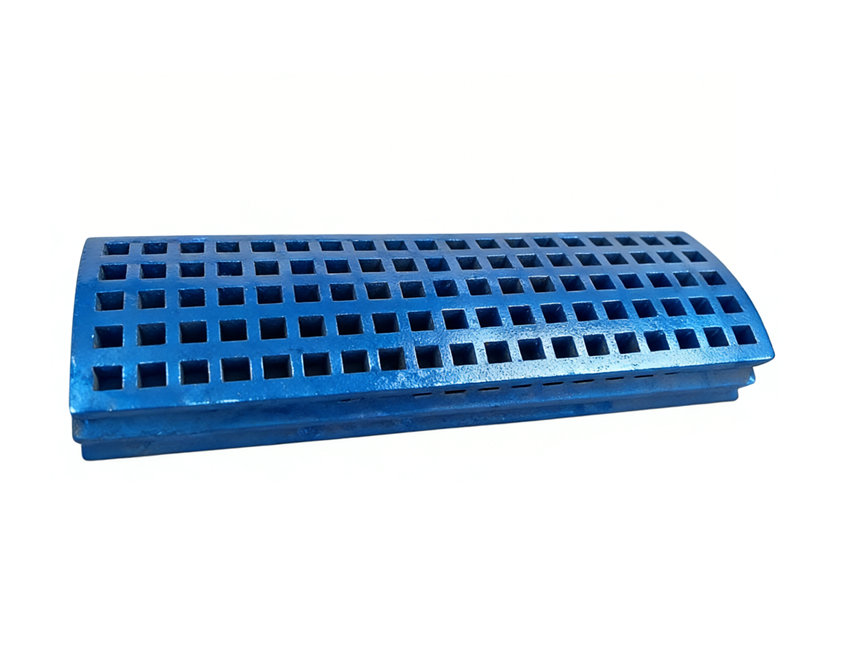
The best grid plate design for efficient cone crusher operation pairs a wear-smart chamber profile with the right casting alloy and tight machining tolerances. A well-built Grid Plate holds discharge size steady, resists sand sticking, and survives longer between changeouts, so your line keeps crushing instead of waiting on parts. Here is what actually matters.
What Defines the Best Grid Plate Design for a Cone Crusher?
Design is not a drawing exercise. It is where wear life, throughput, and fit are decided before metal is ever poured.
Chamber Geometry That Controls Discharge
The best Grid Plate starts with opening size, spacing, and flow path matched to your feed and target gradation. Poor geometry causes packing, uneven wear, and fluctuating output. Good geometry lets material clear freely, spreads wear across the working face, and keeps the crusher drawing steady power instead of surging through every shift.
Alloy Design With Manganese and Potassium Additions
Our grid plate and related castings, including bushings, are enhanced by adding elements such as manganese and potassium. This effectively improves anti-sand sticking and sand clamping performance, which matters in abrasive mining duty, and it extends service life. High manganese steel work-hardens under impact, so the surface gets tougher the harder the crusher works.
Heat Treatment That Builds Wear Resistance
Chemistry alone does not make a durable Grid Plate. Key components undergo special heat treatment processes that improve the wear resistance of the castings, balancing a hard working surface against a tough core. Controlled heating and quenching remove casting stress, refine the structure, and give you predictable wear instead of premature cracking.
How the Right Grid Plate Design Cuts Cost per Ton
Purchase price is one line item. Changeout labor, downtime, and inconsistent product are the real bills.
Longer Life Means Fewer Changeouts
Every hour a grid plate stays in the crusher is an hour your crew is not pulling the machine apart. Longer service life from better alloy and heat treatment means fewer shutdowns, lower labor cost per ton, and smaller spare-parts inventories. For smaller repair shops watching cash flow, that predictability often beats a marginally cheaper quote.
Stable Output and Predictable Scheduling
A Grid Plate that wears evenly keeps discharge sizing consistent, so downstream screens and conveyors run without constant adjustment. That consistency also makes maintenance plannable: you change parts on your schedule, not the crusher’s. Larger equipment manufacturers value this most, because stable quality data makes their own production and delivery promises easier to keep.
Quality Control Across the Whole Process
A Grid Plate is only as good as its weakest pour. Our production team manages quality through the entire process: pattern checks, melt chemistry, heat treatment records, dimensional inspection, and final hardness testing. For OEM buyers with strict quality-control requirements, that traceability is what turns a sample order into a long-term supply relationship.
What Buyers Should Confirm Before Ordering a Grid Plate
A short conversation up front saves weeks later. Here is what experienced purchasing managers ask first.
Drawings, Models, and Fit
Customization can be done according to the model and the drawing, enabling a better fit with the equipment. Send us your Grid Plate drawing, the crusher model, or even a worn sample for reverse engineering. Expect some drawing confirmation rounds on complex custom parts; that back-and-forth is what guarantees the part bolts on the first time.
How It Works With Other Wear Parts
A Grid Plate does not work alone. Cone crusher main shafts should be forged, not cast; springs use spring steel, high-strength steel wire, or carbon steel; dust seal rings suit high manganese steel or high chrome alloy steel; rack bars typically use alloy steel. We also cast toggle plates in high manganese steel, blow bars for impact crushers, and hammer heads for hammer crushers.
Lead Times, Communication, and Support
Standard Grid Plate orders with confirmed drawings typically move through foundry and machining in a matter of weeks. Custom parts can take longer when drawings need repeated confirmation or the process route is complex. What we promise is honest scheduling, quick answers from our technical team, and updates before you have to ask for them.
Conclusion
Efficient cone crusher operation comes down to a Grid Plate designed for your chamber, cast in the right alloy, heat treated for wear, and machined to fit. Get those four things right and cost per ton falls while uptime climbs. Partner with a supplier who controls the whole process.
FAQ
What material suits a cone crusher Grid Plate?
High manganese steel with additions like manganese and potassium, plus special heat treatment for wear resistance.
Can you make a Grid Plate from my drawing?
Yes. We customize by model and drawing, or reverse engineer worn samples for a better equipment fit.
How long does a custom order take?
Standard parts move in weeks; complex custom jobs take longer when drawings need repeated confirmation.
Do you supply other crusher parts?
Yes, including forged main shafts, toggle plates, dust seal rings, rack bars, blow bars, and hammer heads.
Do you serve small repair companies?
Absolutely. We balance price, quality, and delivery for shops of five people and OEMs of several hundred.
Partner With a Foundry That Understands Crushing
With 30 years customizing non-standard mechanical parts for mining and engineering machinery, Xian Huan-Tai delivers excellent service, production-managed quality control, and a technical team that meets your performance requirements. Send your Grid Plate drawing or crusher model to inquiry@huan-tai.org today — tell us your wear problem, and we will reply with a practical quote and honest lead time. Let’s build your next order together.
References
- Evertsson, C. M. (2000). Cone Crusher Performance. PhD Thesis, Chalmers University of Technology, Gothenburg.
- Bearman, R. A., Barley, R. W., & Hitchcock, A. (1991). Prediction of power consumption and product size in cone crushing. Minerals Engineering, 4(12).
- Wills, B. A., & Finch, J. A. (2016). Wills’ Mineral Processing Technology (8th ed.). Butterworth-Heinemann.
- Svensson, A., & Steer, J. F. (1990). New cone crusher technology and developments in comminution circuits. Minerals Engineering, 3(1–2).
- Hawk, J. A., Wilson, R. D., Tylczak, J. H., & Dogan, O. N. (1999). Laboratory abrasive wear tests: Investigation of test methods and alloy correlation. Wear, 225–229.
