
Blow bars in impact crushers wear out more quickly because of the coarse feed material, high impact forces during operation, and excessive rotor speed. Wear rates speed up a lot when the hardness of the feed stone is higher than the material grade of the bar or when the crusher handles over-sized or dirty feed. By understanding these reasons, workers can make equipment last longer, repair it less often, and save money overall.
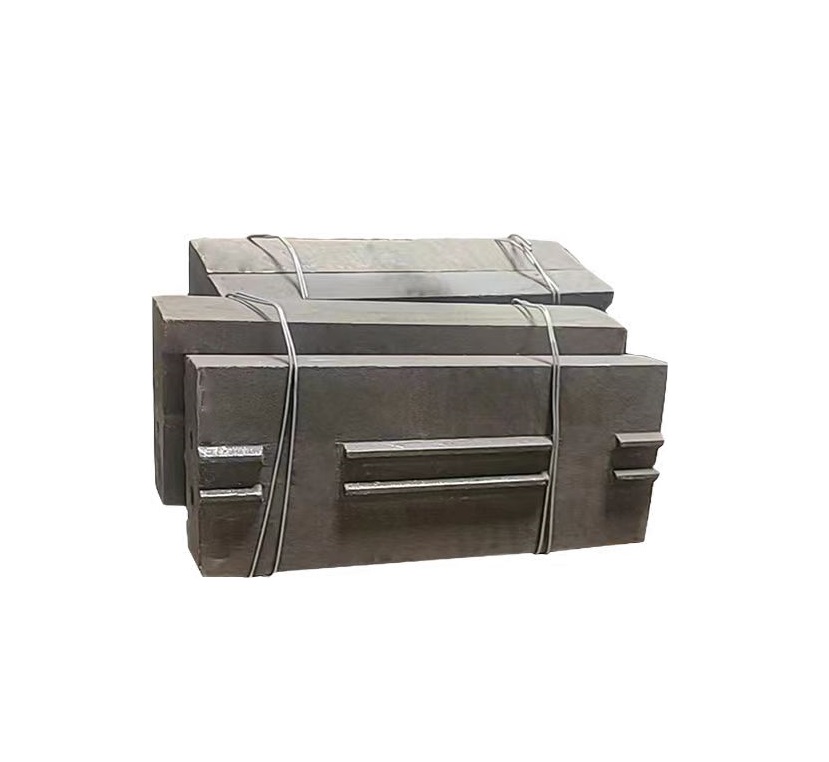
How Feed Material Properties Drive Blow Bar Wear
Abrasiveness and Hardness of the Feed
Some of the things that affect how quickly blow bars break down are how hard the feed material is and how much silica it has. Granite, basalt, and some ores all have a lot of quartz or silica in them, which makes the bar surface micro-cut and gouge every time it hits it. When feed hardness regularly exceeds the allowed range, surface material is lost faster than work-hardening can make up for it. Blow bars made of high-manganese steel perform well under mild wear and repeated impact loads. Choosing the right bar grade for the feed rock is more important than any other practical change for people who work in mines and quarries.
Oversized or Irregular Feed Chunks
When the material going into the crusher isn’t all the same size, like when big blocks are put in, the blow bars feel concentrated stress instead of evenly distributed impact loads. This makes tiny cracks and chips along the working edge of the bar. The rotor can’t take in the energy equally, so the edges break off too soon. This kind of wear can be greatly reduced by prescreening the feed, and both the blow bars and the rotor assembly are kept from having to deal with extra fatigue stress.
Contaminated or Mixed Feed Streams
When used in removal and recycling, tramp metal, rebar, or other hard materials put quick shock loads on blow bars that are far above their design limits. A bar can be cut or cracked by just one piece of trip iron, which makes it less stable for all future hits. When mixed or contaminated feed has to be used, blow bars made of high-chromium metal or composite materials are better at resisting wear and breaking. This makes them better suited to these tough circumstances.
Operational Conditions That Accelerate Blow Bar Wear
Rotor Speed and Impact Velocity
Rotor tip speed directly governs the kinetic energy transferred to material at the moment of impact. Higher rotor speeds increase throughput but also raise the force absorbed by each blow bar exponentially. When tip speed exceeds the recommended range for the feed material, wear rates increase sharply. Operators sometimes raise rotor speed to compensate for reduced output as bars wear down — this creates a cycle that accelerates degradation. Maintaining rotor speed within the manufacturer’s recommended parameters for the specific material type is one of the most effective ways to extend blow bar service life.
Uneven Wear Patterns and Rotor Imbalance
If blow bars are not rotated or replaced in sets, the rotor becomes dynamically unbalanced. This causes vibration that amplifies impact forces on the remaining bars unevenly, creating hot spots of wear. Uneven loading also stresses the rotor body and bearing assemblies. A disciplined maintenance schedule — rotating bars at defined intervals and replacing them as matched sets — keeps the rotor in balance and distributes wear uniformly across all bars, extending the effective service life of each component.
Inadequate Clearance Settings
The gap between blow bars and the impact aprons (breaker plates) must be calibrated precisely for the target product size and feed characteristics. When clearances are set too tight, material is held in the crushing zone longer, creating repeated re-impacts that accelerate bar wear. Conversely, excessively wide gaps reduce crushing efficiency and may cause material to circulate inside the chamber. Regular adjustment of apron clearance — particularly after installing new blow bars or changing feed material type — is essential to balancing throughput with wear rate.
Material Selection: The Right Blow Bar Grade for the Job
High-Manganese Steel for High-Impact Applications
High-manganese steel remains the standard choice for impact crushers processing highly abrasive or hard rock, thanks to its outstanding work-hardening behavior. Under repeated impact, the surface of a manganese blow bar progressively hardens while the core retains toughness — an ideal combination for resisting both abrasion and fracture. Blow bars manufactured from high-manganese steel through precision casting processes, such as lost-wax or resin sand methods, achieve tight dimensional tolerances that ensure correct fit, consistent impact geometry, and predictable wear patterns throughout service life.
High-Chromium Alloy for Abrasion-Dominant Conditions
In applications where abrasion dominates over impact — for example, processing river gravel, recycled concrete, or fine aggregate — high-chromium alloy blow bars offer superior performance. The chromium carbide matrix in these castings is significantly harder than manganese steel, providing excellent resistance to surface wear. Blow bars produced from high-chromium alloy using advanced casting methods maintain their profile longer in abrasive service, reducing the frequency of replacement shutdowns. However, their lower toughness means they are better suited to stable, well-controlled feed conditions rather than variable or heavily contaminated streams.
Composite Materials for Balanced Performance
Modern composite blow bars — combining a tough steel body with a hard-faced or bi-metallic wear surface — are engineered to bridge the gap between impact resistance and abrasion resistance. These designs are particularly valuable in aggregate and mining operations where feed composition varies across shifts or seasons. Casting these components requires precise control of the interface between the hard and tough layers; advanced foundry techniques ensure the metallurgical bond remains intact under cyclic loading. For operations that cannot afford frequent grade changes, composite blow bars offer a practical, durable solution that performs reliably across a wide range of feed conditions.
Conclusion
Blow bar wear in impact crushers is driven by a combination of feed material properties, operational settings, and component material selection. By matching bar grade to actual working conditions, controlling rotor speed, maintaining proper clearances, and following a consistent maintenance schedule, operators can significantly extend service life and reduce replacement costs. Choosing the right casting method and alloy from the outset remains the most reliable path to long-term performance.
FAQ
Q1: How often should blow bars be replaced?
Replacement intervals depend on feed hardness, rotor speed, and bar material. In hard rock quarrying, bars may need replacement every few hundred operating hours, while softer aggregate applications can extend this significantly. Regular inspection of wear profile is more reliable than fixed schedules.
Q2: What material is best for blow bars in granite crushing?
High-manganese steel or composite blow bars are generally preferred for granite due to their balance of toughness and work-hardening capability, which resists the high-impact and abrasive nature of granite processing.
Q3: Can blow bars be turned or reused after partial wear?
Yes — most blow bars are symmetrical and can be flipped or rotated to expose a fresh wear surface. This practice extends useful service life and reduces total replacement cost per tonne of processed material.
Q4: How does casting method affect blow bar quality?
Casting methods such as lost-wax and resin sand deliver tighter dimensional tolerances and more consistent metallurgical structure than conventional sand casting. This translates to better fit, reduced vibration, and more predictable wear behavior in service.
Q5: What is the typical lead time for customized blow bars?
For standard sizes, lead times are generally a few weeks. For non-standard or custom-designed blow bars — particularly those requiring repeated drawing confirmation or specialized casting processes — the cycle may be longer depending on technical requirements and production scheduling.
HUAN-TAI Blow Bars Manufacturing Partnership
At Xi’an Huan-Tai Technology and Development Co., Ltd., we have spent 30 years engineering customized non-standard mechanical parts — including blow bars — for mining, quarrying, and heavy equipment applications worldwide. Our professional production and technical teams manage quality at every stage, from material selection through final inspection, to ensure every component meets your performance requirements. Ready to discuss your specific wear challenge? Contact us today: inquiry@huan-tai.org — let’s find the right solution for your crusher.
References
- Metso Corporation Technical Staff. Impact Crusher Wear Parts: Selection and Application Guide. Metso Minerals, 2019.
- Lindqvist, M., & Evertsson, C. M. “Wear in rock crushing equipment.” Minerals Engineering, 16(12), 2003, pp. 1347–1353.
- Wills, B. A., & Finch, J. A. Wills’ Mineral Processing Technology: An Introduction to the Practical Aspects of Ore Treatment and Mineral Recovery (8th ed.). Butterworth-Heinemann, 2015.
- Cleary, P. W., & Sinnott, M. D. “Simulation of particle flows and breakage in crushers using DEM.” Minerals Engineering, 74, 2015, pp. 132–145.
- Bearman, R. A., & Briggs, C. A. “The active use of crushers to control product requirements.” Minerals Engineering, 11(9), 1998, pp. 849–859.
- Taggart, A. F. Handbook of Mineral Dressing: Ores and Industrial Minerals. John Wiley & Sons, 1945.
