
The liner plate forms the working surface of the crushing chamber. It shapes the cavity, transmits crushing force to the rock, absorbs impact and abrasion, and protects the crusher frame from damage — turning an expensive machine body into a serviceable wear system you can rebuild instead of replace.
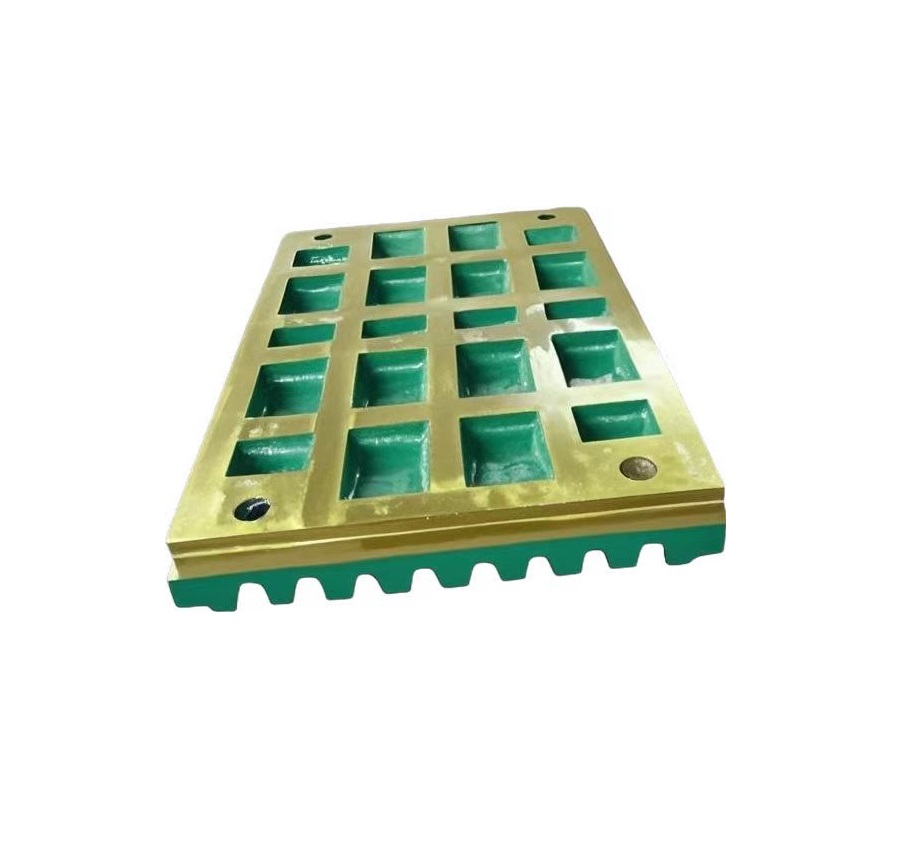
The Three Jobs a Liner Plate Does Inside the Chamber
Ask an operator what a liner does and you’ll hear “it wears out.” Ask an engineer and you’ll get a longer answer. In practice, the part carries three separate responsibilities at once.
Shaping the Cavity and Controlling Product Size
Chamber geometry decides throughput and gradation. The liner plate profile — its tooth pitch, angle and depth — determines how rock is nipped, held and reduced as it travels down the cavity. When the liner plate wears unevenly, the discharge opening drifts, product size creeps upward, and recirculating load climbs. Consistent profiles keep the crusher producing spec material.
Transmitting and Absorbing Crushing Reaction Force
Crushing is a battle of forces. Each stroke pushes rock hard against the chamber wall, and the liner plate must carry that reactive load without deflecting or cracking around the fixing holes. High strength and rigidity are non-negotiable here, because a stiff liner plate keeps the setting stable, protects fasteners, and stops load from being dumped into the crusher frame.
Protecting the Frame and Extending Machine Life
A crusher body is machined, welded and expensive. The liner plate is the sacrificial layer that takes abrasion, gouging and impact so the frame doesn’t. Replace a worn liner plate on schedule and the machine keeps its original geometry for years. Let it wear through, and repairs move from a bolt-on part to costly structural welding and downtime.
How Liner Plate Material Changes Crushing Performance
Material selection is where most buyers either save money or lose it. The right grade depends on feed hardness, impact level and site conditions — not on what the last supplier happened to stock.
High Manganese Steel for Impact-Heavy Duty
For primary crushing with blocky, uneven feed, a cast high manganese steel liner plate remains the benchmark. It arrives comparatively soft, then work-hardens at the surface under repeated blows while the core stays tough. That behaviour means the liner plate deforms and hardens instead of shattering when an oversized boulder drops into the chamber unannounced.
High Carbon Steel for Steady Abrasive Duty
Where impact is lower but abrasion never stops, a high carbon steel liner plate offers strong hardness at a friendlier cost per piece. Repair shops rebuilding older machines and plants running softer, well-graded feed often choose this route. Cast from quality melt and heat-treated correctly, the liner plate delivers dependable wear life without paying for impact toughness that duty doesn’t demand.
Harder Rock, Wet Sites and Corrosion Resistance
Granite, basalt and taconite punish liners differently than limestone. For harder rock, we may specify an alloy steel grade with controlled hardness and fatigue strength. Good corrosion resistance also matters underground, in coastal plants and in wet screening circuits, where a liner plate faces moisture and mineral-laden water alongside constant mechanical wear.
Getting More Tonnes Out of Every Liner Plate
Two identical castings can give very different service lives. What separates them is fit, installation discipline and how well the surrounding wear parts are matched.
Fit, Backing and Bolt Tension
Poor contact behind a liner is a hidden killer. Gaps let the plate flex, hammer against the frame and crack early. Correct backing, seated contact and properly tensioned bolts keep the liner plate rigid and quiet. We machine mounting faces and hole positions to drawing so installation is straightforward, and we recommend re-checking torque after the first hours of running.
Matching the Liner Plate with Other Wear Components
A crusher wears as a system. Toggle plates cast in high manganese steel, tension springs made from spring steel, high-strength steel wire or carbon steel, dust rings in high manganese or high-chrome alloy steel, forged main shafts and rack bars in alloy steel all interact with chamber behaviour. Specifying the liner plate alongside these parts keeps clearances honest and prevents one mismatched component from shortening everything.
Custom Supply, Inspection and Realistic Scheduling
Much of our work is non-standard: obsolete machines, modified profiles, or a worn sample with no drawing left. We reverse-engineer, confirm chemistry by spectrometer, check hardness, run dimensional and NDT inspection, then release the liner plate for shipment. Repeat orders move quickly; first castings take longer when drawings, patterns and process routes need several rounds of confirmation.
Conclusion
The liner plate shapes the crushing cavity, carries reaction force, and shields the frame from wear. Choose high manganese or high carbon steel to match your feed, insist on sound casting and verified hardness, fit it properly — and your crusher holds its setting far longer.
FAQ
Q1: How do I know when a liner plate needs replacing?
Watch for rising product size, dropping throughput, visible flattening of the profile, or thickness approaching your wear limit.
Q2: Which material suits abrasive hard rock best?
High manganese steel for impact-heavy primary duty; high carbon or alloy steel where abrasion dominates and impact is moderate.
Q3: Can you produce a liner plate without drawings?
Yes. Send the worn part, photos or measurements and we reverse-engineer the casting, then confirm material with you.
Q4: Do you supply other crusher wear parts?
We supply toggle plates, springs, dust rings, forged main shafts, alloy steel rack bars and blow bars for impact crushers.
Q5: What quality documents do you provide?
Chemical analysis, hardness results, dimensional reports and NDT records on request.
Let’s Solve Your Wear Problem Together
Xi’an Huan-Tai Technology and Development Co., Ltd. has spent 30 years customizing non-standard cast, forged and machined parts for mining, quarrying and engineering machinery. Our production team controls quality from melt to packing, and our technical team translates your performance targets into a casting that actually fits. Send a drawing, a photo, or simply describe the problem — we’ll reply with a practical solution and a clear quotation. Email inquiry@huan-tai.org.
References
- Wills, B. A., & Finch, J. A. Wills’ Mineral Processing Technology: An Introduction to the Practical Aspects of Ore Treatment and Mineral Recovery, 8th ed., Butterworth-Heinemann.
- Gupta, A., & Yan, D. S. Mineral Processing Design and Operations: An Introduction, 2nd ed., Elsevier.
- Lindqvist, M., & Evertsson, C. M. “Development of Wear Model for Cone Crushers,” Wear.
- Avery, H. S., & Davis, J. R. (Ed.) “Austenitic Manganese Steel,” ASM Specialty Handbook: Cast Irons and Steel Castings, ASM International.
- Bhadeshia, H. K. D. H., & Honeycombe, R. W. K. Steels: Microstructure and Properties, 4th ed., Butterworth-Heinemann.
