
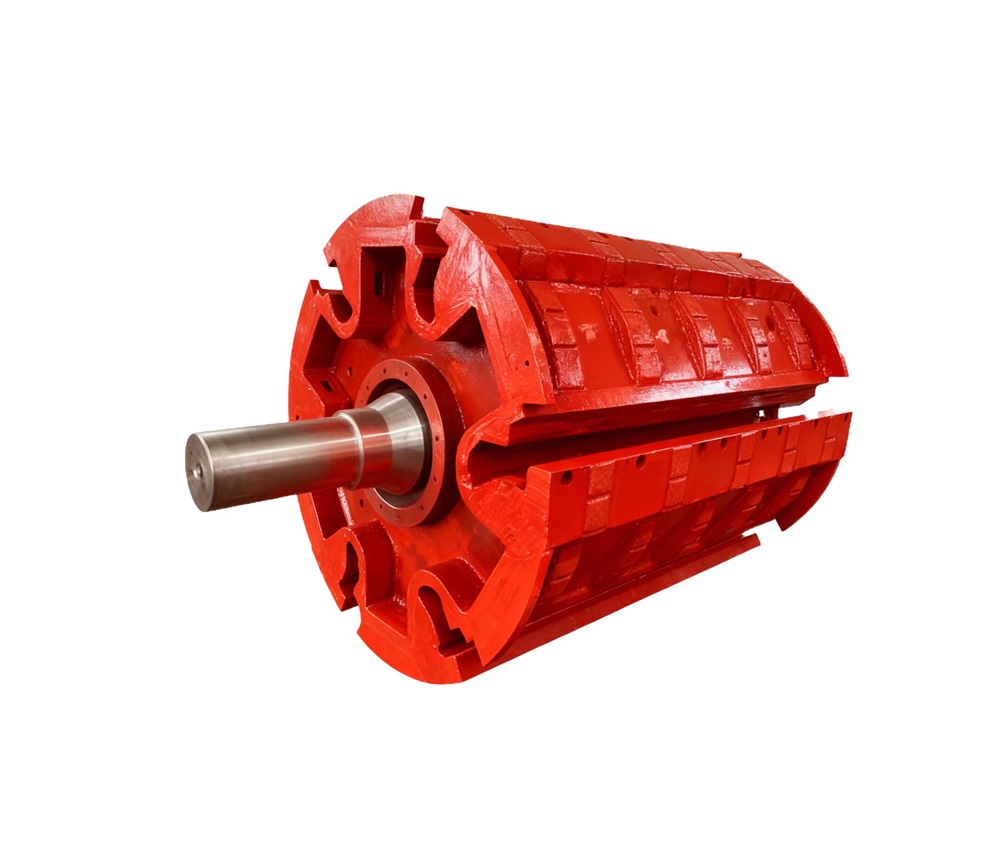
The crusher rotor is the heart of every crushing system, it directly determines the strength of the force applied to the raw materials, and the fine of the crushing. The rotor controls the impact energy required to break rock and ore, as well as the ultimate output size and homogeneity, via its rotating speed, mass and structural design.
How Rotor Speed and Mass Generate Crushing Force
The Role of Rotational Speed in Impact Energy
The speed of rotation is of great importance for the kinetic energy which the rotor gives to the material to be treated. The quicker the rotor is spinning, the harder the impact from each stroke. A good impact crusher is able to smash hard rock and ore. Speed must be carefully adjusted to suit material hardness for effective crushing without excessive wear of components.
Rotor Mass and Inertia in Material Breakage
The weight and inertia of the rotor are important factors in determining the crushing force. A heavier rotor stores more kinetic energy while spinning and is capable of holding momentum while impacting dense or abrasive materials. This constant push helps avoid stalling and encourages regular braking. The reasonable structure design makes the rotor have powerful crushing force and also keep balance and stable throughout operation.
Balancing Speed and Mass for Optimal Performance
It is important to have the correct balance between rotor speed and mass to maximize production. Too rapid a rotor may use more power and wear more quickly. A smaller rotor might have a hard time with harsher feed. Manufacturers may adjust the rotor characteristics to meet the needs of the application via careful engineering, enabling operators to achieve dependable throughput and regulated energy consumption in challenging mining and engineering situations.
How Rotor Design Determines Output Size and Uniformity
Hammerhead and Blow Bar Configuration on the Rotor
Hammer crushers: The material is struck and broken by hammers on the rotor. A customized bimetallic composite hammerhead, with a robust, wear-resistant head and a sturdy grip, overcomes the issue of simple fracture. The rotor of impact crushers is provided with blow bars, generally composed of high manganese steel, alloy steel or high chromium cast iron, to make the material smaller.
The Impact of Rotor Diameter and Clearance Settings
The size of the output is directly related to the diameter of the rotor and the clearance between its components and the crushing chamber. The rotor diameter is bigger, which increases the impact trajectory and the material is finer with tighter clearances. These parameters may be adjusted by operators to regulate particle gradation. The rotor assembly is precision engineered to offer predictable outcomes, allowing mining operations to reliably satisfy particular processing needs.
Optimized Structural Design for Consistent Particle Size
Optimized structural design allows the rotor to distribute the impact stresses on the feed material equally. The balanced energy transfer results in less large pieces and a more consistent particle size which improves the efficiency of downstream processing. At Xian Huan-Tai, all rotors are intended to be versatile for a variety of equipment, assuring compatibility and reliable performance across a variety of crushing jobs in engineering and mining operations.
How Rotor Materials and Manufacturing Sustain Performance
Material Selection for Rotor Components and Wear Parts
Durable materials increase the service life of a rotor and related components. Wear components, e.g. toggle plates, are made of high manganese steel, dust seals are made of high manganese steel or high chromium alloy steel. Crusher springs are usually comprised of spring steel, high strength steel wire or carbon steel. Springs absorb stress and protect the rotor assembly during heavy duty operation.
Forged Main Shafts and Structural Integrity
The main shaft is the backbone of the rotor. It transmits torque and is subject to extreme operating stresses. In crusher applications, the main shaft is made by forging, not casting, which improves strength and fatigue resistance. The solid construction supports the rotor under continuous impact, which reduces the danger of deformation and helps to provide steady crushing force and constant output throughout time.
Customization and Upkeep for Long-Term Reliability
“Every crushing application is different and needs to be customized. The properly designed rotor may be adapted to the equipment and material circumstances. Components such as the rackbar, often alloy steel, provide structural support. Lead times may vary since bespoke parts may need comprehensive drawings confirmed and production changes. The rotor performs reliably for its entire life with routine inspection and maintenance.
Conclusion
The rotor of the crusher determines the crushing force and output size directly with the rotor speed, mass, design and material quality. This knowledge enables operators to choose or customize components for consistent performance and uniform particle size, enhancing productivity and enabling long-term efficiency in challenging mining and engineering applications.
FAQs
Q1: How does speed of the rotor impact the ultimate output size?
A: Higher rotor speed increases impact energy and generates finer material. The lower the speed, the coarser the output. The best speed depends on the hardness of the feed and the desired particle size.
Q2. What material is utilized for hammerhead on crusher rotor?
A: Hammers on hammer crusher rotors are generally constructed of high manganese steel, alloy steel or high chromium cast iron due to their endurance and wear resistance.
Q3: Why do we forge the crusher main shaft instead of casting it?
A: The primary shaft supporting the rotor is forged to give higher strength and fatigue resistance, guaranteeing it can handle continuous severe loads during crushing operations.
Q4: Can a rotor be tailored for various crushing equipment?
A: Yes. A rotor may be designed to meet different kinds of equipment and unique operating circumstances, delivering optimum crushing force and constant output size.
Q5: How long does it take to create a custom rotor?
A: Lead times vary dependent on drawing validation, design complexity, and production procedures. Each custom rotor project is planned to suit particular client needs.
Partner with Xian Huan-Tai for Your Custom Rotor Needs
Looking for a dependable rotor solution adapted to your crushing operations? Xian Huan-Tai Technology and Development Co., Ltd. has 30 years of industry expertise in customizing non-standard mechanical parts for mining and engineering applications. We have competent technical team, strict quality control throughout the whole process of manufacturing and good service. We can provide components meeting your performance and quality criteria. Contact us today to discuss your project and request a quote at: inquiry@huan-tai.org.
References
- Wills, B. A., & Finch, J. A. (2016). Wills’ Mineral Processing Technology (8th ed.). Butterworth-Heinemann.
- Gupta, A., & Yan, D. S. (2016). Mineral Processing Design and Operations: An Introduction (2nd ed.). Elsevier.
- Napier-Munn, T. J., Morrell, S., Morrison, R. D., & Kojovic, T. (1996). Mineral Comminution Circuits: Their Operation and Optimisation. Julius Kruttschnitt Mineral Research Centre.
- Nikolov, S. D. (2004). A performance model for impact crushers. Minerals Engineering, 17(6), 715–721.
- Bearman, R. A., & Briggs, C. A. (1998). The active use of crushers to control product requirements. Minerals Engineering, 11(9), 849–859.
