
Impact plates in hammer crushers enhance material flow by forcing broken rock back into the active path of the rotor, assuring repeated high-energy impacts that generate uniform particle sizes. When impact plates are correctly positioned, material is unable to prematurely exit the crushing zone, causing more overall throughput and drastically reducing wasteful recirculation loads across arduous mining and aggregate processing processes globally.
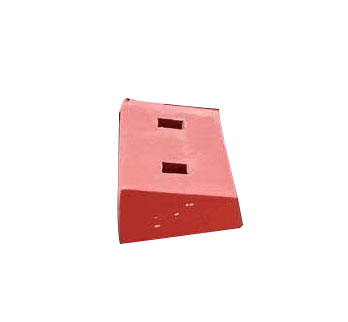
The Role of Impact Plates in Controlling Chamber Material Flow
Deflecting Oversized Fragments Back into the Crushing Zone
Large boulders are thrown off by the spinning rotor and caught by the impact plates as they enter the chamber. The impact plates bounce the pieces straight back to the hammerheads for further hits. This cycle of deflection allows oversize material to stay in the active crushing zone until the desired discharge size is achieved thus making the most use of each rotation of the rotor in heavy mining operations.
Establishing a Predictable Circulation Path Inside the Chamber
The impact plates are tilted to regulate the trajectory of the material in the hammer crusher, directing fragments through many stages of contact prior to ultimate discharge. This predictable circulation eliminates chaotic bouncing, which loses kinetic energy and increases wear on surrounding components such as the forged main shaft and dust seal rings made of high manganese steel or high chromium alloy steel.
Eliminating Premature Material Bypass for Higher Throughput
If the impact plates are not set up correctly, partly crushed material might slide past the rotor and escape through the grate apertures too soon. Good impact plates seal off these escape pathways and subject every piece to enough cycles of crushing. This means better effective throughput and substantially less pressure on downstream screening equipment for big scale engineering and construction projects.
How Impact Plate Geometry Influences Crushing Efficiency and Output
Surface Profile and Its Direct Effect on Particle Fracture
Impact plates may be manufactured with different surface profiles, for example flat, corrugated or stepped, and the impact plate profile will influence the transmission of energy to the material on impact. A corrugated face focuses stress at the sites of contact and promotes clean fractures along natural grain boundaries. This shape is combined with a customisable bimetallic composite hammerhead which, thanks to its robust and wear-resistant head and durable handle, solves the usual breaking issue in hammer crusher operations.
Optimized Structural Design for Uniform Gradation
The impact plates are designed with optimum structure to provide powerful and uniform crushing force over the whole chamber width. By keeping the impact plates the same distance apart and at the same angle relative to the rotor, the particle size dispersion is dramatically narrowed. This consistency of production is very important to the mining operators who want predictable gradation for downstream processing, storage and transit logistics.
Matching Plate Angles to Specific Feed Characteristics
The impact plate configuration is dependent on the input material. Steep angles of the plate are beneficial for hard, brittle ores as they optimize impact velocity, whereas softer limestone is better crushed at shallower angles to minimize over-crushing and excessive formation of particles. Our technical staff analyzes the peculiarities of your individual feed and modifies the impact plates arrangement to adapt to different kinds of equipment in your manufacturing line.
Integrating Impact Plates with Complete Hammer Crusher Systems
Coordinating Impact Plates with Rotor and Hammerhead Performance
The impact plates must work in good harmony with the rotor assembly and its hammerheads to provide effective material flow. The forged main shaft keeps the rotor stable, and the adjustable bimetallic composite hammerhead makes sure every strike is consistent. The impact plates are all in perfect alignment with these spinning components, which means the whole crushing system is operating at optimum efficiency, with little energy loss across long campaigns.
Ensuring Compatibility Across Various Mining Equipment Configurations
Our impact plates are used in many different kinds of equipment, from single-rotor hammer crushers in limestone quarries to heavy-duty machines that handle hard basalt and granite. Whether your operation utilizes toggle plates made from high manganese steel or rack bars manufactured from alloy steel, we can guarantee that each part fits perfectly into your current crusher circuit for dependable, continuous output.
Long-Term Reliability Through Quality Manufacturing and Inspection
The long-term performance of impact plates depends on strict manufacturing requirements at every step of manufacture. Our skilled manufacturing team controls the quality from the raw material to the final dimension inspection. This dedication guarantees that each set of impact plates provides predictable wear life and regular material flow, helping to minimize unexpected downtime in your mining and engineering operations.
Conclusion
Impact plates essentially optimize material flow in hammer crushers, diverting shattered rock, managing internal circulation pathways, and maintaining consistent output size. The choice of plate shape and material composition enhances throughput and extends the life of components. Impact plates are a critical factor for mining and engineering operations striving for dependable crushing performance.
FAQs
Q1: What materials are commonly used for impact plates?
Impact plates are usually made of high manganese steel or alloy steel since they work-harden and have structural strength under continual strong impact loads in mining conditions.
Q2: How are impact plates different from hammerheads?
Impact plates are stationary wear liners that are installed on the inside of the wall of the crusher chamber. Hammerheads revolve with the rotor and hit material directly. And both work together for efficient crushing.
Q3: Are the impact plates adaptable to my particular feed material?
Yes. Our technical team will design the geometry, angle and material composition of the impact plates specifically for your ore characteristics and desired output gradation requirements.
Q4: What is the lead time for bespoke impact plates?
Lead times are dependent on design complexity and drawing validation processes, but our experienced team aims to deliver within a realistic production window for your project timeline.
Q5: Do you offer impact plates for various makes of crusher?
We build bespoke impact plates for all kinds and brands of equipment to your precise dimensions specifications and performance needs.
Partner with a Trusted Manufacturer for Your Crushing Components
Xian Huan-Tai Technologies has 30 years industry expertise in non-standard mechanical parts and provides bespoke impact plates and hammer crusher components to your precise requirements. Our in-house manufacturing and technical teams control quality throughout every step from confirming your design to the final inspection to ensure the stability, consistency and on-time delivery your business demands. To start the discussion, email us now at inquiry@huan-tai.org.
References
- Wills, B. A., & Finch, J. A. (2015). Wills’ Mineral Processing Technology: An Introduction to the Practical Aspects of Ore Treatment and Mineral Recovery. Butterworth-Heinemann.
- Napier-Munn, T. J., Morrell, S., Morrison, R. D., & Kojovic, T. (1996). Mineral Comminution Circuits: Their Operation and Optimisation. JKMRC Monograph Series.
- Lynch, A. J. (1977). Mineral Crushing and Grinding Circuits: Their Simulation, Optimisation, Design and Control. Elsevier Scientific Publishing.
- Bearman, R. A., & Barley, R. W. (1998). The Application of Rock Mechanics in Comminution. Transactions of the Institution of Mining and Metallurgy.
- King, R. P. (2012). Modeling and Simulation of Mineral Processing Systems. Society for Mining, Metallurgy & Exploration.
