
The grid plate is one of the most functionally critical components in a hammer crusher. Its aperture geometry directly controls product sizing, its material and heat treatment determine how long it lasts under continuous abrasion and impact, and its dimensional fit governs how cleanly it interfaces with the rotor and casing. A well-designed, correctly specified Grid Plate keeps output gradation consistent, reduces rotor load, and extends the interval between scheduled replacements — all of which feed directly into crusher productivity and operating cost.
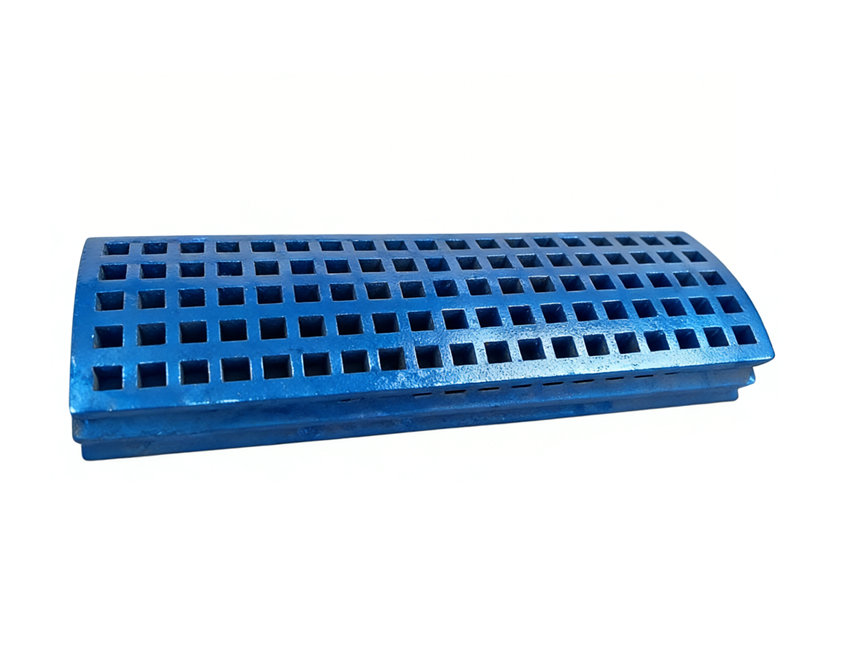
How Grid Plate Aperture Design Directly Controls Crusher Output
Opening Size and Product Gradation
The aperture dimensions of a Grid Plate set the maximum particle size that can pass through the crusher discharge zone. Oversized openings allow coarser product to pass, which may fail to meet downstream specification requirements. Undersized openings retain material longer, increasing recirculation load and rotor wear. A Grid Plate designed with the correct opening geometry for the target product size ensures consistent gradation, reduces oversize returns, and lets the crusher operate at its intended throughput capacity without working against its own design parameters.
Bar Profile and Material Flow Resistance
The profile of the bars forming the Grid Plate structure affects how easily crushed material flows toward the discharge openings. Flat-profiled bars accumulate fine material in the corners, increasing blockage risk under wet or sticky feed conditions. Well-designed bar profiles guide material toward the openings efficiently, reducing the residence time of crushed product in the crushing zone. This directly lowers the energy required per tonne of output and reduces unnecessary re-crushing of already-sized material, which accelerates bar wear over time.
Fit with Rotor Geometry and Casing Clearance
A Grid Plate that does not fit precisely within the crusher casing creates clearance gaps that allow oversized material to bypass the crushing zone or generates contact points that damage the rotor. Customization according to the specific machine model and drawing ensures a correct fit between the Grid Plate and the surrounding equipment geometry. Huan-Tai supports model-specific and drawing-based Grid Plate production, with a pre-production review that checks dimensional compatibility before casting begins to prevent costly fit issues after delivery.
Why Grid Plate Material and Heat Treatment Determine Service Life
Alloy Enhancement for Anti-Sand-Sticking Performance
In crushing applications involving fine abrasive material or damp feed, sand sticking and clamping within the Grid Plate openings is a real operational problem — it reduces effective aperture size, distorts throughput, and forces unplanned cleaning stoppages. Adding manganese and other alloying elements to the casting composition significantly improves the anti-sand-sticking performance of the Grid Plate, keeping openings clear under difficult feed conditions and sustaining the throughput consistency that operations depend on across a full production shift.
Special Heat Treatment for Improved Wear Resistance
Raw castings do not automatically deliver the wear resistance profile a Grid Plate needs to survive continuous abrasive contact in the discharge zone. Controlled heat treatment — applied to key structural components after casting — develops the hardness and toughness combination that resists both gradual surface abrasion and the occasional impact load from oversized feed material. Huan-Tai applies targeted heat treatment processes to Grid Plate production as standard practice, ensuring each component leaves the facility with the mechanical properties its service environment demands.
Material Grade Matched to Feed Characteristics
The right material grade for a Grid Plate depends on whether the primary wear mechanism is abrasion, impact, or a combination of both. High manganese steel suits impact-dominated applications where work hardening under load provides progressive surface protection. Alloy steel with controlled heat treatment is effective where abrasion is the dominant wear mode and consistent surface hardness throughout the service life is the priority. Selecting the correct grade from the outset — with guidance from an experienced supplier — avoids the premature replacement cycles that come from material mismatch.
Practical Considerations When Sourcing a Custom Grid Plate
Custom Specification from Model or Drawing
Standard catalogue Grid Plate dimensions do not always match older crusher models, regionally modified equipment, or machines that have undergone structural changes during their operating life. A manufacturer capable of producing a Grid Plate to customer-supplied drawings or model specifications gives maintenance teams a reliable path to exact replacements. Dimensional customization ensures the new Grid Plate seats correctly, maintains the designed aperture pattern, and integrates cleanly with the rotor and casing geometry without requiring field modification after delivery.
Quality Inspection Before and After Casting
A Grid Plate that carries internal casting defects — porosity, shrinkage voids, or compositional inconsistencies — will wear unevenly and fail earlier than its specification suggests. Rigorous inspection at the raw material stage, during casting, and at the final dimensional check ensures each Grid Plate delivers the service life and performance the customer has planned around. For operations running multiple crushers with shared replacement cycles, this inspection discipline also ensures batch-to-batch consistency that makes maintenance scheduling predictable and reliable.
Lead Time Planning for Replacement Cycles
Standard Grid Plate variants with confirmed drawings and material specifications can move through production and dispatch within a reasonable timeframe, making them compatible with planned maintenance schedules. Custom configurations involving non-standard aperture patterns, special alloy grades, or multiple drawing confirmation rounds naturally require more production time across casting, heat treatment, and final inspection stages. Procurement teams should build realistic lead time buffers into their replacement planning — particularly for custom designs — to avoid unplanned downtime when worn Grid Plates need immediate replacement.
Conclusion
Grid Plate design touches every aspect of crusher performance: aperture geometry controls product size, bar profile affects material flow and energy efficiency, and material selection with heat treatment determines how long the component lasts before replacement. For mining and engineering machinery operations, sourcing a Grid Plate that is correctly specified, consistently manufactured, and precisely dimensioned for the target equipment is the most direct path to stable throughput, predictable maintenance intervals, and lower cost per tonne over the operating cycle.
FAQ
Q1: How does Grid Plate aperture size affect crusher output?
Aperture size sets the maximum particle size that passes through the crusher. Correctly sized openings maintain the specified product gradation, reduce oversize returns, and allow the crusher to operate at its designed throughput capacity without excessive recirculation load.
Q2: What materials are used for a wear-resistant Grid Plate?
High manganese steel is common for impact-dominated applications. Alloy steel with controlled heat treatment suits abrasion-dominated environments. Manganese and other alloying additions improve anti-sand-sticking performance, keeping apertures clear under fine or wet feed conditions.
Q3: Can a Grid Plate be produced to a custom drawing or model specification?
Yes. Manufacturers with casting and machining capability can produce a Grid Plate from customer drawings or model references. A pre-production review confirms dimensional compatibility, material grade, and process suitability before casting begins.
Q4: How does heat treatment improve Grid Plate performance?
Heat treatment develops the hardness and toughness profile the Grid Plate needs to resist both surface abrasion and impact loading. Without it, even correctly specified castings may wear prematurely. Targeted heat treatment cycles are applied based on material grade and application requirements.
Q5: What lead time should I plan for a custom Grid Plate order?
Standard designs with confirmed drawings can often be completed within a few weeks. Custom or non-standard Grid Plate configurations requiring drawing revisions, special alloys, or complex aperture patterns will take longer. Always confirm lead times at quoting stage when planning scheduled maintenance.
Get a Custom Grid Plate Built to Your Crusher Specifications
Huan-Tai has manufactured customized non-standard mechanical parts for mining and engineering machinery since the mid-1990s. Our production team manages quality at every stage — from alloy composition and casting through heat treatment and dimensional inspection — and our technical team works directly with customers to meet exact model fit and performance requirements. Whether you need a standard replacement or a fully custom Grid Plate design, 30 years of industry experience is behind every component we deliver. Send your drawings or model details to: inquiry@huan-tai.org.
References
1. Wills, B. A., & Finch, J. A. (2015). Wills’ Mineral Processing Technology: An Introduction to the Practical Aspects of Ore Treatment and Mineral Recovery (8th ed.). Butterworth-Heinemann.
2. Napier-Munn, T. J., Morrell, S., Morrison, R. D., & Kojovic, T. (1996). Mineral Comminution Circuits: Their Operation and Optimisation. Julius Kruttschnitt Mineral Research Centre.
3. Campbell, J. (2015). Complete Casting Handbook: Metal Casting Processes, Metallurgy, Techniques and Design (2nd ed.). Butterworth-Heinemann.
4. Ashby, M. F., & Jones, D. R. H. (2012). Engineering Materials 1: An Introduction to Properties, Applications and Design (4th ed.). Butterworth-Heinemann.
5. Hosford, W. F. (2012). Iron and Steel. Cambridge University Press.
6. Groover, M. P. (2019). Fundamentals of Modern Manufacturing: Materials, Processes, and Systems (6th ed.). John Wiley & Sons.
