
A crusher frame design guide for stable crushing performance comes down to three things: rigidity that holds your settings, castings that absorb impact, and machining that seats every part where the drawing says. Get the Crusher Frame right and everything bolted to it runs longer. Here is how we design, build, and ship them.
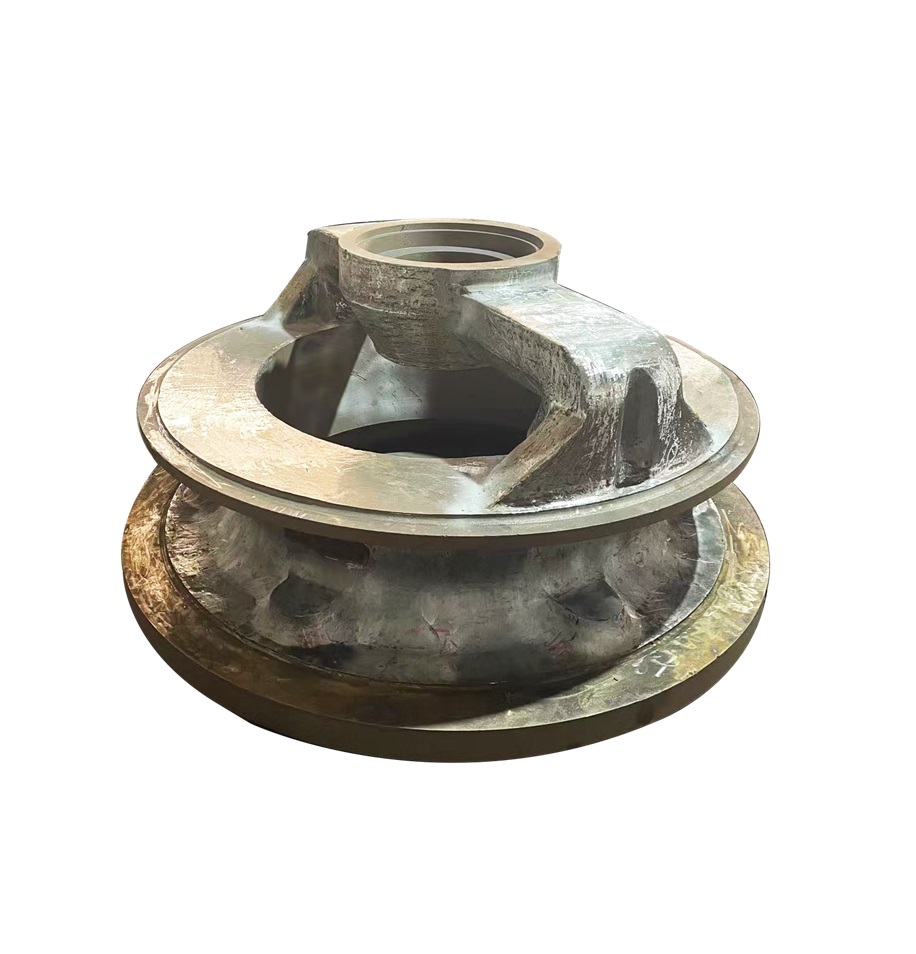
A Crusher Frame Design Guide Starts With the Loads
Impact That Never Hits the Same Way Twice
Feed arrives wet, dry, slabby, or as fines, and the Crusher Frame absorbs all of it. Blows land off-center, tramp iron rings through the walls, and stress concentrates wherever sections change too fast. We read those load paths first — from your crusher model, feed size, and duty — because a frame designed for average loads fails on the first bad day.
Vibration That Finds Every Loose Bolt
A Crusher Frame is a tuning fork whether you like it or not. If stiffness and mass sit in the wrong places, operating speed finds a resonance and the machine shakes itself loose: anchor bolts stretch, grout powders, bearing seats fret. Designing against that means moving resonance away from running speed, not adding random weight and hoping for the best.
Rigidity Is What Holds Your Settings
Stable gradation starts with a Crusher Frame that does not breathe under load. When walls flex, gaps open and close with every stroke, and product size wanders no matter how often operators adjust. Our optimized structural design delivers strong crushing force and more uniform particle size, because the chamber geometry stays exactly where your settings put it.
Design Details That Make a Crusher Frame Crush Stably
Ribs, Radii, and Wall Transitions
Most frame cracks are born in the drawing office: a sharp internal corner, a rib that stops dead, a wall jumping thick to thin. We run generous radii, taper the transitions, and place ribs where load actually travels. Unglamorous work, but it is why a Huan-Tai Crusher Frame keeps its shape through seasons of abuse.
Cast Steel, Poured Clean and Stress Relieved
A Crusher Frame in cast steel only performs if the pour is clean and the stress is out. We control melt chemistry, feed and vent the pattern properly, then heat treat to relieve casting stress before machining. Skip that sequence and the frame moves the first time it takes load — and keeps moving for years afterward.
Machined Datums Where Parts Actually Meet
Design ends at the surfaces other parts touch. Bearing bores, liner seats, and mounting faces on the Crusher Frame are machined from referenced datums, then measured and recorded, so the forged main shaft sits true and liners bed evenly. Our production team manages quality through the whole process, and the inspection reports ship with the frame.
Specifying a Crusher Frame Without Surprises
Send the Drawing, the Model, or the Wreck
New build or field failure, the starting point is the same: a drawing, a machine model, or a broken casting we can reverse engineer. Our Crusher Frame work suits various types of equipment across mining, cement, and aggregate duty. Expect a confirmation round or two on complex geometry — that back-and-forth makes the first pour the right one.
The Parts That Live Inside the Frame
A Crusher Frame ships into a system, so we supply what bolts into it: forged main shafts, high manganese steel toggle plates, dust seal rings in high manganese steel or high chrome alloy steel, alloy steel rack bars, and springs in spring steel, high-strength steel wire, or carbon steel. Hammer crusher builds get our customizable bimetallic composite hammerhead — hard wear-resistant head, strong handle, no easy breakage; impact crusher blow bars are made separately.
Lead Times You Can Plan a Shutdown Around
Confirmed, standard Crusher Frame orders typically move through foundry and machining in a matter of weeks. Custom builds take longer when drawings need repeated confirmation or the process route runs complex, and we say so up front. You get an honest schedule, progress updates before you ask, and documentation your quality team can actually file.
Conclusion
Stable crushing performance is a frame decision: read the loads, design the transitions, pour clean cast steel, machine true datums, and schedule honestly. Do that and settings hold, bearings last, and tonnage stays predictable. Send the drawing — we will build the stability in from the first pour.
FAQ
Can you build a crusher frame to our drawing?
Yes — by drawing, machine model, or a reverse-engineered broken casting.
Are your crusher main shafts cast or forged?
Forged, then machined and ground true.
What is a typical lead time?
Confirmed standard orders move in weeks; complex custom frames take longer with drawing confirmation rounds.
What companion parts do you supply?
Toggle plates, dust seal rings, rack bars, springs, hammer heads, and impact-crusher blow bars made separately.
Do you serve small repair shops?
Yes — from five-person crews to OEMs of several hundred.
Send Us the Frame Everybody Else Quoted Around
Thirty years customizing non-standard mechanical parts for mining and engineering machinery means we have seen every frame failure worth naming. You get excellent service, production-managed quality control, and engineers who meet your performance targets. We cast, forge, and machine — no precision electronics. Email your Crusher Frame drawing or crack photos to inquiry@huan-tai.org, tell us the duty, and we will reply with a plan, a price, and a lead time you can hold us to.
References
- Budynas, R. G., & Nisbett, J. K. (2015). Shigley’s Mechanical Engineering Design (10th ed.). McGraw-Hill.
- Campbell, J. (2011). Complete Casting Handbook: Metal Casting Processes, Metallurgy, Techniques and Design. Butterworth-Heinemann.
- Norton, R. L. (2011). Machine Design: An Integrated Approach (4th ed.). Prentice Hall.
- Juvinall, R. C., & Marshek, K. M. (2017). Fundamentals of Machine Component Design (6th ed.). John Wiley & Sons.
- Bhandari, V. B. (2010). Design of Machine Elements (3rd ed.). Tata McGraw-Hill.
