
In places like mines, building sites, and quarries where heavy machinery is used, the track frame is one of the most heavily damaged parts of the machine. Choosing the right casting method for this part directly affects how long it lasts, how well it holds its shape, and how well it handles the constant shock and wear of real-world use. This piece talks about the main ways to cast and what really counts for longevity.
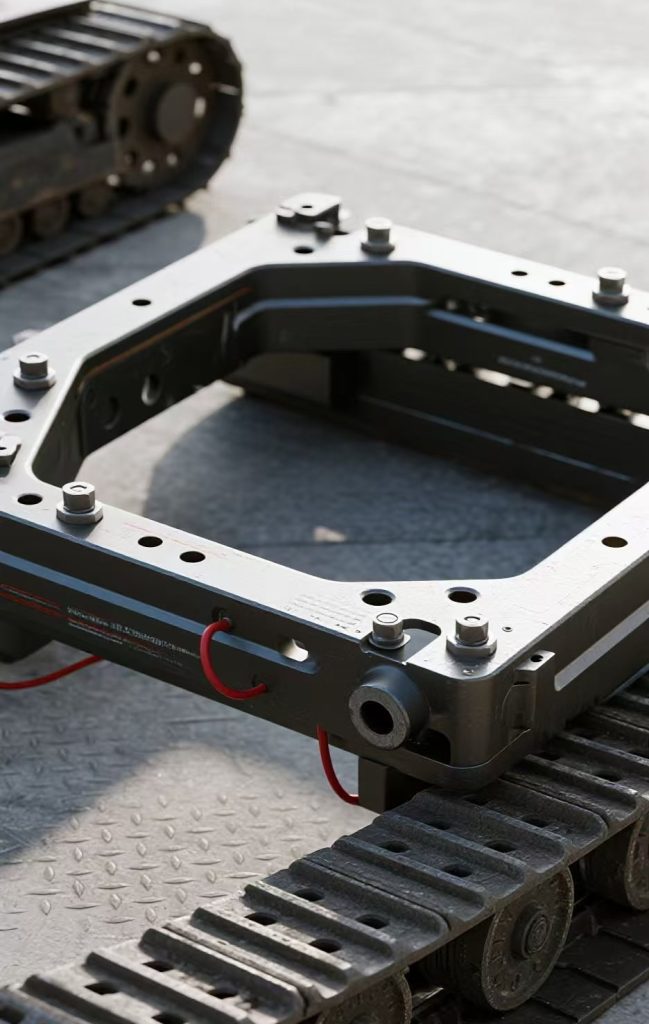
Which Casting Methods Are Used for Track Frame Production?
Resin Sand Casting
One of the most common ways to make a heavy-duty Track Frame is through resin sand casting. Chemically linked sand molds are used in the process. They keep their shape very precisely, which leads to tight tolerances in dimensions and smooth surfaces. Resin sand casting gives buyers the structural stability and accuracy they need across production runs for big, thick-walled parts like the chassis frames used in excavators and other mining equipment.
Lost Foam Casting
Lost foam casting offers a compelling advantage when the Track Frame geometry is complex or when internal cavities would be difficult to form with conventional molds. A foam pattern is coated in refractory material, embedded in dry sand, and replaced by molten metal during pouring. The result is a near-net-shape casting with minimal machining requirements. This method is particularly effective for engineering and mining machinery parts where design complexity and weight optimization matter simultaneously.
Choosing Between Methods Based on Part Requirements
Neither method is universally superior — the right choice depends on the Track Frame‘s wall thickness, required surface finish, batch size, and geometric complexity. Resin sand casting suits straightforward, high-volume structural frames. Lost foam casting is favored when design freedom or internal passage accuracy is a priority. At Huan-Tai, both processes are available, and our technical team works with customers to select the method that best matches the drawing specifications and end-use environment.
How Casting Quality Affects Track Frame Durability in the Field
Dimensional Accuracy and Fit Compatibility
A Track Frame that is cast out of tolerance creates assembly headaches and accelerates wear on connected components. Rigorous dimensional inspection — covering critical mounting surfaces, bore diameters, and overall length — ensures the part installs correctly the first time. Huan-Tai conducts multi-stage inspections throughout production, not only at final release, so deviations are caught before they compound into costly rework or field failures on the equipment.
Material Integrity and Internal Soundness
Casting defects such as porosity, shrinkage cavities, or cold shuts significantly reduce the fatigue life of a Track Frame under dynamic loading. Both resin sand and lost foam processes, when properly controlled, produce dense, sound castings. Post-casting non-destructive testing and visual inspection confirm internal integrity before any machining begins. For mining and construction equipment that operates under constant impact and vibration, this level of quality verification is not optional — it is essential.
Heat Treatment for Structural Performance
Raw castings often require heat treatment to relieve residual stresses and achieve the mechanical properties specified for the Track Frame application. Normalizing or quench-and-temper cycles are selected based on the base material and the expected operating loads. Skipping this step may save time in the short term but leads to premature cracking or deformation in demanding environments. Huan-Tai’s production workflow integrates heat treatment as a standard step for structural undercarriage components.
What to Expect When Ordering a Custom Track Frame
Custom Drawing Support and Design Confirmation
Many buyers need a Track Frame that matches a specific machine model or a modified undercarriage layout not covered by standard catalogues. Huan-Tai supports custom drawing design, working directly from customer-supplied 2D drawings or 3D models. Before production begins, drawings go through a technical review to confirm tolerances, material grade, and casting method suitability. If revisions are needed, this stage may extend the overall timeline — transparency here prevents mismatched parts later.
Lead Time Considerations for Non-Standard Parts
Standard Track Frame variants can move through production and inspection within a moderate window. Highly customized frames — particularly those with complex geometry, tight tolerances, or multiple drawing revision cycles — will naturally require more time. Buyers should factor in mold preparation, casting, heat treatment, machining, and final inspection when planning procurement timelines. Huan-Tai provides honest lead time estimates at the quoting stage, so production schedules can be planned realistically.
Quality Assurance Before Shipment
Before a Track Frame leaves the facility, it passes through dimensional verification, surface inspection, and any application-specific tests requested by the customer. Inspection records are retained for traceability. For repeat orders, these records allow consistent replication of proven production parameters — which matters greatly to larger manufacturers who need batch-to-batch uniformity. This systematic approach to pre-shipment quality is a core part of how Huan-Tai builds long-term supplier relationships.
Conclusion
Selecting the right casting method for a Track Frame — whether resin sand or lost foam — is just the starting point. What ultimately determines durability is the combination of process control, rigorous inspection, appropriate heat treatment, and accurate dimensional execution. For companies sourcing undercarriage components for mining or construction equipment, partnering with an experienced manufacturer who handles all of these stages in-house is the most reliable path to parts that perform consistently over time.
FAQ
Q1: What casting method is best for a heavy-duty Track Frame?
Both resin sand and lost foam casting are well-suited depending on part geometry and batch size. Resin sand works well for straightforward structural frames; lost foam is preferred for complex or cavity-rich designs.
Q2: Can you produce a Track Frame from custom drawings?
Yes. Huan-Tai supports full custom drawing design. Our technical team reviews customer drawings before production to confirm material grade, tolerances, and process suitability.
Q3: How long does it take to produce a custom Track Frame?
Lead time varies with complexity. Simple frames with confirmed drawings move faster; those requiring drawing revisions, special heat treatment, or complex casting geometry take longer. We provide realistic estimates at the quoting stage.
Q4: What quality checks are applied to each Track Frame?
Inspections cover dimensional accuracy, surface condition, and internal soundness. Heat treatment steps are included where required. Pre-shipment records are retained to support traceability and repeat-order consistency.
Q5: What industries use custom Track Frame components?
Mining machinery, excavator manufacturers, construction equipment producers, and heavy-equipment repair companies are the primary users. Any operation running tracked undercarriage equipment may need custom frames to replace worn or non-standard components.
Get a Custom Track Frame Quote From Huan-Tai
Huan-Tai has been manufacturing customized non-standard mechanical parts since the mid-1990s — and our approach has not changed: professional technical support, production-level quality management, and 30 years of experience across engineering and mining machinery applications. Whether you need a single replacement frame or a recurring production run, our team is ready to review your drawings and deliver a solution that fits. Send your specifications and drawings to: inquiry@huan-tai.org.
References
1. Beeley, P. R. (2001). Foundry Technology (2nd ed.). Butterworth-Heinemann.
2. Campbell, J. (2015). Complete Casting Handbook: Metal Casting Processes, Metallurgy, Techniques and Design (2nd ed.). Butterworth-Heinemann.
3. Heine, R. W., Loper, C. R., & Rosenthal, P. C. (1967). Principles of Metal Casting (2nd ed.). McGraw-Hill.
4. Shackelford, J. F. (2014). Introduction to Materials Science for Engineers (8th ed.). Pearson Education.
5. Todd, R. H., Allen, D. K., & Alting, L. (1994). Manufacturing Processes Reference Guide. Industrial Press.
6. Groover, M. P. (2019). Fundamentals of Modern Manufacturing: Materials, Processes, and Systems (6th ed.). John Wiley & Sons.
