
For hard rock crushing applications, the mantle is the inner wear surface of a cone crusher, rotating against the concave to compress and break feed material. A high-quality manganese mantle — enhanced with the right alloy composition and heat treatment — delivers the wear resistance and dimensional stability that demanding mining and quarrying operations require to maintain throughput and control maintenance costs.
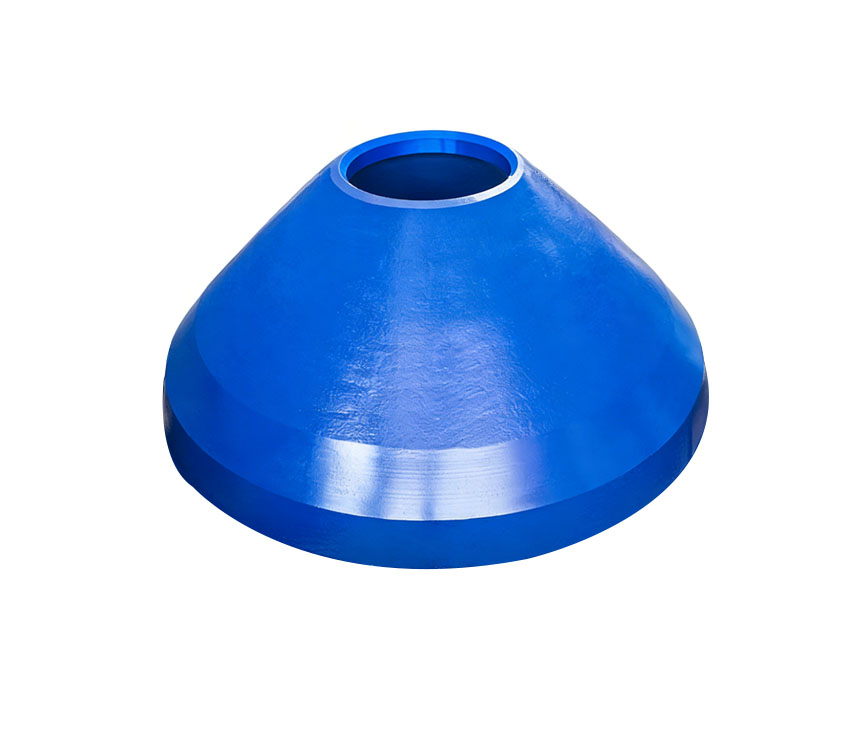
Why Is the Manganese Mantle the Right Choice for Hard Rock Applications?
Work-Hardening Behavior Under Crushing Load
Manganese steel is the material of choice for cone crusher mantles in hard rock applications because of its work-hardening characteristic. Under repeated compressive loading, the surface of a manganese mantle becomes progressively harder — increasing wear resistance as the machine runs. This behavior is particularly valuable when processing granite, basalt, or other high-abrasion rock types where softer materials would wear quickly and lose their profile. The mantle’s geometry directly affects product size distribution, so maintaining its shape throughout the service cycle is operationally important for cone crusher spare parts performance.
Alloy Enhancement for Improved Performance
Standard high manganese steel can be further improved by adjusting the alloy composition — adding elements such as manganese and chromium in optimized ratios to enhance surface hardness, reduce sand adhesion, and improve resistance to material clamping on the crushing surface. This formulation refinement extends the effective service life of the mantle and reduces the cleaning and inspection interventions that adhesion-prone surfaces require. For operations processing sticky or fine-grained feed alongside coarser hard rock, this enhanced alloy performance is a practical advantage that standard cone crusher spare parts don’t always offer.
Special Heat Treatment for Long-Term Wear Resistance
Beyond alloy composition, heat treatment is the other major lever in mantle performance. Key components undergo controlled heat treatment processes that improve microstructural uniformity, relieve casting stresses, and increase the overall wear resistance of the finished part. A mantle that has been properly heat-treated holds its hardness profile deeper into the material — meaning that as the surface wears, the underlying material maintains comparable resistance rather than softening rapidly. This depth of hardness is what distinguishes a well-manufactured mantle from a cheaper alternative cast without equivalent process discipline.
How Does Mantle Quality Directly Impact Cone Crusher Efficiency?
Product Size Consistency Depends on Mantle Profile
The geometry of the mantle — its taper angle, surface profile, and dimensional accuracy — determines the closed-side setting and the way material moves through the crushing chamber. As the mantle wears, the chamber geometry changes and product gradation shifts. A high-quality mantle with good wear resistance holds its profile longer, keeping product size consistent between change-outs. For operations supplying aggregate to specification, this consistency matters as much as throughput volume, and it begins with cone crusher spare parts manufactured to precise dimensional standards.
Reducing the Frequency of Planned Shutdowns
Every mantle change-out requires a planned shutdown — the cone crusher must be taken offline, the head assembly accessed, and the worn mantle removed and replaced. A mantle that lasts longer between replacements directly reduces the frequency of these events, improving overall crusher availability. The time saving across a full year of operation — fewer shutdowns, less labor, less spare parts handling — is measurable. Sourcing cone crusher spare parts that deliver consistent, extended service life is one of the most straightforward ways to improve asset utilization in a crushing circuit.
Fit and Seating Accuracy Affect Crusher Performance
A mantle that doesn’t seat correctly on the crusher head creates stress concentrations, accelerates wear on the head itself, and can cause vibration that affects other components. Customization based on the specific crusher model and drawing — rather than a generic catalog fit — ensures that the mantle seats as designed and performs as intended from the first hour of operation. For non-standard or older cone crusher models still in service, this level of fit precision is only achievable through a supplier with genuine manufacturing and engineering capability.
What Should Buyers Consider When Sourcing a Cone Crusher Mantle?
Specify the Crusher Model and Operating Conditions
A mantle specified correctly for the crusher model, the feed material hardness, and the target product size will consistently outperform one sourced purely on price. Buyers should provide the crusher make and model, the feed material type, and the operating hours between planned maintenance intervals — information that allows a capable supplier to recommend the right alloy grade and confirm the dimensional specification. This upfront detail avoids the costly scenario of receiving cone crusher spare parts that perform below expectation because the specification was underspecified.
Account for Lead Times on Custom Production
Standard mantle profiles for common cone crusher models are typically available within a reasonable timeframe. Custom mantles — required for non-standard configurations, legacy equipment, or application-specific profiles — involve drawing review, material sourcing, casting, and heat treatment steps that extend the production timeline. When drawings require multiple rounds of confirmation or dimensional verification, lead times extend further. Purchasing managers who plan ahead and engage suppliers early avoid the operational pressure of running worn cone crusher spare parts beyond their safe service limit.
Prioritize Suppliers with End-to-End Quality Control
The performance of a manganese mantle is determined by alloy composition, casting quality, heat treatment, and dimensional accuracy — none of which are visible from the outside of a finished part. Suppliers who apply quality control across the full production process, from incoming material verification to final dimensional and hardness inspection, give buyers meaningful assurance that what they receive matches what was specified. For larger operations where mantle performance directly affects production targets, this process discipline is worth paying for.
Conclusion
A manganese mantle optimized for hard rock crushing — through alloy enhancement, controlled heat treatment, and precise dimensional manufacturing — delivers longer service life, consistent product quality, and fewer unplanned disruptions. Selecting the right cone crusher spare parts supplier is as important as selecting the right material grade.
FAQ
Q1: What material is used for cone crusher mantles in hard rock applications?
High manganese steel is the standard choice, valued for its work-hardening behavior under compressive loading. Alloy enhancements — adjusting manganese and chromium content — further improve wear resistance and service life.
Q2: How does heat treatment affect mantle performance?
Controlled heat treatment improves microstructural uniformity and wear resistance through the depth of the material, not just at the surface. This means the mantle maintains its hardness profile as it wears, rather than softening rapidly beneath the surface layer.
Q3: Can mantles be customized for non-standard cone crushers?
Yes. Mantles can be produced to customer drawings or model specifications. Lead times for custom cone crusher spare parts depend on drawing confirmation and production complexity.
Q4: How do I know when a mantle needs replacing?
Changes in product gradation, visible profile wear, or a shift in the closed-side setting are the main indicators. Scheduled dimensional checks during planned maintenance intervals are the most reliable monitoring approach.
Q5: Does mantle fit affect crusher performance?
Directly. A mantle that doesn’t seat correctly creates uneven load distribution, accelerates wear on the crusher head, and can cause vibration that affects other components. Dimensional accuracy at the point of manufacture is essential.
Find the Right Mantle for Your Cone Crusher
At Xi’an Huan-Tai Technology and Development Co., Ltd., we manufacture high-performance cone crusher spare parts — including customized manganese mantles — for mining and engineering customers worldwide. With over 30 years of experience, our technical team matches alloy grade and dimensional specification to your crusher model and operating conditions. Our quality control process covers every production stage, so you receive parts that perform to specification, every time. Share your crusher model and requirements with us today at inquiry@huan-tai.org.
References
- Wills, B. A., & Finch, J. A. (2015). Wills’ Mineral Processing Technology: An Introduction to the Practical Aspects of Ore Treatment and Mineral Recovery (8th ed.). Butterworth-Heinemann.
- Gupta, A., & Yan, D. S. (2006). Mineral Processing Design and Operations: An Introduction. Elsevier.
- Metso Corporation (2015). Crushing and Screening Handbook (5th ed.). Metso Minerals Industries, Inc.
- Lindqvist, M., & Evertsson, C. M. (2006). Prediction of Worn Geometry in Cone Crushers. Minerals Engineering, 19(13), 1355–1361.
- Bearman, R. A., Briggs, C. A., & Kojovic, T. (1997). The Application of Rock Mechanics Parameters to the Prediction of Comminution Behaviour. Minerals Engineering, 10(3), 255–264.
