
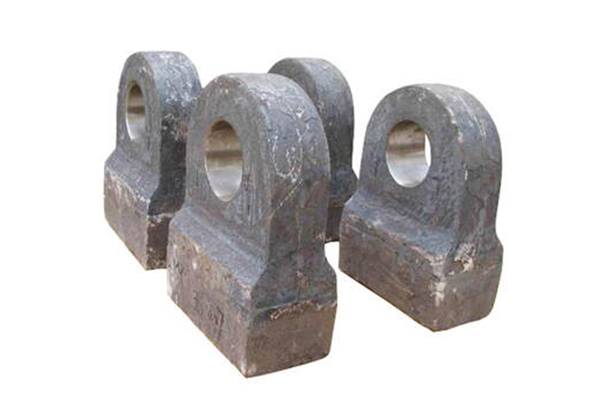
A customised bimetallic hammer head is the best way to improve the uniformity of material size. It has an optimised structural shape and a hard, wear-resistant hitting end. The handle is also tough but flexible. This design keeps the hammer’s shape and weight fixed for longer, gives regular breaking force, and makes output of the same size from all hammer crusher types.
Why Does Output Size Drift in a Hammer Crusher?
Worn Striking Faces Change the Impact Geometry
Most of the time, the hammer head is where uneven product size starts. As the striking face wears down to a round shape, the space between the grate bars and the hammer tip gets bigger, letting big chunks pass through without being fully broken. Then the operators see a mix of small and large pieces. Because of this, the plant has to do more screening, recirculation, or complaints further downstream, which slows it down.
Unbalanced Rotors and Inconsistent Mass
If one hammer head wears out faster than the others, the rotor can’t keep its balance. Since lighter hammers hit with less force and heavier ones with more, the material that goes into the chamber is broken down unevenly. Vibration also goes up, which makes pins loose and puts stress on bearings. A repair shop or a company that makes mining equipment will have a lot of trouble with this part because it doesn’t wear evenly.
Sudden Breakage Interrupts Steady Crushing
There is a trade-off with single-material moulds. A very hard hammer head doesn’t wear down easily, but it can break at the neck when hit hard. A tough one breaks or bends easily. You can’t plan for a broken hammer to stop the machine, and it could damage the grate bars and lining. It also means that until the rotor is fixed, the production batch will have particles of different sizes.
How a Bimetallic Hammer Head Delivers More Uniform Particle Size
Hard Working End, Tough Handle
The customisable bimetallic hammer head from Huan-Tai solves the hardness vs. toughness problem by blending two materials into one part. The hitting end is made of high-chromium cast iron, which is very resistant to wear. The handle is made of alloy steel or cast steel, which is shock-absorbing. This makes a hammer that stays in shape better for longer and doesn’t break at the neck like some single-alloy designs do.
Optimized Structure for Consistent Crushing Force
If you want uniform output, you need uniform energy. Our experts work to improve the shape of the hammer head, the way the mass is distributed, and the location of the pin holes so that each blow hits the barrel with the right amount of force. The tip-to-grate clearance stays the same as wear goes on because the profile is well-balanced. So, the crusher keeps making material of the same size instead of getting bigger between replacements.
Built to Fit Your Equipment
Machines in different plants are not the same. We make each hammer head based on your model, a sample, or a worn-out part. The sizes and weights of the heads are made to fit single-rotor and double-rotor hammer crushers, ring hammer crushers, and hammer mills. We can adjust the grades and hardness of the material to match the feed, so the machine always works at its best, whether it’s limestone, coal, gypsum, or construction waste.
What Makes Huan-Tai a Reliable Hammer Head Partner?
Quality Control From Melt to Shipment
Our production team keeps an eye on every step, from the chemical makeup in the furnace to how well the two metals bond, the heat treatment, and the final hardness test. Before we pack them, we measure and weigh each hammer head to make sure that the whole set fits evenly on the rotor. Bigger companies get the paperwork they need, and smaller repair shops get parts that just work.
Engineering Support That Lowers Total Cost
Cost per tonne is more important than price. Our scientific team looks at how you use the machine and suggests a hammer head design that strikes a good mix between price and service life. When wear gaps are longer, there are fewer changeovers, less work, and steady output. We also sell parts for other mining and engineering equipment, so you can get a lot of different wear parts for your crushing line from the same company.
Predictable Schedules Backed by 30 Years of Experience
Since the mid-1990s, we have shipped customized castings and forgings to overseas buyers who value stability and predictability. Standard hammer head orders move efficiently. New designs may take longer if drawings need several rounds of confirmation or special processes are required. Either way, we agree on a realistic timeline upfront and keep you updated until the parts arrive.
Conclusion
Consistent particle size starts with a hammer head that keeps its shape, mass, and strength over time. Huan-Tai’s customizable bimetallic design pairs a wear-resistant striking end with a tough handle, while an optimized structure delivers steady crushing force. The outcome is fewer breakages, a balanced rotor, and evenly sized material across a wide range of hammer crushers.
FAQs
Q1: What is a bimetallic hammer head?
It is a hammer with a high-chromium cast iron striking end and an alloy steel or cast steel handle. This combination gives you both wear resistance and impact toughness in one part.
Q2: How does it improve material size uniformity?
It holds its profile and weight longer. This keeps grate clearance and rotor balance stable, so every blow crushes material consistently.
Q3: Can you make hammer heads to my drawing?
Yes. We manufacture from drawings, samples, or worn parts for many hammer crusher and hammer mill models.
Q4: How long does production take?
Standard orders are handled efficiently. New custom designs may take longer depending on drawing confirmation and process requirements.
Q5: Do you supply other crusher parts?
Yes. We focus on mining and engineering machinery parts, including castings and forgings for crushing equipment.
Ready to Get More Uniform Output?
Tired of uneven output and broken hammers? Let’s fix that. Send us your drawing, a photo of your worn part, or simply describe your crusher and feed material. Huan-Tai’s technical team will recommend the right bimetallic hammer head, and our production team will manage quality from the first pour to final inspection. With excellent service and 30 years of experience behind every order, we’re ready to help. Email inquiry@huan-tai.org today for a fast, no-obligation quote. What can we answer for you first?
References
- Wills, B. A., & Finch, J. A. (2016). Wills’ Mineral Processing Technology (8th ed.). Butterworth-Heinemann.
- Gupta, A., & Yan, D. S. (2016). Mineral Processing Design and Operations: An Introduction (2nd ed.). Elsevier.
- King, R. P. (2001). Modeling and Simulation of Mineral Processing Systems. Butterworth-Heinemann.
- Hutchings, I. M., & Shipway, P. (2017). Tribology: Friction and Wear of Engineering Materials (2nd ed.). Butterworth-Heinemann.
- Kelly, E. G., & Spottiswood, D. J. (1982). Introduction to Mineral Processing. John Wiley & Sons.
