
A high manganese steel jaw plate lasts longer because when it gets hit, the surface gets harder, but the core stays tough. This means that the plate doesn’t break or wear through fast. This jaw plate is made of high-quality steel that is both strong and rigid. It can handle the reactive force of breaking up harder rocks, doesn’t rust in wet pits, and delivers more tons per set than most wear materials.
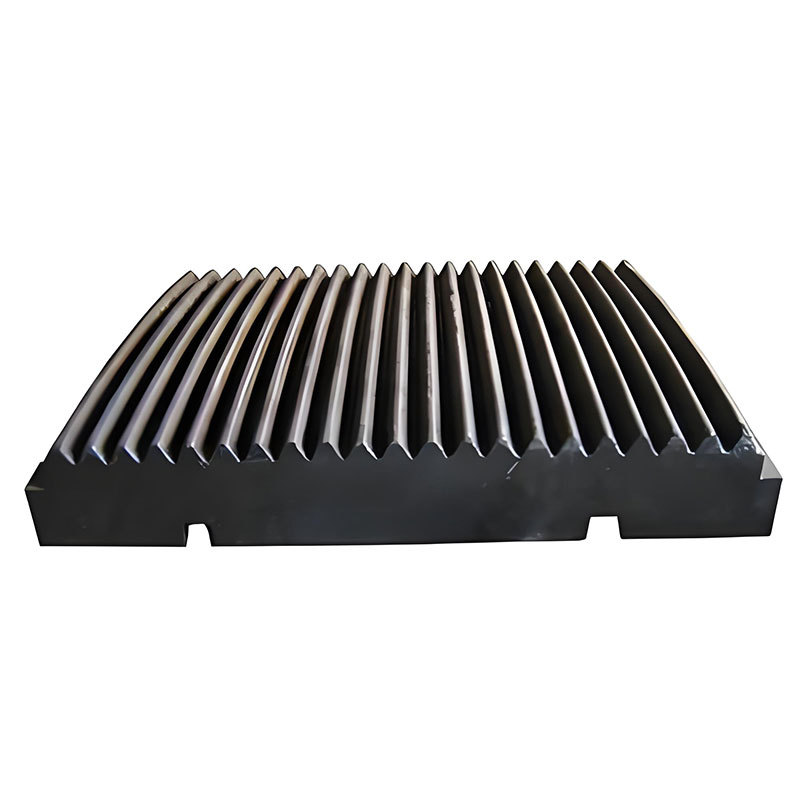
The Metallurgy Behind a Long-Lasting Jaw Plate
Hadfield’s Discovery Still Works Today
It was discovered by Robert Hadfield in 1882 that adding about 12 to 14 percent manganese to steel with about 1.2 percent carbon made a metal that got harder when hit. A lot of the jaw plates used in mining and quarrying today are made with the same chemical mix. That tells you how well this alloy fits the job: not many wear materials from the 1800s are still used today.
Austenite, Water Toughening, and Core Toughness
A manganese steel jaw plate is heated to about 1050°C and then cooled in water after it has been cast. This breaks down the weak carbides and turns the structure into tough, flexible austenite. As a result, the jaw plate bends slightly instead of breaking when a large lump or a stray steel bar goes into the crusher. This is an advantage that hardened martensitic materials can’t provide.
Work Hardening Measured in Numbers
A new jaw plate has a reading of about 200 HB. In a short amount of time, the working face rises to 450 to 550 HB, and under heavy impact, it can go even higher. Quartz and granite can’t gouge or scratch the hardened skin, but the metal below is still soft enough to absorb shock. New skin forms under the old one as it wears away, so the jaw plate is always making new armor.
Operating Conditions Where the Jaw Plate Proves Its Value
Primary Crushing of Hard, Blocky Ore
Big, sharp chunks of iron ore, copper ore, and basalt come into the primary crusher. Most of the bites and hits go to the top of the jaw plate. Here’s where high manganese steel lives up to its name: the high-impact zone is where work hardening is greatest. The type of feed should help you decide what grade to order if the materials you’re running are soft.
Wet and Corrosive Quarry Environments
A lot of aggregate pits are near the water or below it. Between shifts, water, chlorides, and acidic runoff wear down parts. When properly alloyed, a manganese jaw plate is more resistant to rust than plain carbon grades. This means that pitting doesn’t turn into a cracking point. Because it is rigid, the jaw plate keeps its tooth shape and product size stable during the wet season.
Recycling Concrete and Demolition Waste
When contractors break down removal debris, they face a new enemy: rebar and random tramp iron that are buried in the debris. A high manganese jaw plate is tough enough to handle these threats without breaking. The mix of cost and life is what some recyclers use. On the fixed side, they put a high carbon steel jaw plate for lighter work. The manganese grade takes care of the impact side either way.
Practical Steps That Stretch Jaw Plate Service Life Further
Buying the Right Grade for Your Feed
Heavy-duty Mn13 is good for most hard rock work. As ore gets rougher, Mn18 and chromium-containing variants like Mn18Cr2 make it last longer. If you use soft limestone, a plain Mn13 jaw plate might not fully work harden. Instead, a leaner grade or high carbon steel might be a better value. Before you place an order, let your supplier know the feed hardness, top size, and daily tonnage.
Choke Feeding and Proper Gap Setting
A jaw plate gets stronger when it has things to do. When the barrel stays full during choke feeding, the pressure is spread evenly across the face, which helps the metal harden evenly. If you don’t feed the crusher, rocks will bounce around and break the teeth. When you set the closed side gap correctly and check the wear on the toggle plate, which is also made of high manganese steel, the crushing forces stay where they should be on the jaw plate.
Rotation, Inspection, and Replacement Timing
The shapes of most jaw plates are symmetrical. When you turn the plate after the lower teeth are half worn down, new metal moves into the high-wear area. This can add a lot of extra life. At each planned stop, measure the width that is still there a few times and keep a log. If you replace the jaw plate before it wears through, you protect the frame and avoid having to shut down for long periods of time, which costs a lot more than a new casting.
Conclusion
A high manganese steel jaw plate lasts longer than others because it hardens on impact while the austenitic core stays tough and won’t crack. Its high strength and rigidity allow it to withstand the reactive force of breaking up harder rocks, and its high corrosion resistance keeps it safe in wet pits. These built-in benefits are increased by choosing the right grade, choke feeding, and rotating at the right time.
FAQ
What makes a manganese steel jaw plate tougher after being used?
The austenitic surface gets deformed by impact, which raises its hardness from about 200 HB to over 500 HB. The core stays tough, though.
Can soft rock be worked with high manganese steel?
It works, but it might not harden all the way. High carbon steel might be a better choice for limestone because it costs less.
How long does a manganese jaw plate last?
Two to three times a plain carbon jaw plate in hard rock situations, based on the feed and how the machine is used.
Can the jaw plate be turned around?
Asymmetrical patterns can be turned around to make them wear more evenly.
Do you make jaw plates for crushers that are no longer being made?
Yes, from plans, a worn sample, or measurements taken on the site.
Want a Jaw Plate That Outlasts Your Current One?
As a company with 30 years of experience in mining and engineering castings, Xian Huan-Tai Technology and Development Co., Ltd. has been making custom, non-standard mechanical parts since the mid-1990s. Our production team is in charge of quality from the chemistry of the melt through water toughening and final testing. Our expert team, on the other hand, fits your feed to the right manganese grade and tooth shape. Send your crusher model or a picture of a worn plate to inquiry@huan-tai.org today to get a practical quote. The lead time depends on the confirmation of the drawing and the heat treatment.
References
- Subramanyam, D. K., Swansiger, A. E., & Avery, H. S. “Austenitic Manganese Steels,” ASM Handbook, Vol. 1: Properties and Selection, ASM International, 1990.
- Hadfield, R. A. “Hadfield’s Manganese Steel,” Science, Vol. 12, No. 306, 1888.
- Lindqvist, M., & Evertsson, C. M. “Liner Wear in Jaw Crushers,” Minerals Engineering, Vol. 16, No. 1, 2003.
- Wills, B. A., & Finch, J. A. Wills’ Mineral Processing Technology, 8th ed., Butterworth-Heinemann, 2016.
- Zum Gahr, K. H. Microstructure and Wear of Materials, Elsevier, 1987.
