
A well-designed bearing housing keeps the shaft in place, supports operating loads, keeps lubricant in, and keeps dust or moisture from getting to the bearing. This lowers the number of crusher failures. It is very important to choose the right material, machine it accurately, finish it, place it, and check it for errors. This guide tells buyers how to choose, test, and keep up customised housings for reliable mining and building equipment.
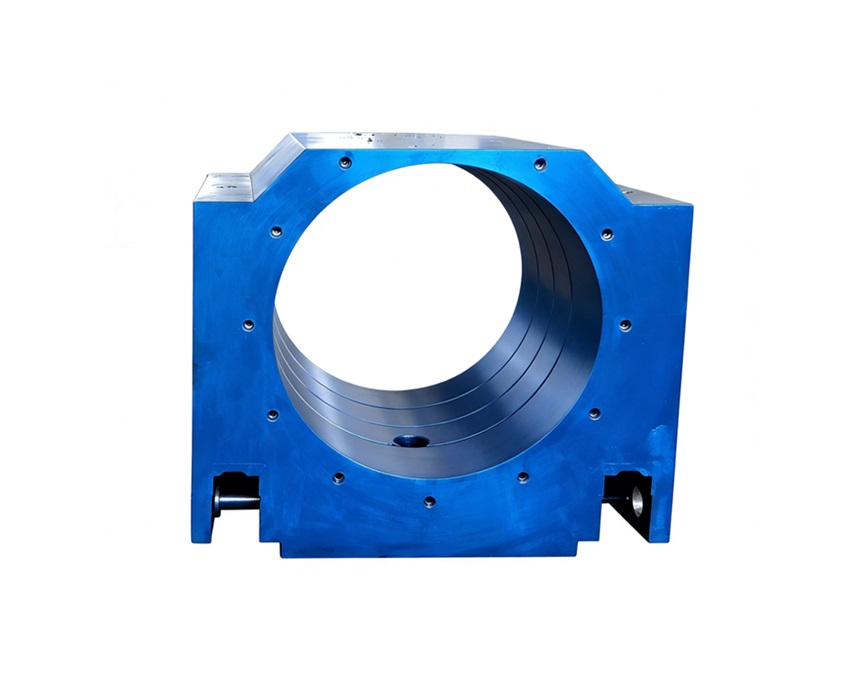
How Does a Bearing Housing Prevent Crusher Failures?
Maintaining Alignment Under Crushing Loads
Crushers produce vibrations all the time, rotational loads, and sometimes contact loads. A stiff bearing housing keeps the bearing and cast main shaft in the right place, which stops uneven loads, too much space, and wear in one area. Instead of copying from a part that looks similar, the housing dimensions, bearing seats, wall thickness, mounting surfaces, and fastener locations should be designed based on how the part will actually be used.
Controlling Dust and Other Contaminants
Stone dust can get into small gaps in seals, mix with lubricant, and speed up the wear on bearings. So, for a bearing housing to work well, it needs to have properly machined seal seats, the right labyrinth arrangements, and dust-control parts that work with each other. High-manganese steel or high-chromium alloy steel are often used to make crusher dust rings when they need to be resistant to impact and sharp wear in mining and material processing settings.
Supporting Reliable Lubrication
A crusher bearing housing needs to keep oil moving without causing areas where it doesn’t flow, ways for it to leak, or too much pressure. The way the lubrication is done and the speed at which it is done should match the grease passages, oil intakes, drain points, and inspection access. During commissioning, technicians should check the type of lubricant, the amount that should be used, how often it should be reapplied, how the temperature affects the lubricant, and whether the seals will still work after continuous use.
How Should Buyers Specify a Customized Bearing Housing?
Providing Complete Operating Information
A good question should include drawings, measurements, bearing numbers, details about the shaft, how it is mounted, the model of the crusher, its speed, the direction of the load, the lubricant, and the temperature at which it works. If there isn’t a full plan, a worn sample can help with reverse engineering. Before making each bearing housing, Xian Huan-Tai looks over these details. This helps cut down on repeated changes, installation problems, and unexpected dimensional conflicts.
Selecting Materials for the Application
You should choose a material based on its load, vibration, machinability, repair needs, and the structure around it. A bearing housing could be made of cast steel, malleable iron, or another engineering-grade material that has been passed by expert review, depending on the design. Buyers shouldn’t just choose material based on price; it’s more important for long-term crusher efficiency that the material is strong enough, stable enough, and has bearing seats that can be machined.
Coordinating the Complete Crusher Assembly
The bearing housing and any close mechanical parts should be looked at together. Steels like carbon steel, high-strength steel wire, and spring steel can be used to make crusher springs. High-manganese steel is usually used to make hinge plates. Forged, not cast, main rods, and alloy steel is often used for rack bars. By checking these interfaces before putting the parts together, you can avoid problems with fit, load transfer, and maintenance.
How Can Inspection and Maintenance Extend Bearing Housing Life?
Verifying Production Quality Before Shipment
Controlled production is the first step toward reliable performance. Each custom bearing housing should be checked for visible flaws, material matching, casting or forging state, machining dimensions, bearing seat geometry, mounting flatness, and flaws that can be seen. It is possible to agree on inspection records before they are made. Schedules for deliveries rely on the approval of the plan, the difficulty of the process, the supply of materials, and the need for inspections, especially for new parts that aren’t standard.
Monitoring Practical Warning Signs
After installing a bearing housing, operators should set the normal temperature, vibration, lubricant condition, and sound of operation. A slow rise in temperature, repeated seal leakage, strange vibrations, loose mounting bolts, or metal particles in the lubricant could all be signs that problems are starting to happen. When maintenance teams check early, they can fix problems with alignment, greasing, fixing, or closing before the damage spreads to the bearing and cast shaft.
Working With an Integrated Parts Supplier
Coordinating dimensions can be made easier by buying related parts from an experienced engineering source. Along with custom bearing housings, Huan-Tai also supports mining and industrial machinery parts, such as optimised crusher parts that help produce particles with a stronger breaking force. Bimetallic composite hammerheads can have a strong handle and a hard, wear-resistant head. They can also be used with different types of hammer crushers.
Blow bars are part of impact crushers and are usually made of high-manganese steel, alloy steel, or high-chromium cast iron. They should be handled separately. Hammer crushers have hammerheads that they use. By knowing this difference, the bearing housing and other replacement parts can be checked against the right machine structure instead of being chosen for a crusher type that doesn’t work with it.
Conclusion
A reliable bearing housing keeps the breaker available by making sure it is properly aligned, sealed, lubricated, made of the right materials, and regularly inspected. Buyers can lower operating uncertainty by giving full technical details and picking a maker with experience making custom mechanical parts. Sound planning, controlled production, proper fitting, and condition-based upkeep work together to get the best results.
FAQ
Q1: Can a bearing housing be produced from an existing sample?
Yes. A worn sample can support measurement and reverse engineering, although critical dimensions, bearing data, and operating conditions should also be confirmed.
Q2: Which information is required for quotation?
Provide drawings, quantities, materials, tolerances, bearing and shaft details, crusher model, lubrication method, and operating environment.
Q3: How is bearing housing quality inspected?
Typical checks cover material, bearing-seat dimensions, concentricity, mounting surfaces, seal positions, machining quality, and visible defects.
Q4: Is a customized housing suitable for different crushers?
Yes, but every design must be reviewed against its specific loads, shaft arrangement, bearing selection, interfaces, and installation space.
Q5: How long does production take?
Lead time varies with drawing approval, material sourcing, manufacturing complexity, quantity, and inspection scope. It is confirmed after technical review.
Ready to reduce crusher downtime with a better-matched bearing housing?
Xian Huan-Tai Technology and Development Co., Ltd. has 30 years of experience producing customized, non-standard mechanical parts for mining and engineering machinery. Our technical team supports performance and quality requirements, while our production specialists manage quality throughout the manufacturing process. Send us your drawing, damaged sample information, operating conditions, and required quantity for a practical manufacturing review. Contact inquiry@huan-tai.org to discuss your project.
References
- Harris, Tedric A., and Michael N. Kotzalas. Rolling Bearing Analysis: Essential Concepts of Bearing Technology. CRC Press, 2006.
- Wills, Barry A., and James A. Finch. Wills’ Mineral Processing Technology. 8th edition, Butterworth-Heinemann, 2016.
- Napier-Munn, Tim J., et al. Mineral Comminution Circuits: Their Operation and Optimisation. Julius Kruttschnitt Mineral Research Centre, 1996.
- Bloch, Heinz P., and Fred K. Geitner. Machinery Failure Analysis and Troubleshooting. Gulf Professional Publishing, 2012.
- SKF Group. Rolling Bearings Catalogue. SKF Group, 2018.
