
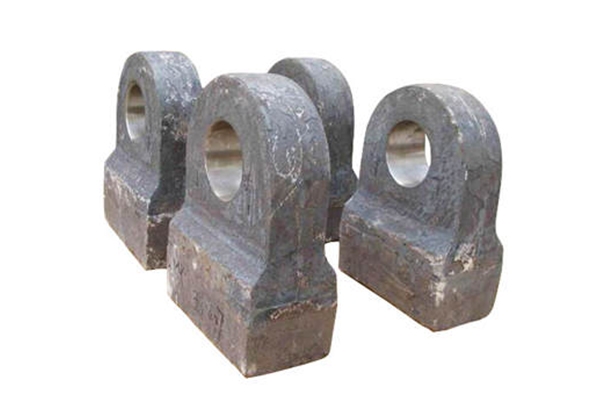
A heavy-duty crusher part called a bimetallic composite hammer head is made of two different material zones: a hard, wear-resistant striking head and a strong, tough handle. This structure makes it easier to crush, protects against rough wear, and lowers the chance of breaking. It is often found in hammer crushers that are used in mining, quarries, cement plants, recycling, and the preparation of industrial materials.
What Makes a Bimetallic Composite Hammer Head Different?
A Hard Working End and a Tough Supporting Handle
One of the most important things about a bimetallic composite Hammer Head is that it is made of two different types of metals. Because it hits rock, ore, coal, or recycled material so often, the striking end is made to be very resistant to wear. The handle and attachment area are made to be tough and strong, so the hammer head stays safely attached to the rotor even when hit many times.
Designed to Resist Wear and Fracture
A conventional single-material Hammer Head may face a difficult balance between hardness and toughness. A very hard material can resist abrasion, while a tougher material can better tolerate impact and vibration. A bimetallic composite design aims to provide both qualities in the areas where they are needed most. This practical structure helps solve the common challenge of excessive wear at the hammer face and potential breakage around the mounting section.
Suitable for Hammer Crusher Applications
A Hammer Head is used specifically in a hammer crusher, where it is mounted on a rotor and strikes incoming material to achieve size reduction. It should not be confused with a blow bar, which is installed in an impact crusher. Hammer crushers are used in many industrial and mining operations to process materials such as limestone, coal, gypsum, brick, slag, and certain ores. The correct hammer design depends on the machine and feed conditions.
How Does a Bimetallic Composite Hammer Head Improve Crushing Performance?
Stronger Crushing Force at the Contact Surface
The hard working end of a bimetallic composite Hammer Head helps transfer impact energy effectively to the feed material. When the striking surface maintains its intended profile, the hammer crusher can break material more efficiently and consistently. This is important for operations that require controlled particle size before screening, conveying, grinding, or further crushing. Good hammer geometry also supports more stable processing of irregular or hard feed material.
More Uniform Material Size After Crushing
An optimized Hammer Head structure can contribute to more uniform material output by maintaining effective impact action over its service cycle. As hammer surfaces wear, crushing efficiency and particle-size consistency can change. A wear-resistant composite head can help preserve the required working profile for a longer period in suitable conditions. This supports downstream operations that depend on stable feed size, including screens, conveyors, mills, and sorting equipment.
Better Stability Under High-Load Conditions
Hammer crushers operate with repeated impacts, vibration, and changing material loads. A well-manufactured Hammer Head must withstand these conditions without loose fitment or premature structural damage. The tough handle section in a bimetallic design supports secure connection to the rotor, while the wear-resistant striking section handles abrasive contact. This combination is valuable in mining and engineering machinery where continuous operation and reliable maintenance planning are important.
What Should Buyers Consider Before Ordering a Hammer Head?
Match the Hammer Head to the Feed Material
Material selection for a Hammer Head should be based on the hardness, abrasiveness, moisture content, feed size, and expected throughput of the processed material. Hard and abrasive rock may require greater wear resistance, while high-impact material may require stronger toughness around the mounting area. Buyers should provide operating details whenever possible. A suitable material and structure can offer better long-term value than selecting a component only by its initial purchase price.
Confirm Rotor, Mounting, and Dimension Details
A replacement Hammer Head must match the hammer crusher rotor, pin arrangement, mounting hole, weight, swing radius, and working direction. Buyers should provide drawings, samples, part numbers, photographs, or measured dimensions for technical confirmation. Accurate fitment helps maintain rotor balance and reduces unnecessary installation work. For older equipment, a worn sample can be especially useful when original documentation is incomplete or the crusher has been modified.
Plan Orders Before Wear Becomes Critical
A Hammer Head should be ordered before the existing component reaches a critical wear condition. Production time depends on drawing confirmation, material selection, casting or composite manufacturing requirements, machining work, quantity, and inspection standards. Repeat orders with confirmed specifications may progress more smoothly. However, customized hammer heads can require a longer schedule if drawings are revised repeatedly or special processes are needed. Early planning supports more controlled maintenance shutdowns.
How Does Huan-Tai Control Hammer Head Quality?
Technical Review Starts with Real Operating Conditions
Xian Huan-Tai Technology and Development Co., Ltd. reviews the crusher model, feed material, output requirement, mounting arrangement, and requested service conditions before producing a custom Hammer Head. This engineering-focused approach helps customers select a practical design for their machinery. Our products serve mining, engineering, industrial, and heavy equipment applications rather than precision electronic equipment, so our manufacturing decisions are based on real mechanical working conditions.
Production Control Covers the Entire Process
A reliable Hammer Head requires more than a suitable material. Production control includes pattern preparation, casting or composite processing, heat treatment where required, machining, dimensional inspection, and final packing. Huan-Tai’s professional production team manages quality throughout each stage. Our inspection team checks critical dimensions and mounting features against confirmed drawings or samples, helping customers receive parts that are suitable for installation and stable operation.
Custom Manufacturing Supports Diverse Equipment Needs
Huan-Tai has more than 30 years of experience producing customized non-standard mechanical parts. We can manufacture a Hammer Head according to a customer’s model, drawing, sample, or technical requirement. This is useful for machinery manufacturers needing repeat supply and repair companies replacing damaged parts. Our technical team works with buyers to confirm details before production, helping reduce fitting risks and support more predictable delivery communication.
Conclusion
A bimetallic composite Hammer Head combines a wear-resistant striking surface with a strong supporting handle, making it a practical solution for hammer crusher applications. Its performance depends on correct material selection, optimized structure, accurate fitment, and regular inspection. Customized production helps mining and engineering operators improve crushing consistency, maintenance control, and replacement-part reliability.
FAQ
Q1: What is a bimetallic composite Hammer Head?
It is a Hammer Head with a hard, wear-resistant working end and a tougher handle or mounting section.
Q2: Where is a Hammer Head used?
A hammer head is used in hammer crushers for mining, quarrying, cement, and material-processing applications.
Q3: Is a Hammer Head the same as a blow bar?
No. A hammer head is used in a hammer crusher, while blow bars are used in impact crushers.
Q4: Can Huan-Tai make custom hammer heads?
Yes. We can manufacture from drawings, samples, part numbers, photos, and confirmed dimensions.
Q5: What affects Hammer Head service life?
Feed hardness, abrasiveness, rotor speed, material selection, installation quality, and maintenance practices all affect service life.
Build a Better Hammer Crusher Maintenance Plan with Huan-Tai
Need a customized Hammer Head for a hammer crusher rebuild, mining maintenance program, or machinery production project? Xian Huan-Tai Technology and Development Co., Ltd. provides excellent service, technical support, controlled production, and professional inspection for custom mechanical parts. With 30 years of industry experience, we help customers turn drawings, samples, and operating requirements into dependable crusher components. Contact our team at inquiry@huan-tai.org for a practical quotation and responsive project discussion.
References
- Wills, Barry A., and James Finch. Wills’ Mineral Processing Technology: An Introduction to the Practical Aspects of Ore Treatment and Mineral Recovery. Butterworth-Heinemann, 2016.
- Gupta, Ashok, and Denis S. Yan. Mineral Processing Design and Operation: An Introduction. Elsevier, 2016.
- Mular, Andrew L., Doug N. Halbe, and Derek J. Barratt. Mineral Processing Plant Design, Practice, and Control. Society for Mining, Metallurgy, and Exploration, 2002.
- Davis, Joseph R., editor. ASM Specialty Handbook: Cast Irons. ASM International, 1996.
- Campbell, John. Complete Casting Handbook: Metal Casting Processes, Metallurgy, Techniques and Design. Butterworth-Heinemann, 2015.
