
A grid plate is a wear part with holes or bars that is put in the feed area or output zone of a crusher or screening system to control the biggest pieces of material that get to the next step in the process. The grid plate literally limits what can go into and out of the crushing room. This protects equipment further down the line, keeps the product consistent, and lowers the chance that too much material will damage or clog up equipment further along the processing circuit.
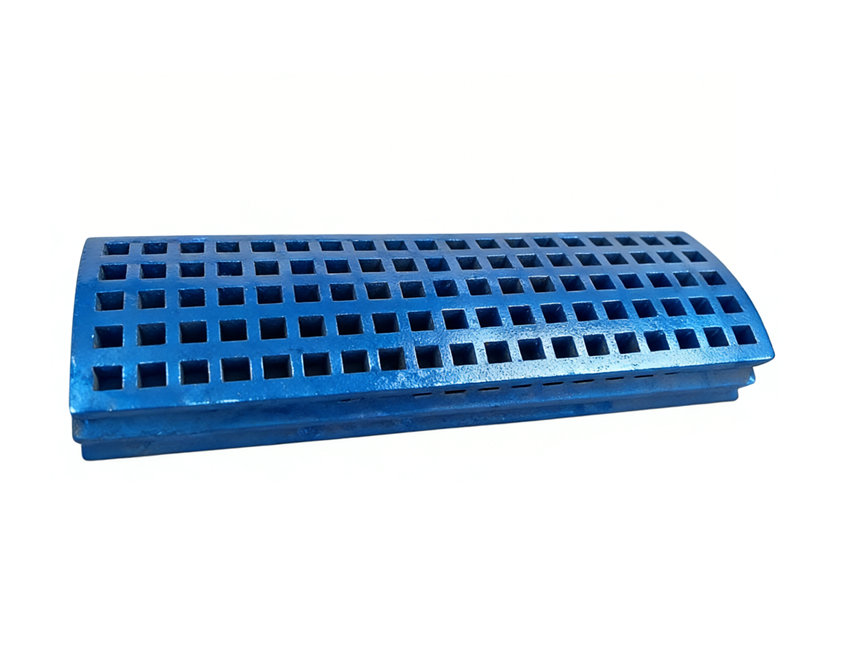
What a Grid Plate Does in a Crusher System
Controlling Maximum Feed Size at the Inlet
At the feed inlet, a grid plate acts as a pre-screen that prevents oversized lumps from entering the crushing chamber before they can be properly handled. Material that exceeds the grid opening dimensions is rejected and must be broken down separately before it can proceed. This protects the crushing chamber, the frame liner, and internal wear components from the disproportionate impact loads that oversized feed creates. The grid plate is the first line of mechanical size control in the entire crushing circuit.
Regulating Discharge Size at the Outlet
In some crusher configurations, a grid plate is positioned at the discharge zone to ensure that only material meeting the maximum size specification exits the crusher. Material that hasn’t reached the required size is retained in the crushing zone for further reduction. This function directly influences product gradation — and by extension, downstream process efficiency. A worn or incorrectly specified grid plate compromises this control, allowing oversized material to pass and increasing the load on subsequent screening and processing equipment alongside the frame liner.
Protecting Internal Components from Impact Overload
By limiting feed and discharge size, a grid plate reduces the peak impact events that the crusher’s internal components — including the frame liner, rotor, and wear plates — are exposed to. Large, irregular lumps entering an unprepared crushing chamber generate sudden, concentrated impact loads that accelerate wear and can cause fracture in components not designed for that kind of shock loading. The grid plate absorbs and redirects some of that energy at the point of entry, acting as a buffer that extends the service life of the more expensive components behind it.
Material and Manufacturing: What Makes a Grid Plate Last
Alloy Additions for Wear Resistance and Anti-Sticking Performance
Grid plates manufactured with alloy additions — including manganese — benefit from improved resistance to abrasive wear at the bar and aperture surfaces. These additions also improve the component’s resistance to material sticking and packing in the grid openings, which is a practical problem in applications where fine, moist, or clay-bearing feed is present. A grid plate that resists sticking maintains its effective aperture size and keeps material flowing freely, protecting both throughput and the frame liner downstream.
Heat Treatment for Extended Service Life
Key components like the grid plate benefit significantly from special heat treatment processes applied after casting. Heat treatment improves surface hardness and the depth of the wear-resistant layer, extending the interval between replacements. In high-throughput mining and quarrying applications, a grid plate that holds its aperture geometry longer under abrasive conditions is directly worth more than one that softens and deforms quickly, regardless of initial price. Proper heat treatment is what makes this difference reliably.
Casting Precision and Custom Fit
Grid plate aperture dimensions, bar thickness, and overall frame dimensions must match the specific crusher model to function correctly. Precision casting methods — combined with customization to the machine model and drawing — ensure the grid plate fits correctly in its mounting position and that aperture sizes match the design specification. A poorly dimensioned grid plate that allows gaps at the mounting edges defeats its own purpose. For non-standard or legacy equipment, custom fabrication from the original drawing or a sample part is the reliable path to a correctly fitting replacement.
Sourcing the Right Grid Plate for Your Application
Matching Aperture Size to Process Requirements
The aperture size of a grid plate determines the maximum particle size that the system passes, so specification must match the crusher’s design output and the feed requirements of the next process stage. Getting this wrong — even slightly — affects product quality throughout the circuit. Before sourcing a replacement, confirm the aperture dimensions, bar spacing, and any specific geometry requirements from the equipment documentation or by measuring the worn part.
Working with a Capable Custom Manufacturer
For non-standard crusher models or where the original grid plate design has been modified, a custom manufacturer with experience in crusher wear components is the most reliable source. Provide accurate drawings or measurements, confirm the specification before production begins, and allow realistic lead time — custom grid plates with non-standard aperture patterns or alloy grades take longer than standard catalogue items, and drawing confirmation steps add time when the geometry is complex. Planning procurement around your maintenance schedule rather than against it makes the whole process smoother.
Verifying Quality Before Installation
On receipt, verify key dimensions — aperture size, overall frame dimensions, bar thickness — against the drawing or the original part. Check that the casting is free of defects at the bar intersections and mounting surfaces, as these are the highest-stress zones during operation. Confirming that the heat treatment process was applied is also worthwhile for components going into high-wear service. A frame liner that has been protected by a correctly specified, quality grid plate will show noticeably less wear at the next inspection.
Conclusion
A grid plate controls feed and discharge size, protects internal components including the frame liner, and directly influences product quality throughout the crushing circuit. Material grade, aperture precision, heat treatment, and correct fit to the machine are all factors that determine whether a grid plate performs reliably over a full service interval — making supplier quality and specification accuracy two decisions worth getting right.
FAQ
Q1: What is the main function of a grid plate in a crusher?
A grid plate controls the maximum size of material entering or exiting the crushing chamber, protecting internal components and maintaining product gradation consistency.
Q2: What material is a grid plate typically made from?
Grid plates are commonly cast with alloy additions including manganese, which improves wear resistance and resistance to material sticking in the apertures.
Q3: How does aperture size affect crusher performance?
Aperture size determines the maximum particle size the system passes. Incorrect aperture sizing leads to oversized product, reduced throughput, or increased load on downstream equipment.
Q4: Can grid plates be custom-made for non-standard crusher models?
Yes. Custom fabrication from drawings or sample measurements is standard practice for non-standard or legacy equipment where catalogue replacements are unavailable.
Q5: How do I know when a grid plate needs replacing?
Visible enlargement of apertures, bar deformation, material bypassing the grid, or a measured change in product gradation are the clearest indicators that replacement is due.
Partner with Huan-Tai for Custom Grid Plates
Keeping your crusher performing to specification starts with wear components you can rely on. At Xian Huan-Tai Technology and Development Co., Ltd., we’ve spent over 30 years manufacturing customized non-standard mechanical parts for mining and engineering equipment. Our technical team works to your drawings and model specifications, and our production team controls quality from casting through heat treatment and final inspection. Ready to source a grid plate that fits and performs? Send your inquiry to inquiry@huan-tai.org — let’s make it happen.
References
- Wills, B. A., & Finch, J. A. (2015). Wills’ Mineral Processing Technology: An Introduction to the Practical Aspects of Ore Treatment and Mineral Recovery (8th ed.). Butterworth-Heinemann, Oxford.
- Metso Corporation (2011). Crushing and Screening Handbook (5th ed.). Metso Minerals, Helsinki. [Authored by Metso technical staff.]
- Zum Gahr, K. H. (1987). Microstructure and Wear of Materials. Elsevier Science Publishers, Amsterdam.
- Mular, A. L., Halbe, D. N., & Barratt, D. J. (Eds.) (2002). Mineral Processing Plant Design, Practice, and Control (Vol. 1). Society for Mining, Metallurgy and Exploration, Littleton, CO.
- Ashby, M. F., & Jones, D. R. H. (2012). Engineering Materials 2: An Introduction to Microstructures and Processing (4th ed.). Butterworth-Heinemann, Oxford.
