
Blow bars are the striking elements mounted on the rotor of an impact crusher. As the rotor spins at high speed, each blow bar collides with incoming feed material, fracturing it by impact rather than compression. They are among the highest-wear impact crusher parts in any operation — directly contacting rock on every revolution — and their material grade, casting quality, and dimensional accuracy all determine how long the rotor runs productively before a bar change is needed.
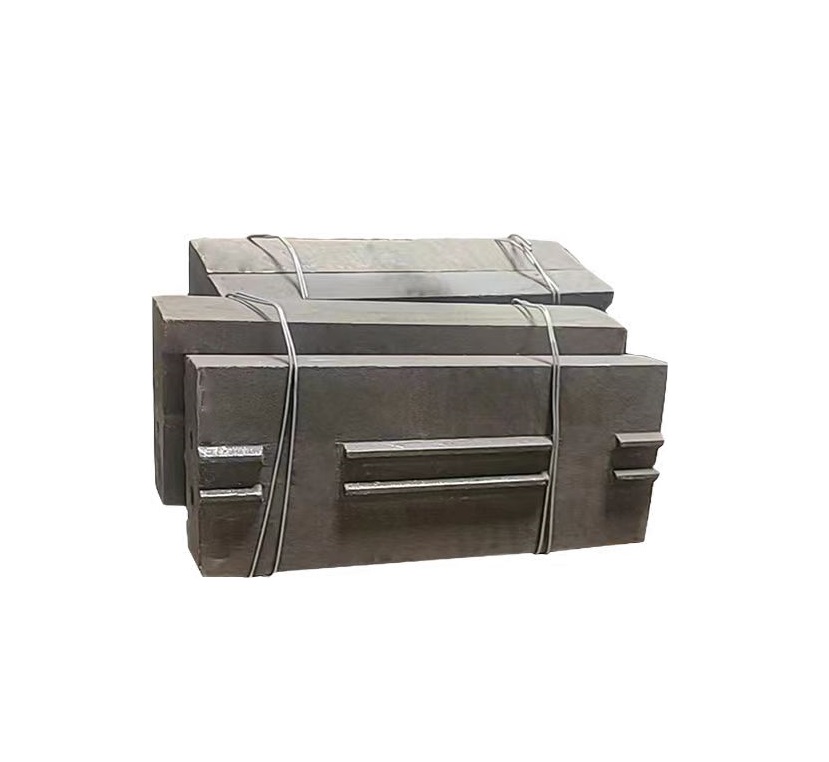
The Role of Blow Bars in an Impact Crusher
How Blow Bars Break Material
An impact crusher uses the rotor’s moving energy to do the work instead of the rock being squeezed between the sides like a jaw or cone crusher. Attached to the rotor face are blow bars that move quickly into the feed material and break it up when they come into contact. As the main part of an impact crusher, each blow bar has to take huge shock loads thousands of times an hour while still being strong enough to keep breaking material smoothly without moving or breaking.
How Blow Bars Interact With the Crusher Chamber
After the first contact, the broken pieces move outward and hit the apron covers or curtain plates that line the crusher room. The blow bar causes the main split, and the chamber design determines the end product size. Blow bars and chamber walls function as a unit. In order for impact crusher parts to work together, the blow bar shape and rotor speed need to be right for the liner gap sets and the type of material being fed.
Why Blow Bar Wear Rate Matters to Production Planning
Because the blow bars are the parts that touch the rock the most, they wear out faster than most other pieces of an impact crusher. A rock’s strength, feed size, and spinning speed can all change the rate of wear. Production planners need to know the expected rate of wear so that bar changes can be planned during planned repair windows instead of having to deal with sudden failures that stop production at the worst possible time.
Materials Used to Manufacture Blow Bars
High Manganese Steel for High-Impact Applications
High manganese steel is one of the most widely used materials for blow bars in impact crusher parts applications where the dominant wear mechanism is impact rather than abrasion. It work-hardens at the surface under repeated striking, progressively increasing hardness while the core stays tough. This combination allows blow bars made from high manganese steel to absorb the shock of hard feed material without fracturing — a critical performance requirement in primary crushing service.
Alloy Steel and High-Chromium Cast Iron for Abrasive Feeds
Where the feed material is fine, sharp, and highly abrasive — such as certain silica-rich ores or recycled concrete — high-chromium cast iron or alloy steel grades deliver better service life than high manganese steel, because their initial surface hardness resists scratching and gouging more effectively. Huan-Tai selects the appropriate material grade for each blow bar order based on the customer’s feed characteristics, ensuring the impact crusher parts supplied are matched to the actual wear conditions rather than a generic default.
Casting Methods That Ensure Dimensional Accuracy
Blow bars are produced through casting processes including lost-wax (investment casting), resin sand casting, and V-method casting, each offering different levels of dimensional precision and surface quality. For impact crusher parts that must fit a rotor to tight tolerances, dimensional accuracy in the casting directly affects how securely the bar seats and how evenly load is distributed across the mounting interface. Huan-Tai applies the appropriate casting method based on the complexity of the blow bar geometry and the tolerance requirements of the target rotor.
Sourcing, Maintenance, and Custom Blow Bar Supply
Matching Blow Bars to Your Specific Rotor
Not all blow bars are interchangeable. Rotor dimensions, mounting slot geometry, and bar cross-section vary between crusher brands and models. Ordering impact crusher parts without confirmed dimensional compatibility risks installation problems at best and rotor imbalance at worst. Huan-Tai manufactures blow bars to customer drawings or from sample parts, confirming critical dimensions — length, width, height, and mounting profile — before production begins to ensure the finished bar fits without modification.
The Main Shaft and Rotor Assembly Context
It is worth noting that while blow bars are cast components, the main shaft of the impact crusher rotor is a forged part, produced through forging rather than casting to achieve the fatigue resistance required under high-speed cyclic loading. Understanding which components are cast and which are forged is important when sourcing impact crusher parts — the two manufacturing processes serve different structural purposes, and substituting one for the other is not appropriate regardless of cost considerations.
Lead Times and Planning for Custom Orders
Standard blow bar profiles for common impact crusher models can typically be produced and shipped within a reasonable schedule once specifications are confirmed. For custom or non-standard impact crusher parts — particularly where drawing confirmation or alloy selection requires multiple review rounds — lead times extend accordingly. Huan-Tai recommends customers identify blow bar requirements well ahead of scheduled maintenance shutdowns to avoid the production losses that come from waiting on parts with a machine already offline.
Conclusion
Blow bars are the primary wear element in any impact crusher, and their material, casting quality, and dimensional accuracy directly determine how the whole machine performs. Choosing the right material grade for the feed conditions, sourcing from a manufacturer with genuine process control, and planning replacements ahead of need are the three things that most consistently improve impact crusher uptime and reduce total wear-part cost.
FAQ
Q1: What is the difference between blow bars and hammers in crushers?
Blow bars are impact crusher parts mounted on the rotor of an impact crusher. Hammers are the striking elements in a hammer crusher — a different machine type. Each is specific to its own crusher design and should not be confused or interchanged.
Q2: How often do blow bars need replacing?
Replacement frequency depends on feed material hardness, throughput volume, and rotor speed. Regular thickness measurement at planned intervals is the most reliable way to schedule replacements before bars wear to the point of causing rotor damage.
Q3: Can blow bars be reversed to extend service life?
Yes. Many rotor designs allow blow bars to be flipped end-for-end when one face is worn, using the unworn face before the bar is fully replaced. This can effectively double the service interval.
Q4: What causes blow bar cracking or breakage?
Tramp metal in the feed — steel bolts, wire, or equipment fragments — is the most common cause of sudden blow bar fracture. Correct alloy selection also matters; a grade optimized for abrasion may be too brittle for high-impact feeds.
Q5: Can Huan-Tai manufacture blow bars for older or less common crusher models?
Yes. Huan-Tai produces custom impact crusher parts to customer drawings or samples, covering a wide range of crusher brands including older and non-OEM equipment.
Source Blow Bars Built for Real Crushing Conditions
At Xian Huan-Tai Technology and Development Co., Ltd., we’ve spent over 30 years supplying Blow bars and impact crusher parts to mining and engineering customers who need parts that perform — not just fit. Our technical team selects the right material for your feed conditions, our production team controls quality from casting through final inspection, and our 30 years of experience means we’ve solved most supply challenges before. Ready to get started? Contact us at inquiry@huan-tai.org.
References
- Wills, B. A., & Finch, J. A. (2015). Wills’ Mineral Processing Technology: An Introduction to the Practical Aspects of Ore Treatment and Mineral Recovery (8th ed.). Butterworth-Heinemann / Elsevier.
- Gupta, A., & Yan, D. S. (2006). Mineral Processing Design and Operations: An Introduction. Elsevier Science.
- Nikolov, S. (2004). Modelling and simulation of particle breakage in impact crushers. International Journal of Mineral Processing, 74(S1), S219–S225.
- Bearman, R. A., & Briggs, C. A. (1998). The active use of crushers to control product requirements. Minerals Engineering, 11(9), 849–859.
- Cleary, P. W., & Morrison, R. D. (2011). Understanding fine ore breakage in a laboratory jaw crusher using DEM simulation. Minerals Engineering, 24(3–4), 352–366.
