
A hammerhead is the striking element mounted on the rotor of a hammer crusher, designed to break rock and bulk material through high-speed impact rather than compression. Each Crusher Hammer Head hits the feed material directly, making it the fastest-wearing component in the machine — and the one whose material and geometry most directly influence crushing efficiency and operating cost. Choosing the right type for your application is one of the most practical decisions a maintenance or purchasing manager can make to improve throughput and reduce wear-part spend.
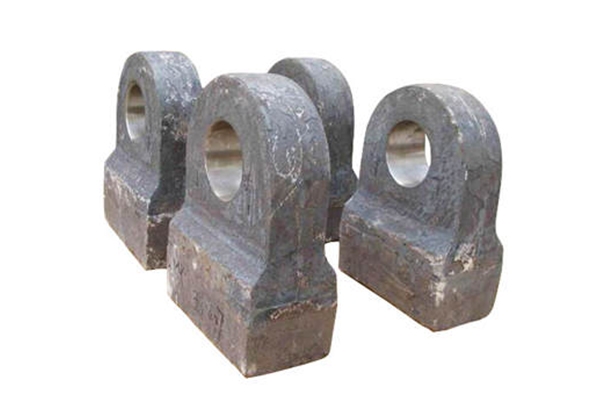
Hammerhead Types Classified by Material
High Manganese Steel Hammerheads
High manganese steel is the most established material for Crusher Hammer Head production in general-purpose hammer crushing applications. Its defining characteristic is work-hardening: the striking surface becomes progressively harder under repeated impact while the core retains toughness. This makes the Hammerhead increasingly resistant to surface wear as it accumulates service hours, without becoming brittle through the section. For operators processing medium-hardness feed in quarrying or aggregate production, high manganese steel delivers reliable, predictable service life.
Alloy Steel Hammerheads for Balanced Performance
Alloy steel Crusher Hammer Head variants — incorporating chromium, molybdenum, or nickel in controlled proportions — offer a calibrated balance of initial hardness, toughness, and fatigue resistance. Unlike high manganese steel, which depends on in-service work-hardening to reach peak surface hardness, alloy steel achieves its mechanical properties through the heat treatment applied after casting. This makes alloy steel hammerheads well suited to applications where impact loads are high and consistent, and where the operator needs predictable wear behavior from the first hour of service.
High-Chromium Cast Iron for Abrasion-Dominated Wear
Where fine, sharp feed material causes surface scratching and gouging rather than impact-dominated wear, high-chromium cast iron delivers the best Crusher Hammer Head service life. Its very high initial surface hardness resists abrasive wear modes that high manganese steel handles less efficiently. Huan-Tai produces Hammerheads in high-chromium cast iron for applications where feed material is highly abrasive — such as certain silica-rich ores or recycled construction material — and where maximizing abrasion resistance takes priority over impact toughness.
Hammerhead Types Classified by Geometry and Application
Standard Single-Face Hammerheads
The most common crusher hammer head geometry is the single-face design, where one striking surface contacts the feed material on each rotor pass. When the active face wears, the Hammerhead can typically be reversed on its pin to present the unworn face, effectively doubling the usable life before replacement. This simple, proven design suits most primary and secondary hammer crushing applications in mining and quarrying, where feed size and material hardness fall within the machine’s rated operating range.
Bimetallic Composite Hammerheads
Bimetallic composite construction addresses a common failure mode in Crusher Hammer Head service: the striking face wears well, but the handle or pin bore section breaks under shock loading. In a bimetallic Hammerhead, the striking face is cast from a hard, wear-resistant alloy while the handle zone uses a tough, ductile material that absorbs impact without fracturing. Huan-Tai produces customizable bimetallic composite Hammerheads that combine a hard, wear-resistant head with a strong handle — directly solving the breakage problem that standard single-material designs encounter in high-load applications.
Heavy-Duty Hammerheads for High-Load Environments
For larger hammer crushers processing hard rock in primary crushing duty, the Crusher Hammer Head must withstand extreme impact energy on every rotor pass without fracturing through the section. Heavy-duty Hammerhead designs use increased cross-sectional mass and optimized geometry to distribute impact stress away from the pin bore — the most common crack initiation point. Huan-Tai’s casting processes — including lost-wax, resin sand, and V-method — ensure the dimensional accuracy and internal soundness that these high-load Hammerhead applications demand.
Casting Process, Quality Control, and Procurement
Matching Casting Method to Hammerhead Complexity
Not every Crusher Hammer Head geometry suits every casting method. Lost-wax (investment) casting produces the tightest dimensional tolerances and cleanest surfaces for complex profiles, while resin sand casting handles larger, simpler geometries cost-effectively. V-method casting offers excellent surface finish and dimensional consistency for medium-complexity shapes. Huan-Tai selects the appropriate casting method based on the Hammerhead geometry, alloy, and tolerance requirements of each order, ensuring the production process is matched to what the finished part actually needs.
The Main Shaft Is Forged — The Hammerhead Is Cast
It is worth clarifying for buyers sourcing multiple hammer crusher components at once: while the Hammerhead is a cast component, the main shaft of the hammer crusher is produced through forging, not casting. Forging gives the shaft the fatigue resistance it needs under continuous rotational and bending loads. Huan-Tai manufactures both types, and understanding which process applies to which crusher part is important for specification accuracy and supplier qualification.
Lead Times and Planning for Replacement Stock
Standard Hammerhead profiles for common hammer crusher models can typically be produced within a reasonable timeframe once specifications are confirmed. For bimetallic composite or heavily customized Crusher Hammer Head designs, the process involves alloy selection, pattern preparation, trial casting, and dimensional verification — all of which extend the lead time, particularly if drawings require multiple rounds of confirmation. Huan-Tai recommends customers identify Hammerhead requirements ahead of planned maintenance intervals to avoid the production losses that result from waiting on critical wear parts.
Conclusion
The right Hammerhead type depends on feed material, machine size, and the dominant wear mechanism in your specific application. High manganese steel, alloy steel, and high-chromium cast iron each serve different conditions well — and bimetallic composite designs address applications where single-material options fall short. Matching the Crusher Hammer Head to the job, sourced from a manufacturer with genuine material and process control, is what drives consistent crushing performance and lower total wear-part cost.
FAQ
Q1: What is the difference between a Hammerhead and a blow bar?
A Hammerhead is the striking element on a hammer crusher rotor. A blow bar is the striking element on an impact crusher — a fundamentally different machine type. Each is specific to its own crusher design and should not be interchanged.
Q2: How do I choose the right Hammerhead material?
Match the material to the dominant wear mode. High manganese steel suits impact-heavy applications; high-chromium cast iron suits fine, abrasive feeds; alloy steel offers a balanced profile for varied conditions.
Q3: When should I replace Hammerheads?
When the striking face shows significant wear depth, when crushing efficiency drops noticeably, or when cracking appears near the pin bore. Regular weight measurement is a reliable way to track wear progress.
Q4: Can Hammerheads be customized for non-standard crushers?
Yes. Huan-Tai manufactures Crusher Hammer Head components to customer drawings or worn samples, covering both standard and non-OEM hammer crusher models.
Q5: What causes Hammerhead handle breakage?
Tramp metal in the feed, oversized feed material, or a single-material design that lacks sufficient toughness at the handle zone. Bimetallic composite construction specifically addresses this failure mode.
Find the Right Hammerhead for Your Crusher — Talk to Huan-Tai
At Xian Huan-Tai Technology and Development Co., Ltd., we manufacture Hammerheads and Crusher Hammer Head components for mining and engineering customers across the globe. Our technical team helps you select the right material and geometry for your application, our production team controls quality from casting through final inspection, and our 30 years of experience means we’ve handled most crusher wear-part challenges before. Ready to get started? Contact us at inquiry@huan-tai.org.
References
- Wills, B. A., & Finch, J. A. (2015). Wills’ Mineral Processing Technology: An Introduction to the Practical Aspects of Ore Treatment and Mineral Recovery (8th ed.). Butterworth-Heinemann / Elsevier.
- Gupta, A., & Yan, D. S. (2006). Mineral Processing Design and Operations: An Introduction. Elsevier Science.
- Nikolov, S. (2004). Modelling and simulation of particle breakage in impact crushers. International Journal of Mineral Processing, 74(S1), S219–S225.
- Bearman, R. A., & Briggs, C. A. (1998). The active use of crushers to control product requirements. Minerals Engineering, 11(9), 849–859.
- Cleary, P. W., & Morrison, R. D. (2011). Understanding fine ore breakage in a laboratory jaw crusher using DEM simulation. Minerals Engineering, 24(3–4), 352–366.
