
The main shaft bearings in a crusher are held in place by the bearing housing, which is a structural part. It supports all the radial and axial loads that are created when the rock is crushed, sends those forces to the machine frame, and keeps the shaft straight even when it is hit over and over again. Bearing misalignment happens quickly without a properly designed and made Bearing Housing. This speeds up wear across the whole rotor assembly and causes unexpected shutdowns that cost a lot more than the part itself.
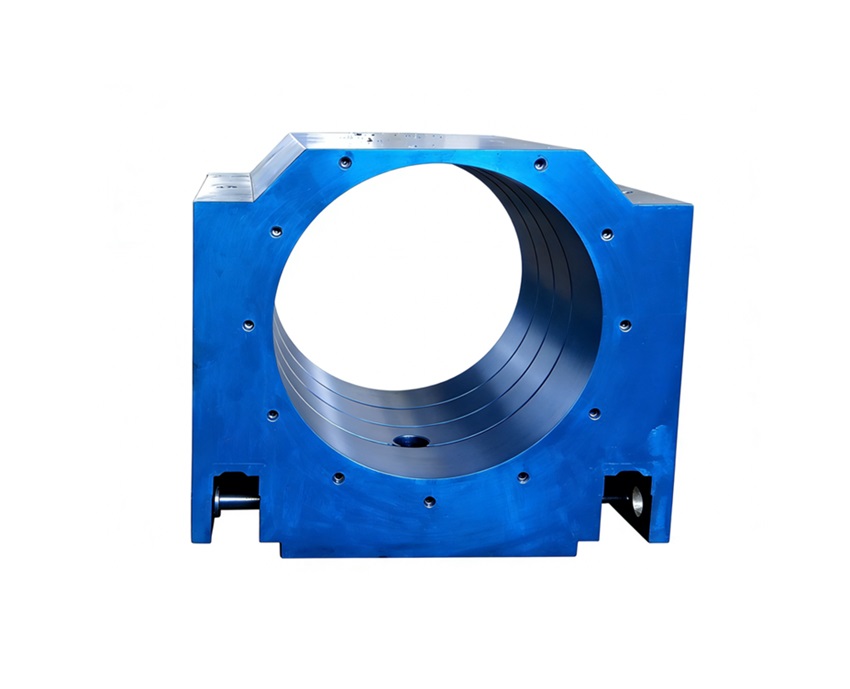
Structural Role: How the Bearing Housing Holds the Main Shaft in Position
Providing a Rigid, Accurately Bored Seat for the Bearing
The bore of a Bearing Housing must be machined to tight tolerances so the bearing outer race seats without movement. Any looseness — even a fraction of a millimeter — allows the bearing to shift under load, generating heat and accelerating race wear. Huan-Tai’s Bearing Housing components are processed with precision boring to ensure the bearing sits firmly and concentrically, maintaining shaft alignment throughout the operating cycle.
Transmitting Crushing Loads Into the Machine Frame
Every strike in the crushing chamber goes through the main shaft, the bearings, and the Bearing Housing before ending up in the frame of the crusher. Because of this load path, the housing needs to be strong enough to keep it from bending under high shock loads. These forces are spread out evenly across the housing body by an optimal structural design. This keeps stress from building up at bolt ends or hole edges, which could cause cracks over time.
Maintaining Shaft Concentricity Across Operating Temperature Ranges
The crushers are warm. Both the shaft and the Bearing Housing grow as the machine works. If their temperature behavior is different, the bearing preload changes in ways that shorten its life. A well-thought-out Bearing Housing made of high-quality cast steel or alloy steel can handle temperature expansion in a predictable way. This keeps the shaft running straight from cold startup to steady-state operation without the need for constant adjustments.
Material and Design Factors That Determine Bearing Housing Performance
Cast Steel as the Foundation Material
Cast steel is strong, tough, and easy to work with, which are all qualities that a Bearing Housing needs. Because it can be formed into complicated forms, mounting flanges, lube tubes, and seal seats can all be built into one part. This cuts down on the number of parts that could become leak points. Huan-Tai chooses the type of cast steel or alloy steel based on the target crusher’s load rate and working conditions. This makes sure that the housing works reliably for the whole time it’s supposed to.
Sealing Arrangements to Protect Bearing Integrity
The places where crushers work are dusty. Small pieces of rock and minerals that get into a bearing quickly kill it, so the Bearing Housing needs to have good insulation. In this case, dust sealing rings are usually made of high manganese steel or high-chromium alloy steel, which are hard and don’t wear down easily in places where regular rubber or polymer seals would fail quickly. Contaminants stay out and oil stays in a housing that is built with the right seal geometry.
Lubrication Passage Design Within the Housing
Lubrication is what makes the difference between a bearing that lasts years and one that breaks in months. The Bearing Housing needs to have oil drain and entry holes that are placed in a way that makes sure the lube gets to all the moving parts without pooling or going around them. As part of the customization process, Huan-Tai’s technical team looks over the lubrication circuit design to make sure the housing shape works with the lubrication method the customer’s equipment needs, such as grease-packed, flowing oil, or oil mist.
Sourcing and Customizing Bearing Housings for Different Crusher Types
Compatibility Across Various Crusher Configurations
Jaw crushers, cone crushers, impact crushers, and hammer crushers each place different load profiles on their Bearing Housing. The mounting geometry, bore diameter, and flange pattern vary significantly between machine types and brands. Huan-Tai manufactures Bearing Housing components suitable for various types of equipment, working from customer drawings or existing part samples to produce a replacement that installs without modification and performs to the original specification.
The Main Shaft Is Forged — The Housing Must Match Its Precision
It is worth noting that crusher main shafts are forged components, produced through forging rather than casting, to give them the fatigue resistance required under cyclic bending loads. The Bearing Housing that supports this shaft must be manufactured to an equivalent level of dimensional discipline. Bore roundness, surface finish at the bearing seat, and perpendicularity of mounting faces are all critical. Huan-Tai’s inspection process verifies these parameters before any housing leaves the factory.
Lead Times for Standard and Custom Bearing Housings
Replacement Bearing Housings for common crusher models can often be produced within a reasonable timeframe once drawings are confirmed. For non-standard or heavily modified machines, the process of drawing review, pattern making, casting, heat treatment, and precision machining takes longer — sometimes considerably so if drawing revisions are needed. Huan-Tai recommends that customers identify critical spare parts well ahead of scheduled maintenance windows to avoid production delays caused by parts availability.
Conclusion
The Bearing Housing does quiet but essential work — holding the main shaft in position, absorbing crushing loads, and protecting the bearings that keep the rotor turning. Getting this component right, in terms of material, dimensional accuracy, and sealing design, is one of the most effective things a maintenance team can do to extend crusher life and reduce the frequency of unplanned downtime.
FAQ
Q1: What material is a crusher Bearing Housing typically made from?
High-quality cast steel or alloy steel is standard. These materials provide the strength, toughness, and machinability needed to handle heavy crushing loads while allowing precise bore finishing.
Q2: How do I tell if my Bearing Housing needs replacing?
Common indicators include bearing overheating, unusual vibration, visible cracks in the housing body, or bore wear that causes bearing movement. Early inspection prevents secondary damage to shafts and frames.
Q3: Can Bearing Housings be customized for non-standard crushers?
Yes. Huan-Tai manufactures to customer drawings or samples, covering a wide range of crusher types and sizes including older or non-OEM equipment.
Q4: Why does bore tolerance matter so much in a Bearing Housing?
A loose bore allows micro-movement of the bearing outer race, generating heat and fretting corrosion that destroys the housing bore and the bearing simultaneously, often in a short time.
Q5: Should the Bearing Housing be replaced when the bearing is replaced?
If bore wear or out-of-round is detected during bearing removal, yes. Reusing a worn housing with a new bearing shortens the new bearing’s life significantly.
Let Huan-Tai Solve Your Bearing Housing Supply Challenge
At Xian Huan-Tai Technology and Development Co., Ltd., we back every Bearing Housing with 30 years of manufacturing experience, a professional technical team that works through your specifications carefully, and end-to-end quality control from raw material to final inspection. Whether you need a standard replacement or a fully customized solution for older equipment, we deliver components that perform. Tell us what you need: inquiry@huan-tai.org.
References
- Wills, B. A., & Finch, J. A. (2015). Wills’ Mineral Processing Technology: An Introduction to the Practical Aspects of Ore Treatment and Mineral Recovery (8th ed.). Butterworth-Heinemann / Elsevier.
- Harris, T. A., & Kotzalas, M. N. (2006). Rolling Bearing Analysis: Essential Concepts of Bearing Technology (5th ed.). CRC Press / Taylor & Francis Group.
- Gupta, A., & Yan, D. S. (2006). Mineral Processing Design and Operations: An Introduction. Elsevier Science.
- Brändlein, J., Eschmann, P., Hasbargen, L., & Weigand, K. (1999). Ball and Roller Bearings: Theory, Design, and Application (3rd ed.). John Wiley & Sons.
- Lindqvist, M., & Evertsson, C. M. (2006). Liner wear in jaw crushers. Minerals Engineering, 16(1), 1–12.
