
The center moving part known as the eccentric shaft is what causes the swing jaw to move back and forth in response to motor power. It handles all three types of dynamic loads—bending, twisting, and shock—at the same time, and it does this constantly for thousands of hours. Picking the right material for this important part of the breaker is not an afterthought. It has a direct effect on how long the shaft lasts, how well it guards the gears around it, and how well the jaw crusher works over its entire life.
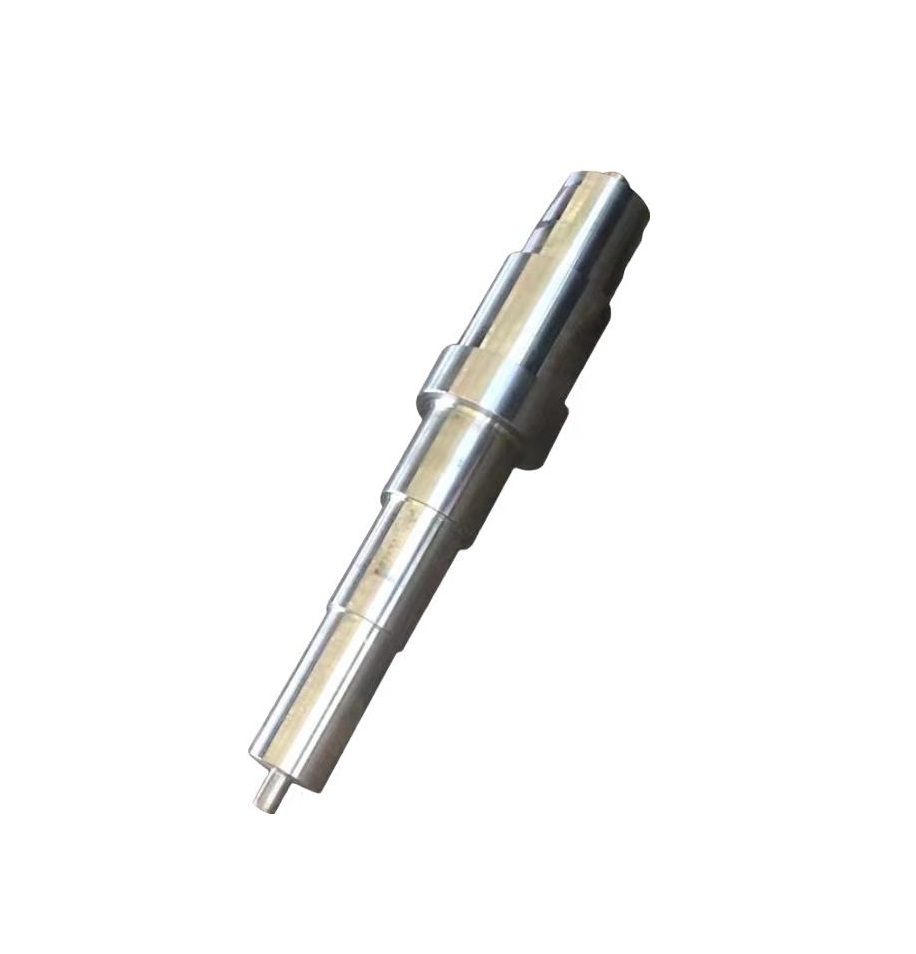
Why Material Selection Matters More for the Eccentric Shaft Than Most Crusher Parts
The Load Profile Is More Complex Than It Appears
Most of the parts of a crusher are worn or loaded by one main motor. Eccentric shaft is subjected to a number of stresses at the same time, including bending stress from the swing jaw reaction force, twisting stress from the drive, and contact stress at the bearing journals. This kind of joint stress will cause wear cracks in any material that is strong but not tough enough. Choosing the right material—one that is strong enough and tough enough—is what makes the difference between a shaft that lasts and one that breaks quickly.
The Shaft Must Be Forged, Not Cast
The eccentric shaft and other main shafts in crusher parts assemblies are made through forging, not casting, to correct a common misunderstanding. When steel is forged, the grain structure is aligned along the shaft axis. This gives the steel the wear strength that is needed for repeated bending and twisting loads. No matter what metal is used, a made shaft is not good for this job because it could have internal holes. Be wary of suppliers who offer a cast Eccentric shaft as an alternative that works just as well.
Corrosion Resistance in Wet and Aggressive Mining Environments
Jaw crushers in mining applications often operate in wet conditions — water sprays for dust suppression, natural groundwater, or chemically active slurries. An Eccentric shaft that corrodes at the bearing seating surfaces loses its dimensional integrity and accelerates bearing wear. Huan-Tai selects alloy compositions for its crusher parts that provide adequate corrosion resistance for the operating environment, ensuring that the shaft surface condition at bearing journals remains within tolerance across extended service intervals.
The Right Steel Grades for Eccentric Shaft Forging
Alloy Steel: The Practical Standard for Most Applications
The most common material for cast eccentric shaft production in jaw crusher service is alloy steel, which contains elements like chromium, molybdenum, and nickel in controlled amounts. It has the right amount of yield strength, wear resistance, and hardenability for this crushing part. After being forged, alloy steel shafts are heated to give them the right mechanical properties all the way through, not just on the surface. This makes the shaft work the same way under different loads.
High-Strength Carbon Steel for Less Severe Duty
High-strength carbon steel is a cost-effective eccentric shaft material for jaw crusher uses with lighter feed, lower flow, or smaller machine sizes without compromising the crusher part’s structural performance. Forged carbon steel rods can be heated and cooled to the right level of hardness and stiffness for mild breaking action. Before suggesting a steel grade, Huan-Tai’s expert team looks at the target crusher’s load rating and how it will be used, making sure that the standard matches the real service need.
Surface Hardening to Protect Bearing Journal Zones
Regardless of the base alloy, the bearing journal surfaces of an Eccentric shaft benefit from localized surface hardening — through induction hardening or flame hardening — to resist the contact fatigue and fretting that occur at the shaft-bearing interface. This treatment increases surface hardness at the journal without embrittling the shaft core, giving the crusher part improved resistance to the micro-motion wear that bearing contact generates under cyclic loading. Huan-Tai applies surface treatment specifications validated for each alloy grade and shaft geometry.
Manufacturing Process, Quality Control, and Procurement
Forging Process Controls That Determine Final Quality
The quality of a forged Eccentric shaft is determined as much by process control as by material selection. Forging temperature, reduction ratio, and cooling rate all affect the grain structure and mechanical properties of the finished crusher part. Huan-Tai’s production process includes forging parameter control, post-forge heat treatment, and mechanical property verification — tensile strength, yield strength, and impact toughness — before any shaft proceeds to the machining stage. This ensures the material specification on paper is actually achieved in the finished component.
Precision Machining and Dimensional Inspection
After forging and heat treatment, the Eccentric shaft is machined to final dimensions. Journal diameter, roundness, surface finish, and the eccentricity offset between the main and eccentric diameters are all critical dimensions that must meet tight tolerances. Huan-Tai inspects these parameters on every finished crusher part before shipment, providing dimensional reports to customers who require incoming quality documentation. A shaft that deviates from tolerance at the bearing journals will cause premature bearing failure regardless of how good the forging was.
Lead Times and Custom Shaft Procurement
Standard Eccentric shaft profiles for common jaw crusher models can be produced and delivered within a reasonable schedule once drawings are confirmed and material is verified. For non-standard or heavily customized crusher parts — particularly large shafts where the forging die or tooling setup requires additional preparation — lead times extend accordingly, and the drawing review process may require several rounds of confirmation before production begins. Customers managing planned overhauls are encouraged to initiate procurement well in advance to avoid the operational cost of waiting on a critical path component.
Conclusion
The Eccentric shaft is one of the most load-critical crusher parts in a jaw crusher, and material selection determines whether it delivers its expected service life or fails ahead of schedule. Alloy steel forged to the correct specification, heat-treated through the section, and machined to bearing-quality tolerances is the proven solution for demanding jaw crusher service — and it starts with choosing a manufacturer who controls the whole process.
FAQ
Q1: Why must an Eccentric shaft be forged rather than cast?
Forging aligns the steel grain structure along the shaft axis, giving it fatigue resistance under cyclic bending and torsional loads that casting cannot reliably provide due to porosity and directional weakness.
Q2: What steel grade is most commonly used for Eccentric shafts?
Alloy steel is the standard for most jaw crusher applications, offering the combination of strength, toughness, and hardenability the shaft requires across its full cross-section.
Q3: How do I know when an Eccentric shaft needs replacing?
Visible surface cracking, measurable journal wear beyond bearing tolerance, or abnormal vibration and bearing temperature are the main indicators that the shaft requires inspection or replacement.
Q4: Can Huan-Tai supply custom Eccentric shafts for non-standard crushers?
Yes. Huan-Tai manufactures Eccentric shafts to customer drawings for a wide range of jaw crusher models, including legacy and non-OEM equipment where standard replacements are unavailable.
Q5: How important is surface finish at the bearing journals?
Very important. Rough or out-of-tolerance journal surfaces cause uneven bearing load distribution, accelerated wear, and heat generation that shortens both the bearing and the shaft service life significantly.
Partner With Huan-Tai for Eccentric Shafts That Perform
At Xian Huan-Tai Technology and Development Co., Ltd., we manufacture forged Eccentric shafts and precision crusher parts for mining and engineering customers worldwide. Our technical team specifies the right material for your application, our production team controls quality from forging through final inspection, and our 30 years of experience means we understand what these components actually need to deliver in service. Ready to discuss your requirement? Contact us at inquiry@huan-tai.org to know more about information.
References
- Wills, B. A., & Finch, J. A. (2015). Wills’ Mineral Processing Technology: An Introduction to the Practical Aspects of Ore Treatment and Mineral Recovery (8th ed.). Butterworth-Heinemann / Elsevier.
- Shigley, J. E., & Mischke, C. R. (2001). Mechanical Engineering Design (6th ed.). McGraw-Hill.
- Lindqvist, M., & Evertsson, C. M. (2006). Liner wear in jaw crushers. Minerals Engineering, 16(1), 1–12.
- Gupta, A., & Yan, D. S. (2006). Mineral Processing Design and Operations: An Introduction. Elsevier Science.
- Cleary, P. W., & Morrison, R. D. (2011). Understanding fine ore breakage in a laboratory jaw crusher using DEM simulation. Minerals Engineering, 24(3–4), 352–366.
