
Impact plates are wear parts that stay in place inside impact crushers. They change the path of the material thrown by the rotor and soak up its rotational energy. How well rock or metal is broken up in a single pass is directly related to their shape, the type of material they are made of, and the way their surface is shaped. A well-designed set of impact plates cuts down on recycling, lowers the amount of energy needed per ton, and makes the output particles of a more even size. This makes them essential to the total efficiency of any breaking process.
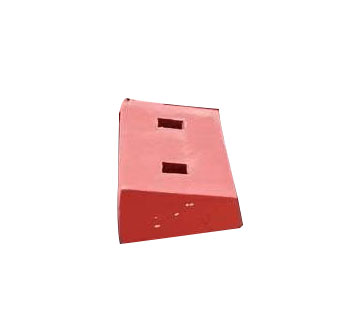
How Impact Plate Geometry Drives Crushing Efficiency
Angle and Curvature of the Striking Surface
How things move through the crushing chamber is based on the angle at which the impact plates are placed in relation to the path of the blade. When the plate angle is set properly, the impact energy is transferred most efficiently into breaking work on the material, rather than being lost through passing deflections. In mining and material processing, workers depend on impact plates that can be adjusted to change the output of the crusher without having to stop work to make hardware changes.
Chamber Profile and Material Flow
How the material moves through the crusher from the feed to the output is controlled by the general chamber shape made by the arrangement of impact plates. A well-thought-out shape keeps particles going through active breaking zones for as long as needed while quickly letting out material that is the right size. This keeps the cost of running a high-throughput operation low by preventing the impact plates from over-grinding and wearing out prematurely. This also increases the time between service calls.
Surface Texture and Secondary Fracture
The surface roughness of impact plates affects secondary fracture mechanics in addition to their overall shape. A curved or corrugated shape makes more impact points that cause cracks in the feed material across different lines, which increases the efficiency of size reduction. This design feature significantly raises the amount of on-spec product that can be produced every hour in engineering and mining settings that work with rough, hard rock. It does this without needing more energy or a bigger machine size.
How Material Selection Determines Impact Plate Performance
High-Chromium Alloy for Abrasion Resistance
Impact plates made of a high-chromium metal are very resistant to wear from abrasives even when they are used continuously under heavy loads. The high-chromium alloy’s carbide-rich texture keeps the working surface hard even as the plate wears down over time. This keeps the breaking shape stable for longer. Huan-Tai makes impact plates out of a high-chromium metal using lost-wax, resin sand, and V-process casting, among other precise casting methods, based on the size and finish needs of each job.
High-Manganese Steel for Impact Toughness
High-manganese steel is the best material for impact plates when the feed material has big, lumpy pieces that put quick shock loads on them. Its work-hardening property means that the plate surface gets harder over time when it is hit over and over, but the core stays tough enough to not break. Because of these qualities, high-manganese steel impact plates work well for the first stages of breaking in quarries, mining, and big civil building projects.
Composite Materials for Demanding Conditions
Composite impact plates with a hard, wear-resistant top layer and a tough structure back give the best mix of resistance to wear and fracture toughness in the harshest working conditions. These bimetallic or composite designs, which have a hard, wear-resistant face and a strong, flexible body, solve the problem of plates breaking too soon when they are pushed past their design limits in high-load, high-impact situations like those found in mining and large-scale aggregate production.
How Casting Process Quality Affects Impact Plate Reliability
Dimensional Accuracy Through Precision Casting
The casting method used to make impact plates has a direct effect on how well they fit inside the crusher body and how uniform their sizes are. When it comes to surface finish, measurement accuracy, and production scalability, lost-wax casting, resin sand casting, and V-method casting are all good in their own ways. Huan-Tai chooses the best casting route for each impact plate order based on the geometry of the part and the customer’s needed standards. This makes sure that each plate is installed properly and keeps its planned breaking geometry from the first hour of operation.
Internal Integrity and Fracture Prevention
If a cast impact plate has holes, shrinking gaps, or inclusion flaws, they can become places where a crack starts when it is subjected to the repeated impact loads that come with crushing duty. Before sending something out, Huan-Tai’s production team uses a set of structured review processes, which include checking the dimensions and making sure the materials are correct. Paying close attention to the quality of the casting is especially important for custom impact plates that are used in heavy-duty mining and engineering tasks where unplanned part failures cause expensive production stops.
Lead Time and Customization Process
Customized impact plates need a lot of technical coordination between the buyer and the maker right from the start. The production cycle takes longer when the drawings are confirmed, the material specifications are approved, the tools are made, and casting tryouts are done. Replacement profiles that aren’t too complicated can usually be done pretty quickly, but unique shapes or the need for new tools may take longer. At the question stage, Huan-Tai gives customers clear wait time predictions so they can plan their repair schedules and extra parts supplies.
Conclusion
One of the parts of an impact crushing machine that wears out the fastest is the impact plate. How well and consistently a crusher works over its lifetime depends on how well the shape, material grade, and casting quality are chosen. Investing in properly designed and made impact plates is a simple choice that has measured results for mining, drilling, and building businesses that need steady output and low running costs.
FAQ
What kinds of materials are most impact plates made of?
There are a few major choices: high-manganese steel, high-chromium metal, and hybrid materials. The choice of material is based on how rough the feed is, how hard the impact loads are, and how often the machine needs to be serviced.
Can impact plates be changed to fit certain types of crushers?
Yes, Huan-Tai makes impact plates based on plans or samples provided by the customer. The casting method and material grade are chosen based on the equipment’s working needs.
How does the way the impact plate is made affect its quality?
When it comes to accuracy and surface finish, methods like lost-wax, resin sand, and V-process casting are not all the same. Which option is best relies on the shape of the part and the tolerances that need to be met.
How long does it take to get unique impact plates?
Lead times depend on how complicated the part is and how long it takes for the drawing to be approved. At the inquiry stage, Huan-Tai gives customers rough estimates of when the work will be done to help them plan ahead.
What is it about high-chromium metal that makes it a good choice for impact plates?
Its carbide-rich structure makes it very resistant to wear, so the plate shape stays the same and it crushes well for a longer time than standard steel grades.
Partner With Huan-Tai for Your Impact Plate Requirements
The Xian Huan-Tai Technology and Development Co., Ltd. has been making customized non-standard mechanical parts for mining and industrial uses for 30 years. They have the production capacity and technical depth to give you impact plates that are exactly what you need. From casting to final review, our skilled team oversees quality at every step. This way, you can count on getting consistent parts on time. Send your drawings or inquiry today: inquiry@huan-tai.org.
References
1. Wills, B. A., & Finch, J. A. (2015). Wills’ Mineral Processing Technology: An Introduction to the Practical Aspects of Ore Treatment and Mineral Recovery (8th ed.). Butterworth-Heinemann.
2. Metso Corporation (2020). Crushing and Screening Handbook (6th ed.). Metso Minerals.
3. Gupta, A., & Yan, D. S. (2006). Mineral Processing Design and Operations: An Introduction. Elsevier Science.
4. Bearman, R. A., & Briggs, C. A. (1998). The Active Use of Crushers to Control Product Requirements. Minerals Engineering, 11(9), 849–859.
5. Lindqvist, M., & Evertsson, C. M. (2003). Liner Wear in Jaw Crushers. Minerals Engineering, 16(1), 1–12.
