
Pushing strengthens hydraulic cylinders. The push (extension) stroke in a heavy duty cylinder works on the whole piston tube, making the most force at the same working pressure. When you pull the rod back, it affects the circular area, which is the hole area minus the rod cross-section. This area is always smaller. This means that the expansion force is always greater than the retraction force. This difference is taken into account by machine makers when they choose the cylinder size and fixing position.
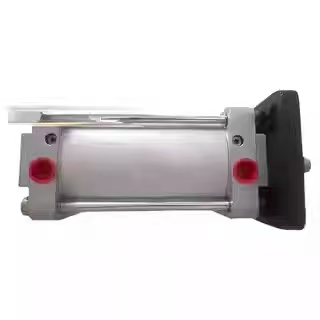
Why Push Force Is Greater Than Pull Force in Hydraulic Cylinders
The Physics Behind Piston Area and Force Output
Force in a hydraulic cylinder is calculated as pressure multiplied by the effective piston area. During extension, the full bore area of a heavy duty cylinder is exposed to hydraulic pressure, producing the highest possible force output for a given operating pressure. During retraction, the rod occupies a portion of that bore area, reducing the effective area and therefore the force available. The larger the rod diameter relative to the bore, the more significant this difference becomes in practice.
How Rod Diameter Affects the Force Ratio
The ratio between extension and retraction force in a heavy duty cylinder depends directly on the rod-to-bore diameter ratio. A cylinder with a relatively small rod — common in light-duty applications — has a retraction area close to the full bore area, so the force difference is modest. A cylinder with a large-diameter rod, often used in heavy mining and engineering equipment to resist buckling under compression loads, has a more pronounced force asymmetry. Equipment designers working with these cylinders must factor this into their load calculations to ensure the retraction stroke delivers sufficient force for the application.
Practical Implications for Machine Design
Understanding the push-pull force difference helps explain why most heavy duty cylinder installations are oriented so that the extension stroke performs the primary work — lifting, pressing, or clamping. In excavator boom circuits, the cylinder extends to lift the load; in press machinery, the cylinder extends to apply force to the workpiece. Where retraction force is the critical requirement, engineers either increase the bore size, use a double-rod cylinder, or specify a higher system pressure for the retraction circuit — all solutions that add cost and complexity compared to simply designing for extension as the power stroke.
How Heavy Duty Cylinders Are Built to Handle High Push Loads
Barrel and End Cap Structural Integrity
The extension stroke places the cylinder barrel under internal pressure across its full cross-section, making barrel wall thickness and end cap design critical to structural performance. A well-engineered heavy duty cylinder uses high-quality cast iron or cast steel for its body components, providing the toughness and strength needed to contain high operating pressures without deformation or cracking. The barrel must remain dimensionally stable under pressure to prevent bore distortion that would accelerate seal wear and reduce the cylinder’s rated service life.
Seal System Performance Under Pressure
The piston seal in a heavy duty cylinder must maintain a reliable pressure boundary across the full bore during extension, preventing high-pressure oil from bypassing the piston and reducing effective force output. A well-designed seal system remains undamaged and leak-free under the continuous impact of high-pressure hydraulic oil, ensuring that the pressure applied at the inlet is converted efficiently into mechanical force at the rod end. Seal selection, groove geometry, and surface finish on the bore and piston all contribute to how well this performance is maintained over the cylinder’s service life.
Rod Design and Buckling Resistance
During extension, the cylinder rod operates under compressive load — it is being pushed rather than pulled. Long rods under high compressive force are susceptible to Euler buckling, particularly if the rod is undersized relative to the stroke length or if the cylinder is subject to side loading at the rod end. A heavy duty cylinder designed for high push-force applications uses an appropriately sized rod diameter and a structurally optimized end cap and clevis arrangement to keep the rod in axial alignment throughout the stroke, protecting both the rod and the seals from the side loading that would otherwise cause premature wear.
Selecting and Sourcing the Right Heavy Duty Cylinder for Your Application
Matching Cylinder Specification to Load Direction
Before specifying a heavy duty cylinder, confirm which stroke direction carries the primary load in your application and what force is required on both extension and retraction. This determines the minimum bore diameter, rod diameter, and operating pressure needed to meet performance requirements. For mining and engineering machinery where both strokes carry significant loads — such as in dozer blade tilt circuits or excavator bucket linkages — getting this balance right at the specification stage avoids costly re-engineering once the machine is in service.
Custom Manufacturing for Non-Standard Requirements
Many mining and industrial machines require cylinders that don’t match standard catalog dimensions. In these cases, custom heavy duty cylinders manufactured from customer drawings or samples are the practical solution. Lead times vary depending on drawing complexity, material sourcing, and the number of specification confirmation rounds needed — straightforward designs move through production faster, while those with unique bore-to-rod ratios, non-standard port configurations, or specialized material requirements take longer. Providing complete, finalized drawings at the inquiry stage keeps the process efficient.
Quality Assurance for High-Pressure Service
Every heavy duty cylinder intended for high-load mining or engineering service should be pressure-tested, dimensionally inspected, and surface-checked before shipment. The castings should be easy to replace and install, and the overall assembly should be documented with inspection records that give procurement and maintenance teams confidence in what they’re receiving. For equipment operating in remote locations, a cylinder that passes full quality verification before dispatch is far less likely to cause unplanned downtime than one sourced purely on price without documented inspection.
Conclusion
Hydraulic cylinders are stronger on the push stroke because extension acts on the full bore area, while retraction acts on the reduced annular area. For heavy duty cylinder applications in mining and engineering machinery, this principle directly influences how equipment is designed, how cylinders are specified, and which stroke handles the primary workload. Understanding this distinction helps procurement and engineering teams make better decisions when selecting and sourcing hydraulic components.
FAQ
Q1: Why is push force always greater than pull force in a hydraulic cylinder?
Because the push stroke acts on the full piston bore area, while the pull stroke acts on the annular area — the bore area minus the rod cross-section — which is always smaller at the same pressure.
Q2: When should I use a double-rod cylinder instead of a standard heavy duty cylinder?
When equal force and equal speed are required on both extension and retraction strokes, a double-rod cylinder is the appropriate solution.
Q3: What materials are used in mining-grade heavy duty cylinders?
High-quality cast iron or cast steel are standard for body components, selected for their toughness, pressure containment, and resistance to the shock loads common in mining applications.
Q4: How do I prevent rod buckling in a long-stroke heavy duty cylinder?
Use an appropriate rod diameter for the stroke length, ensure axial mounting alignment, and avoid side loading at the rod end. Consult the cylinder manufacturer’s stroke-to-diameter guidelines during specification.
Q5: Can heavy duty cylinders be customized for non-standard machines?
Yes. Custom cylinders can be manufactured from drawings or samples to match any bore, rod, stroke, port, and mounting configuration required by your equipment.
Source Heavy Duty Cylinders Built for the Work They Do
At Xian Huan-Tai Technology and Development Co., Ltd., our 30 years of manufacturing experience means we understand the demands placed on hydraulic components in real mining and engineering applications. Our production and technical teams manage quality from casting through final inspection, and we work directly with customers to confirm specifications before production begins. Whether you need standard or fully custom heavy duty cylinders, we’re ready to deliver. Send your drawings or inquiry to inquiry@huan-tai.org — let’s build something that lasts.
References
- Esposito, A. (2008). Fluid Power with Applications (7th ed.). Pearson Prentice Hall. Chapters on hydraulic cylinder force calculations, push-pull force ratios, and cylinder selection criteria for industrial applications.
- Manring, N. D. (2005). Hydraulic Control Systems. John Wiley & Sons. Analysis of piston area relationships, actuator force output, and cylinder performance under variable load conditions.
- Fitch, E. C., & Hong, I. T. (1998). Hydraulic Component Design and Selection. BarDyne Inc. Detailed guidance on bore and rod sizing, force asymmetry, and buckling resistance for heavy equipment cylinders.
- Nervegna, N. (2003). Oleodinamica e Pneumatica (Vol. 1). Politeko. Coverage of hydraulic actuator mechanics including extension and retraction force relationships in industrial cylinder applications.
- Watton, J. (2009). Fundamentals of Fluid Power Control. Cambridge University Press. Treatment of hydraulic cylinder dynamics, force output under pressure, and rod stability considerations for high-load applications.
