
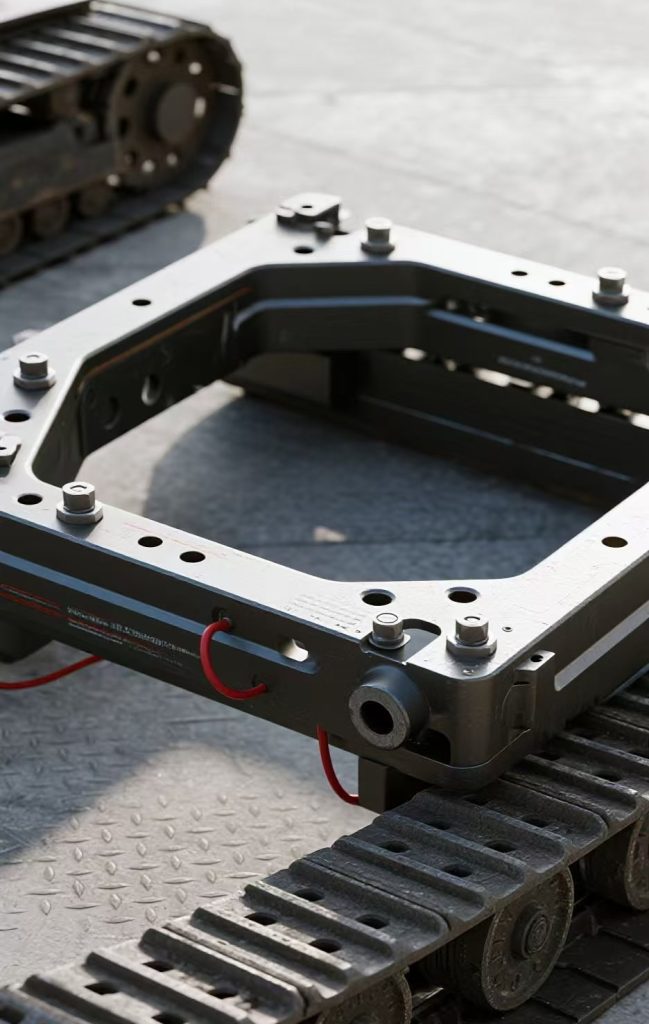
Resin sand casting is now the most popular way to make Track Frames for big tools and construction equipment. Resin sand casting gives you tighter tolerances on dimensions, smoother surfaces, and stronger structures than traditional green sand casting. These are all very important when a Track Frame has to hold the weight and shock loads of excavators, bulldozers, and other crawler equipment working in rough field conditions.
Why Resin Sand Casting Is Well-Suited for Track Frame Production
Superior Dimensional Accuracy for Complex Frame Geometries
A Track Frame typically features thick-walled sections, internal cavities, and multiple mounting interfaces that must align precisely with undercarriage components. Resin sand molds hold their shape far better than conventional sand molds under the heat of molten metal, reducing distortion and shrinkage. This dimensional stability means each Track Frame meets assembly tolerances right out of the casting process, reducing the amount of post-cast machining needed.
Smooth Surface Finish Reduces Secondary Processing
Resin sand casting produces a noticeably cleaner surface compared to green sand methods, which is particularly valuable for a Track Frame where weld preparation surfaces, bore areas, and sealing faces require consistent quality. Fewer surface defects translate directly into lower rejection rates and reduced finishing labor. For manufacturers supplying Track Frame components to equipment OEMs or aftermarket repair operations, this consistency is a competitive advantage.
Compatibility with Custom Drawing Design
One of the practical strengths of the resin sand process is its flexibility for custom configurations. Whether a customer provides detailed engineering drawings or requires collaborative design support, resin sand tooling can be adapted to produce a Track Frame to specific non-standard dimensions. This matters for repair companies replacing discontinued or hard-to-source frames, where an exact geometry match to the original equipment specification is essential for fit and performance.
Structural and Material Advantages That Benefit Track Frame Performance
High Integrity Castings for Load-Bearing Applications
Track Frames bear the entire operational load of a crawler machine — static weight, dynamic travel forces, and impact from rough terrain. Resin sand casting produces dense, low-porosity castings with consistent wall thickness, giving each Track Frame the structural integrity needed for these demanding conditions. Rigorous inspection procedures, including dimensional checks and non-destructive testing where required, ensure that every finished frame meets quality and reliability standards before it leaves the facility.
Material Selection Matched to Application Requirements
For heavy engineering and mining applications, Track Frame castings are typically produced in alloy steel or cast steel, selected based on the required strength grade, weldability, and operating environment. Alloy steel provides a good balance of toughness and machinability, while higher-strength grades are available for extreme loading conditions. The resin sand process is compatible with a wide range of steel grades, giving engineers flexibility to specify the right material for each Track Frame application.
Consistent Quality Across Production Batches
Batch-to-batch consistency is a major concern for machinery manufacturers that need Track Frame components to be interchangeable across equipment fleets. Because resin sand molds resist deformation throughout the pour and solidification cycle, dimensional variation between castings is kept tight. Combined with in-process inspection at key manufacturing stages, this gives procurement teams confidence that replacement or production Track Frame parts will perform identically to the originals.
Practical Benefits for Procurement and Project Planning
Flexibility for Small and Large Order Volumes
Resin sand casting tooling is relatively accessible compared to permanent mold or die casting tooling, making it practical for both small repair-order quantities and larger production runs. A maintenance or repair company needing a single replacement Track Frame can have a casting produced from a custom pattern without the prohibitive tooling investment of alternative processes. Larger manufacturers benefit from the same tooling once volume requirements grow.
Lead Time Considerations for Custom Track Frame Orders
Standard replacement Track Frame castings can often be ready within a few weeks once specifications are confirmed. However, custom or non-standard frames — particularly those requiring drawing review, tooling fabrication, and iterative dimension verification — may involve a longer production cycle. Clear and complete drawing submissions at the start of the project are the single most effective way to keep the schedule on track and avoid delays from repeated confirmation rounds.
Lost Foam Casting as a Complementary Option
For Track Frame designs with particularly complex internal structures or where near-net-shape output is a priority, lost foam casting is an effective alternative to resin sand. Both processes are used in professional Track Frame manufacturing and each has specific strengths depending on geometry, volume, and tolerance requirements. Experienced casting suppliers will recommend the most suitable process based on the customer’s drawing and application context, rather than defaulting to a single method for all projects.
Conclusion
Resin sand casting brings meaningful advantages to Track Frame manufacturing — from tighter dimensional accuracy and cleaner surface finish to compatibility with custom designs and a broad range of structural steel grades. For mining and heavy engineering applications where frame integrity directly affects machine reliability and operator safety, choosing a casting process and supplier with proven quality controls is not a detail to overlook. The right Track Frame, produced to specification, is a long-term investment in equipment uptime.
FAQ
Q1: What casting process is used to manufacture Track Frames?
Resin sand casting and lost foam casting are both commonly used. The choice depends on the frame geometry, required tolerances, and order volume. Both processes support custom drawing-based production.
Q2: What materials are Track Frames typically cast from?
Alloy steel and cast steel are the most common materials, selected based on the required strength, weldability, and operating conditions of the specific crawler equipment application.
Q3: Can a Track Frame be produced to non-standard or custom dimensions?
Yes. Suppliers with resin sand casting capabilities can produce Track Frames to customer-supplied drawings, including non-standard sizes needed to replace discontinued or legacy equipment frames.
Q4: How long does it take to receive a custom Track Frame casting?
Lead times vary. Standard configurations may be completed within a few weeks, while custom designs requiring new tooling and drawing confirmation can take longer depending on complexity.
Q5: How is casting quality verified for Track Frame components?
Quality inspection includes dimensional measurement against drawing specifications, visual surface inspection, and non-destructive testing where required. Rigorous checks at each production stage help ensure consistent results across batches.
Get Your Custom Track Frame from Huan-Tai
At Xian Huan-Tai Technology and Development Co., Ltd., we have spent over 30 years manufacturing precision-engineered, customized non-standard mechanical parts for mining, construction, and heavy engineering industries. Our professional technical team works directly from your drawings to produce Track Frame castings that meet your exact dimensional and performance requirements, with quality managed throughout every stage of production. Whether you need a single replacement frame or a recurring production run, we are ready to help. Contact us today: inquiry@huan-tai.org.
References
1. Beeley, P. R. (2001). Foundry Technology (2nd ed.). Butterworth-Heinemann. Chapter 6: Resin Sand Processes and Their Application in Structural Castings.
2. Campbell, J. (2015). Complete Casting Handbook: Metal Casting Processes, Metallurgy, Techniques and Design (2nd ed.). Butterworth-Heinemann. Chapter 9: Sand Casting Processes and Dimensional Control.
3. Stefanescu, D. M. (2008). Science and Engineering of Casting Solidification (2nd ed.). Springer. Chapter 5: Mold Materials and Their Influence on Casting Quality.
4. Heine, R. W., Loper, C. R., & Rosenthal, P. C. (1967). Principles of Metal Casting (2nd ed.). McGraw-Hill. Chapter 11: Chemically Bonded Sand Systems and Dimensional Accuracy.
5. Kalpakjian, S., & Schmid, S. R. (2014). Manufacturing Engineering and Technology (7th ed.). Pearson. Chapter 11: Metal Casting Processes — Sand, Shell, and Investment Casting for Structural Components.
6. Groover, M. P. (2020). Fundamentals of Modern Manufacturing: Materials, Processes, and Systems (6th ed.). Wiley. Chapter 11: Casting Processes for Heavy Engineering and Construction Machinery Components.
