
It is important to remember that the track frame is one of the most physically important parts of a heavy-duty suspension system. It has to handle constant pressure, wear, and load stress in hard working conditions. Recently, lost foam casting has become a very good way to make track frame parts that meet these needs. It has better accuracy in measurements, a consistent material density, and the ability to work with complex geometries that traditional sand casting often has trouble with. Understanding this process is important for machinery workers and buying managers who are looking for custom mechanical parts because it affects how long the parts last and how much they cost to own.
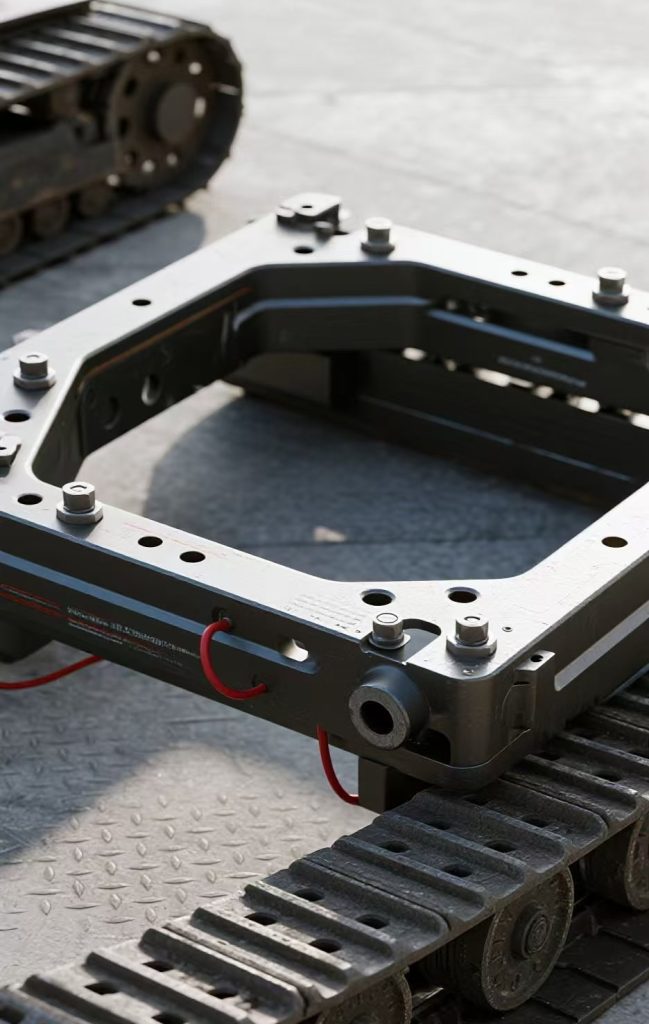
Why Lost Foam Casting Is Well-Suited for Track Frame Production
The process and its structural advantages
Lost foam casting works by creating a full-density foam pattern of the desired part, coating it in refractory material, and embedding it in unbonded sand before pouring molten metal. The foam vaporizes on contact with the metal, leaving behind a precise cavity that fills without the dimensional distortions common in conventional tooling. For track frame components — which typically feature thick cross-sections, integrated mounting bosses, and ribbed reinforcement structures — this level of detail fidelity is practically significant. The resulting castings show tight wall consistency and minimal porosity, both of which directly influence the load-bearing capacity of the finished track frame.
Material compatibility for demanding working conditions
Track frame parts used in mining and engineering machinery are routinely subjected to high-impact and abrasion-intensive conditions. Lost foam casting is compatible with a range of ferrous alloys suited to these environments, including high-manganese steel and alloy steel, both of which are commonly specified for track frame applications. High-manganese steel is particularly valued for its work-hardening characteristics — the material actually becomes harder under repeated impact, making it a practical choice for ground-engaging undercarriage structures. This material flexibility allows manufacturers to tailor each track frame component to its specific service conditions rather than applying a one-size-fits-all approach.
Resin sand casting as a complementary option
While lost foam casting delivers strong results for complex or high-volume track frame geometries, resin sand casting remains a practical alternative for certain configurations — particularly larger single-piece track frame structures where dimensional accuracy must be maintained across an extended surface area. Both techniques undergo rigorous dimensional inspection and mechanical property testing before any component is approved for shipment. The choice between methods is made on a case-by-case basis, driven by the geometry of the track frame, the required material specification, and the production volume. This flexibility in process selection is a key aspect of how custom components are properly matched to their application.
Custom Engineering and Quality Control in Track Frame Manufacturing
Working from custom drawings and design files
Most procurement teams sourcing track frame components arrive with their own engineering drawings or 3D models. A reliable manufacturer must be capable of reviewing those files critically — identifying potential casting concerns, recommending wall thickness adjustments where stress concentrations are likely, and confirming that tolerances are achievable with the selected process. Supporting custom drawing design is standard practice for track frame production, and close communication during the drawing review stage is often what separates a successful first article from a costly revision cycle. Design changes that are caught before pattern production are far less disruptive than those discovered during inspection of a finished casting.
Inspection and dimensional verification
Every track frame casting passes through a defined inspection sequence before leaving the production floor. This includes dimensional checks against the approved drawing, surface quality assessment, and where specified, non-destructive testing to verify internal soundness. For track frame components entering heavy-duty machinery applications, material certification may also be required to confirm that the alloy composition meets the specified standard. The goal at every inspection stage is to catch any deviation before it reaches the customer — reducing the risk of field failures that carry significant cost in downtime and equipment replacement. Consistent quality control is what allows buyers to order with confidence across repeated production runs.
Lead times and production planning for custom parts
Custom track frame components generally involve a production sequence that includes drawing confirmation, pattern or tooling preparation, trial casting, inspection, and final production. Lead times vary depending on the complexity of the part geometry, the number of drawing revision rounds required, and current production scheduling. Simpler track frame profiles with clean geometry and well-defined drawings can move relatively quickly through the process. However, components with intricate features or those requiring iterative design adjustments may take longer — and buyers should build that variability into their procurement planning. Communicating timeline requirements early in the inquiry stage allows production to be scheduled realistically.
Applications of Lost Foam Cast Track Frame Parts in Engineering and Mining Machinery
Mining equipment undercarriage systems
In surface and underground mining operations, tracked equipment works in some of the harshest conditions encountered by any machinery — loose rock, steep gradients, constant vibration, and abrasive ground contact. The track frame forms the backbone of the undercarriage and must retain structural integrity across thousands of operating hours. Lost foam cast track frame components made from high-manganese or alloy steel have demonstrated reliable performance in these environments, offering the combination of strength and wear resistance that mining applications demand. Procurement managers in this sector typically prioritize consistency and repeatability across production batches as much as unit price.
Construction and earthmoving equipment
Excavators, bulldozers, and crawler cranes all rely on robust undercarriage assemblies, with the track frame at the center of the structure. These machines operate across a wide range of ground conditions, and the track frame must accommodate dynamic loading without cracking or deforming. Lost foam casting allows manufacturers to produce track frame components with uniform wall sections and minimal internal defects — characteristics that directly affect fatigue life under cyclic loading. For construction equipment manufacturers sourcing cast parts, the ability to specify alloy type and have it consistently delivered batch after batch is an important factor in maintaining the quality of their finished machines.
Repair and replacement parts for existing equipment
Repair companies and equipment dealers often need to source replacement track frame components for machines where original parts are no longer available through standard supply channels. This is a segment where custom casting capability has clear value — the ability to produce a single part or small batch from a customer-supplied drawing or from a reverse-engineered sample. Lost foam casting supports this use case well, since pattern tooling costs are lower than permanent mold alternatives and the process can be adapted to short-run production without prohibitive setup expense. For a repair business working to get a machine back in service, the key requirement is accurate parts delivered within a workable timeframe.
Conclusion
Lost foam casting offers a well-proven path to producing durable, dimensionally accurate track frame components for engineering and mining machinery. Whether working from new custom drawings or replacing worn parts on existing equipment, the combination of process flexibility, material selection, and systematic quality inspection ensures that each track frame component performs reliably in the field. For procurement teams prioritizing consistency and long service life, this manufacturing approach is worth close consideration.
FAQ
What materials are typically used for lost foam cast track frame components?
High-manganese steel and alloy steel are the most commonly specified materials for track frame applications. Material selection depends on the operating environment — high-manganese steel is preferred where impact resistance and work hardening are priorities.
Can I supply my own drawings for a custom track frame part?
Yes. Custom drawing design is fully supported. Customers can submit 2D drawings or 3D models, and the engineering team will review geometry and tolerances before confirming feasibility and proceeding to production.
Is lost foam casting always used, or are there other options for track frame production?
Both lost foam casting and resin sand casting are employed depending on part geometry, size, and required tolerances. The appropriate method is selected based on the specific requirements of each track frame component.
How long does production typically take for a custom track frame casting?
Lead times vary based on drawing complexity, revision rounds, and production scheduling. Simple geometries with confirmed drawings move faster; custom track frame parts requiring iterative design work will take longer. Early communication of delivery requirements is recommended.
What quality checks are performed on track frame castings before delivery?
Each track frame component is subject to dimensional inspection against approved drawings, surface quality assessment, and where required, non-destructive testing and material certification to confirm alloy composition meets specification.
Start Your Custom Track Frame Project Today
Xian Huan-Tai Technology and Development Co., Ltd. has over 30 years of experience producing customized non-standard mechanical parts for demanding engineering and mining applications. Our professional production and technical teams manage quality at every stage — from drawing review through final inspection — ensuring your track frame components meet performance and delivery expectations. If you have a specific requirement or an inquiry drawing ready, we would be glad to discuss it directly. Contact us: inquiry@huan-tai.org.
References
- Monroe, R. W. (2005). Expendable Pattern Casting. Materials Park, OH: ASM International.
- Stefanescu, D. M. (2009). Science and Engineering of Casting Solidification (2nd ed.). New York: Springer.
- Campbell, J. (2015). Complete Casting Handbook: Metal Casting Processes, Metallurgy, Techniques and Design (2nd ed.). Oxford: Butterworth-Heinemann.
- Beeley, P. R. (2001). Foundry Technology (2nd ed.). Oxford: Butterworth-Heinemann.
- American Foundry Society (AFS). (2018). Metal Casting Design and Purchasing Guidelines for Ferrous Alloys. Schaumburg, IL: AFS Press.
- Heine, R. W., Loper, C. R., & Rosenthal, P. C. (1967). Principles of Metal Casting (2nd ed.). New York: McGraw-Hill.
