
Rotors are an impact crusher’s heart, and damage that isn’t obvious to the operator is a common reason why they break down suddenly and cost a lot of money when they can’t work. Surface wear is easy to see, but cracks, imbalances, and fatigue damage that happen inside rotors often happen slowly and aren’t noticed until they get really bad. An organized inspection routine that includes both visible checks and measurement proof is what finds these issues early, before they get so bad that the whole rotor has to be replaced or something even worse.
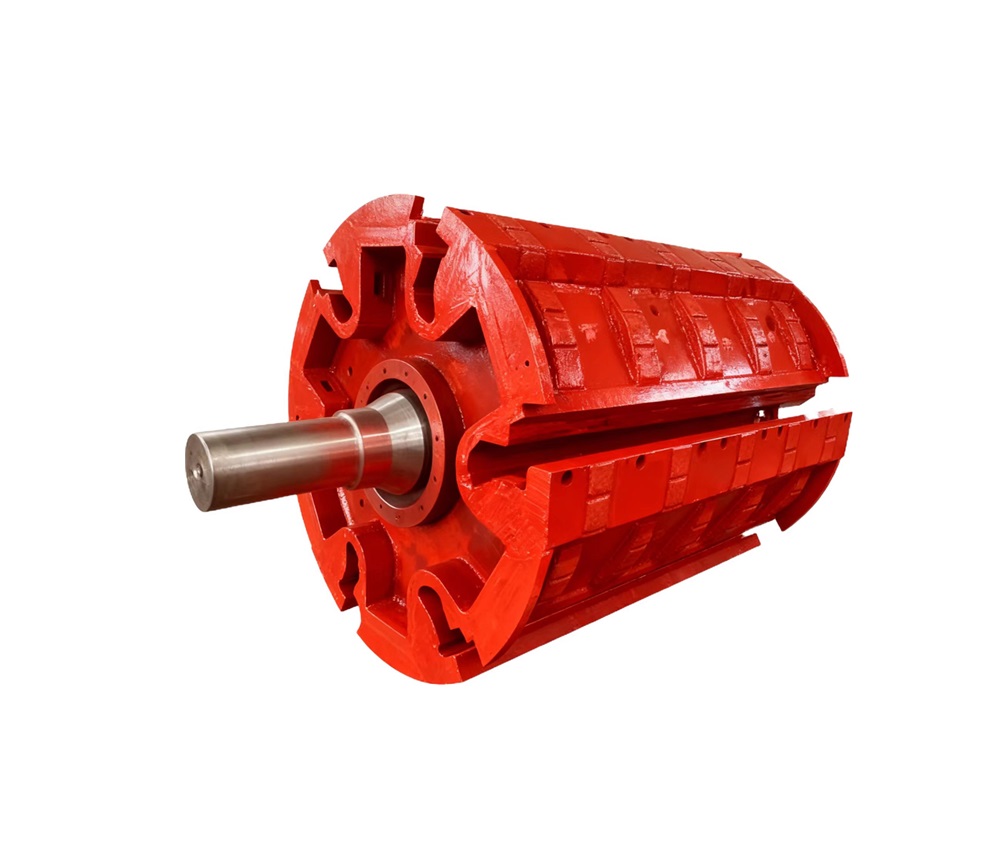
Visual Inspection: What to Look for on the Rotor Surface
Cracks at High-Stress Zones
The blow bar seat edges, the disc weld joints, and the shaft-to-disc contacts are the parts of crusher rotors that are most likely to crack. During operation, these areas are loaded with high impacts and wear and tear. Make sure there is enough light for the eye check, and look closely at these areas for tiny cracks, which can be hard to see if the surface isn’t cleaned first. Before the crusher is put back into service, any crack at a stress concentration point should be taken very seriously and looked into further.
Wear Pattern Asymmetry on Disc Faces
Uneven wear on the sides of the rotor discs is a sign that you should look into. Wear that is even and slow is normal; it’s how things work. But if one side of the rotor has a lot more wear than the other, or if the wear is concentrated in an odd place, it means that either the material isn’t moving properly inside the crusher or the rotors have been out of balance. Not just the wear itself, but also both of the reasons needs to be fixed.
Blow Bar Seat Deformation
When bars are hit against feed material, they put a lot of force on the seats where the blow bars sit on the rotor of an impact crusher. The seats can change shape over time, which can make the blow bars less stable and the loads on the rotor body less evenly spread. Check each seat for cracks, deformation of the plastic, or signs that the bars have been moving during operation. Loose bars under load speed up seat damage and throw off the balance of the rotors.
Dimensional and Balance Checks for Crusher Rotors
Measuring Rotor Runout
Rotor runout, or how far the rotor is from rotating in a circle, has a direct effect on the amount of shaking and the load on the bearings. If you don’t fix even mild runout, it speeds up bearing wear and can cause the shaft to become worn out. A number indicator is used to measure runout while the rotor is held in its bearings or on a stand made just for that reason. It should be a regular part of every big check for rotors that have been used for a long time to measure their runout.
Checking Blow Bar Weight Balance
Impact crusher rotors need to keep the weight evenly spread across the body of the rotor, which includes all the blow bars that are fitted. The rotors become unbalanced when bars wear differently or when one bar is changed without matching the other bar. This causes vibrations that put stress on the shaft, bearings, and frame. Before installing new blow bars, you should always weigh them and line them up in pairs across the rotor. Wear rates for high-manganese steel and alloy steel bars depend on the material and the conditions of use, so don’t assume that bars from the same batch will stay balanced after a long time of use.
Shaft Condition and Forging Integrity
An impact crusher’s main shaft is made of a forged part. Forging gives the grain structure and wear resistance that a casting can’t match in this situation. While inspecting the rotor, look for surface cracks, stress at the points where the bearings touch the shaft, and any signs of bending. If the shaft is bent or cracked, it is a safety issue that requires the machine to be taken out of service right away. Replacement shafts for non-standard or older crusher types may need to be made to order. The wait time depends on how complicated the dimensions are and how many times the drawings need to be reviewed before they are approved.
When to Escalate: Damage That Requires Immediate Action
Visible Cracks Confirmed by NDT
If an eye check shows that the rotors might have cracks, the next step is non-destructive testing. Magnetic particle inspection or dye penetrant testing are useful methods that can be used in the field. Cracks in core rotor parts that have been confirmed are not a case of “monitor and continue.” Before the crusher can run again, the rotor has to be taken out of service and checked to see if it can be fixed or needs to be replaced.
Severe Imbalance Causing Abnormal Vibration
Before continuing, stop the machine and check the rotors if the sound levels are noticeably higher than usual. This is especially true after changing the bars or an overload event. When you run an unbalanced rotor, the bearings get damaged quickly, and the shaft can eventually break. Most of the time, rapid vibrations mean that something has changed. On an impact crusher, the rotors are the first place to check for changes.
Sourcing Replacement Rotor Components
It is very important to find high-quality replacements for old or broken rotor parts that fit perfectly in terms of size. If you need structural rotor disc parts or blow bars made of high-manganese steel, alloy steel, or high-chromium cast iron, work with a maker that has experience making custom crusher wear parts to make sure the replacement fits right and does what you need it to do. The best way to keep wait times as short as possible is to be clear about your plans and needs from the start.
Conclusion
The best way to find secret damage in crusher rotors before it leads to a major failure is to carefully check their surface state, measurement accuracy, balance, and shaft integrity. Impact crushers work well and protect the bigger investment in the machine when they are regularly inspected and when they need new, high-quality parts are used.
FAQ
How often should the rotors of a crusher be checked for damage?
How often you inspect relies on how long the machine is used and how hard the material is. In contrast to lighter-duty uses, high-utilization hard-rock mining companies should check rotors more frequently.
What are the blow bars on the rotors of impact crushers made of?
Depending on the feed material and the level of wear that is needed, blow bars are usually made from high-manganese steel, alloy steel, or high-chromium cast iron.
Is it possible to fix an unbalanced rotor without having to replace it completely?
Most of the time, yes. If the mismatch is caused by uneven wear on the blow bars, it can be fixed by re-matching the bar weights across the rotor. When a disc is damaged and causes structural instability, it needs a more thorough evaluation.
Is a crusher’s main shaft cast or forged?
Forged. Forging gives the shaft the grain structure and wear strength it needs to handle the heavy loads that come with running a crusher.
What should I do if I check the rotor and find a crack?
Take the breaker out of service right away and use non-destructive tests to prove the crack before choosing whether to fix it or buy a new one. Do not keep working with a crack that has not been confirmed.
Source Quality Rotor Components from Huan-Tai
When your crusher rotors need attention, the parts you put back in matter. Xian Huan-Tai Technology and Development Co., Ltd. has over 30 years of experience manufacturing customized non-standard mechanical parts for mining and heavy equipment applications. Our technical team works to your drawings and specifications, and our production team manages quality at every stage — so the component you receive is the one you specified. Send your inquiry or drawings to inquiry@huan-tai.org and let’s get your crusher back in service.
References
- Wills, B. A., & Finch, J. A. (2015). Wills’ Mineral Processing Technology: An Introduction to the Practical Aspects of Ore Treatment and Mineral Recovery (8th ed.). Butterworth-Heinemann, Oxford.
- Metso Corporation (2011). Crushing and Screening Handbook (5th ed.). Metso Minerals, Helsinki. [Authored by Metso technical staff.]
- Shigley, J. E., Mischke, C. R., & Budynas, R. G. (2004). Mechanical Engineering Design (7th ed.). McGraw-Hill, New York.
- Zum Gahr, K. H. (1987). Microstructure and Wear of Materials. Elsevier Science Publishers, Amsterdam.
- Mular, A. L., Halbe, D. N., & Barratt, D. J. (Eds.) (2002). Mineral Processing Plant Design, Practice, and Control (Vol. 1). Society for Mining, Metallurgy and Exploration, Littleton, CO.
