
Crusher breakage can be avoided by designing a custom hammer head that fits the part to its real-world use instead of a generic catalogue specification. The hammer head is made of two metals: high-chromium, which doesn’t wear down easily, and alloy steel, which is strong and won’t crack when hit. Its optimised shape spreads stress evenly, keeps rotors balanced, and is made to fit your unique type of hammer crusher.
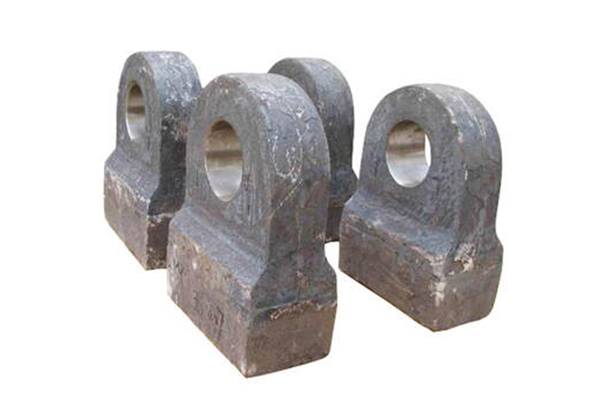
Where Standard Hammer Heads Fail Under Load
Stress Concentration at the Neck and Pin Hole
Most hammers break in two places: the neck just below the end that hits something and the area around the pin hole. When the hammer head hits a rock at high spinning speed, these zones take the load and break. Sharp internal corners, thin sections, and poorly placed holes multiply that stress until fatigue cracks form and the hammer snaps mid-shift.
Tramp Metal and Oversized Feed
Mining and recycling plants don’t usually get feed that is clean and the right size. A stray bolt, a loose bucket tooth, or a big rock can hit the hammer head with a lot more force than it was designed to handle. There is no safety margin for these shock loads in a generic part that was made for normal conditions. One uncrushable item can crack the handle and damage the grate bars and liners.
Hidden Defects in Generic Castings
Lots of cheap, ready-to-use parts come from foundries that don’t keep a close eye on the process. Shrinkage pores, slag inclusions, and uneven heat treatment can’t be seen until the hammer head is being used. That means more calls and angry customers for a small service shop. For a bigger equipment maker, it means more guarantee claims and a worse image with customers who expect machines to work well.
Custom Design Features That Stop Hammer Head Breakage
Bimetallic Construction: Hard Where It Strikes, Tough Where It Bends
A single alloy forces you to make a choice. When something is tough enough to fight wear, it usually breaks easily, and when it’s tough enough to take a hit, it runs out quickly. That trade-off is taken away by Huan-Tai’s adjustable bimetallic hammer head. High-chromium cast iron is used to make the striking end tough against wear. The handle is made of cast or alloy steel, which bends when hit hard but doesn’t break.
Reshaped Geometry That Spreads Stress
First, our experts look at where the old part broke. Then, to fix that weak spot, they change the shape of the hammer head. Sharp corners are replaced with large fillet radii, the neck is widened where cracks usually start, and the area around the pin hole is made stronger. This improved structure also has a strong crushing force, so the reworking makes it last longer and make particles that are all the same size.
Mass and Fit Tailored to Your Rotor
A hammer that is too heavy overloads the pin and shaft. One that is too light lets material bounce back against it. We match each hammer head to your rotor speed, pin diameter, and grate clearance, and we hold tight weight tolerances across a full set. Our designs suit single-rotor, double-rotor, and ring hammer crushers, as well as hammer mills in many industries.
Turning a Custom Hammer Head Into Reliable Uptime
Starting From Real Operating Data
Good custom design begins with questions. What do you crush? How big is the feed? Where did the last hammer head crack? We work from drawings, samples, or even a broken part. Our technical team uses those details to choose the right material grades and hardness levels. Thirty years of building engineering and mining machinery parts have taught us this practical approach.
Inspection That Catches Weak Points Early
Our production team controls quality throughout the entire process. We verify chemical composition at the furnace, check the bond between the two metals, confirm heat treatment results, and test hardness on the finished surface. Every hammer head is measured and weighed before packing. Larger manufacturers receive the inspection reports they require, and smaller buyers get parts that install correctly the first time.
Lower Cost Per Ton, Not Just a Lower Price
Buyers naturally compare unit prices. However, a cheap hammer that breaks early costs far more in downtime, labor, and secondary damage. A properly engineered hammer head runs longer between changeovers and protects grate bars, liners, and the forged main shaft. Standard designs move quickly through production. New custom parts may take longer when drawings need several rounds of confirmation.
Conclusion
Crusher breakage rarely comes down to bad luck. It usually comes from hammers that were never designed for the job. A custom hammer head with a wear-resistant high-chromium striking end, a tough alloy steel handle, and stress-relieving geometry survives shock loads, keeps rotors balanced, and fits your exact machine. The payoff is less downtime, steadier output, and lower cost per ton.
FAQ
Why do hammer heads usually break at the neck?
The neck carries the highest bending stress. Sharp corners and thin sections in that area lead to fatigue cracks.
What makes a bimetallic hammer head stronger?
It pairs a high-chromium cast iron striking end for wear resistance with an alloy steel or cast steel handle that absorbs impact.
Can you copy and improve my existing hammer?
Yes. Send us a drawing, sample, or broken part, and we will reinforce the weak areas.
Which crushers do your hammer heads fit?
They fit single-rotor, double-rotor, and ring hammer crushers, as well as hammer mills.
How long does a custom order take?
Standard designs are produced efficiently. New designs may need extra time for drawing confirmation and process setup.
Stop Replacing Broken Hammers: Talk to Our Engineers
How many hammers did your crusher lose last quarter? Send us a photo of your broken part or your drawing. Huan-Tai’s technical team will pinpoint why it failed and design a hammer head that lasts. Since the mid-1990s, overseas buyers have trusted our production team to control quality at every step, backed by responsive service and 30 years of custom parts experience. Email inquiry@huan-tai.org today for a free design review and quote. We’d love to see your toughest application.
References
- Napier-Munn, T. J., Morrell, S., Morrison, R. D., & Kojovic, T. (1996). Mineral Comminution Circuits: Their Operation and Optimisation. Julius Kruttschnitt Mineral Research Centre, University of Queensland.
- Laird, G., Gundlach, R., & Röhrig, K. (2000). Abrasion-Resistant Cast Iron Handbook. American Foundry Society.
- Zum Gahr, K.-H. (1987). Microstructure and Wear of Materials. Elsevier.
- Blau, P. J. (Ed.). (1992). ASM Handbook, Volume 18: Friction, Lubrication, and Wear Technology. ASM International.
- Campbell, J. (2015). Complete Casting Handbook: Metal Casting Processes, Metallurgy, Techniques and Design (2nd ed.). Butterworth-Heinemann.
