
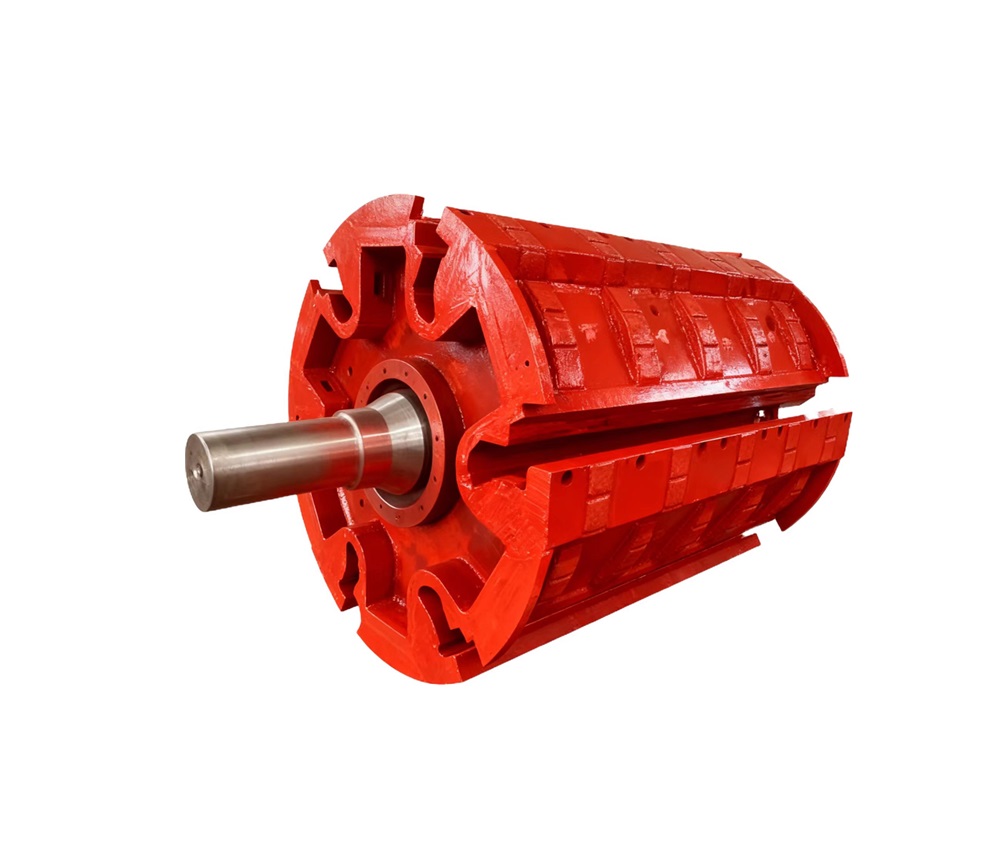
Rotor balance matters because a hammer crusher spins a heavy assembly at speed, and any weight error turns into vibration that chews bearings, loosens foundations, and drifts product size. A balanced rotor crushes harder, runs quieter, and lasts longer between shutdowns. Here is where balance gets lost, where it is won, and how to keep it.
What an Unbalanced Rotor Does to Your Crusher
Imbalance rarely announces itself loudly at first. It shows up as small bills that keep arriving.
Bearings and Foundations Take the Hit
Centrifugal force grows with the square of speed, so a small weight error on the Rotor becomes a large shaking load at operating rpm. Bearings run hot, housings fret, anchor bolts work loose, and weld seams fatigue. By the time vibration readings alarm your crew, the damage has usually been compounding for weeks.
Product Size Drifts and Hammers Wear Lopsided
A wobbling Rotor strikes feed at inconsistent angles, so crushing force varies blow by blow and gradation wanders off spec. Hammers on the heavy side wear faster, which deepens the imbalance every shift. Recirculating loads climb, screens complain, and your operators start chasing settings that never quite hold.
The Downtime Bill Nobody Budgeted
The Rotor itself is rarely the expensive part; the stopped line is. Emergency pulls mean crane time, overtime labor, expedited freight, and missed delivery promises downstream. Plants that track cost per ton consistently find that planned balance corrections cost a fraction of one unplanned weekend shutdown.
Where Rotor Balance Is Won on the Shop Floor
Balance is not a final inspection trick. It is built into the part from the first process decision.
A Forged Shaft and True-Running Discs
Everything on the Rotor references the shaft, so we forge crusher main shafts rather than cast them, then grind journals and datums true. Disc bores, spacer fits, and runout are checked before assembly. If the backbone runs straight, every component stacked on it starts life concentric instead of compensating for hidden error.
Weight-Matched Hammers Across the Set
Hammer weight scatter is the classic Rotor killer. We weigh and group hammers so opposing positions match within tight limits, and our customizable bimetallic composite hammerhead pairs a hard, wear-resistant head with a strong handle, solving the easy-breakage problem while holding weight consistent cast after cast.
Machining, Inspection, and Balance Verification
After machining, the Rotor assembly is verified on balancing equipment, with correction applied and results recorded. Dimensional reports, hardness readings, and balance data ship with the part, so your quality team files evidence instead of taking our word for it. That traceability is what repeat OEM programs are built on.
How to Keep a Rotor Balanced for Its Whole Service Life
A good start is half the job. The other half is specifying parts that wear evenly and planning spares sensibly.
Bimetallic Hammers That Wear Evenly
Balance drifts when wear is uneven. Because the bimetallic head resists abrasion while the tough handle absorbs shock, each hammer loses weight at nearly the same rate, and the Rotor keeps its poise deep into the campaign. Optimized structural design also delivers strong crushing force and more uniform particle size.
Structure Tuned to Your Feed and Equipment
There is no universal Rotor. Disc layout, hammer swing, and tip speed are matched to your feed size, abrasiveness, and target gradation, and the assemblies suit various types of equipment across mining, cement, and aggregate duty. Tell us the machine model and material, and our engineers tune the build around them.
Drawings, Lead Times, and Spares Planning
Send a drawing, a model number, or a worn sample for reverse engineering. Confirmed standard orders typically move in weeks; custom builds take longer when drawings need repeated confirmation. We also cover companion parts: dust seal rings in high manganese steel or high chrome alloy steel, high manganese steel toggle plates, alloy steel rack bars, springs in spring steel, high-strength steel wire, or carbon steel, and blow bars for impact crusher lines.
Conclusion
Rotor balance is earned at the forge, the scale, and the balancing machine, then kept through even-wearing bimetallic hammers and honest scheduling. Get those right and vibration stays quiet, bearings last, and cost per ton falls. Send your drawing; we will build the balance in from day one.
FAQ
Can you balance a complete rotor assembly before shipping?
Yes. Assemblies are verified on balancing equipment, corrected, and shipped with recorded balance and inspection data.
Are your crusher main shafts cast or forged?
Forged, then machined and ground true, so the whole rotor stacks up concentric.
What hammer design do you recommend?
A customizable bimetallic composite hammerhead: hard wear-resistant head, strong handle, solving easy breakage.
How long does a custom rotor order take?
Confirmed standard jobs move in weeks; complex custom builds take longer with drawing confirmation rounds.
Can you match parts to our existing equipment?
Yes, by drawing, model, or reverse-engineered worn sample, across various crusher types.
Ready to Quiet That Crusher Down?
Thirty years of customizing non-standard mechanical parts for mining and engineering machinery means we have balanced our share of rotors. You get excellent service, production-managed quality control, and a technical team that meets your performance targets. We cast, forge, and machine; no precision electronics. Send your Rotor drawing or vibration story to inquiry@huan-tai.org — tell us what the bearings are telling you, and we will reply with a fix, a quote, and an honest lead time.
References
- Wowk, V. (1995). Machinery Vibration: Balancing. McGraw-Hill.
- Adams, M. L. (2010). Rotating Machinery Vibration: From Analysis to Troubleshooting (2nd ed.). CRC Press.
- Schneider, H. (1977). Balancing Technology. VDI-Verlag.
- Lynch, A. J. (1977). Mineral Crushing and Grinding Circuits: Their Simulation, Optimisation, Design and Control. Elsevier.
- Eshleman, R. L. (1999). Basic Machinery Vibrations: An Introduction to Machine Testing, Analysis, and Monitoring. VIPress.
