
There is a direct and measured link between the casting method used to make a track frame and how well it works in service. Crawler-type machines like excavators, bulldozers, and mining equipment are held together by a track frame that has to handle constant dynamic loads, shaking, and rough ground contact. Picking the right casting method affects the mass of the material inside, the accuracy of the measurements, the quality of the surface, and finally, how long the whole chassis system will last.
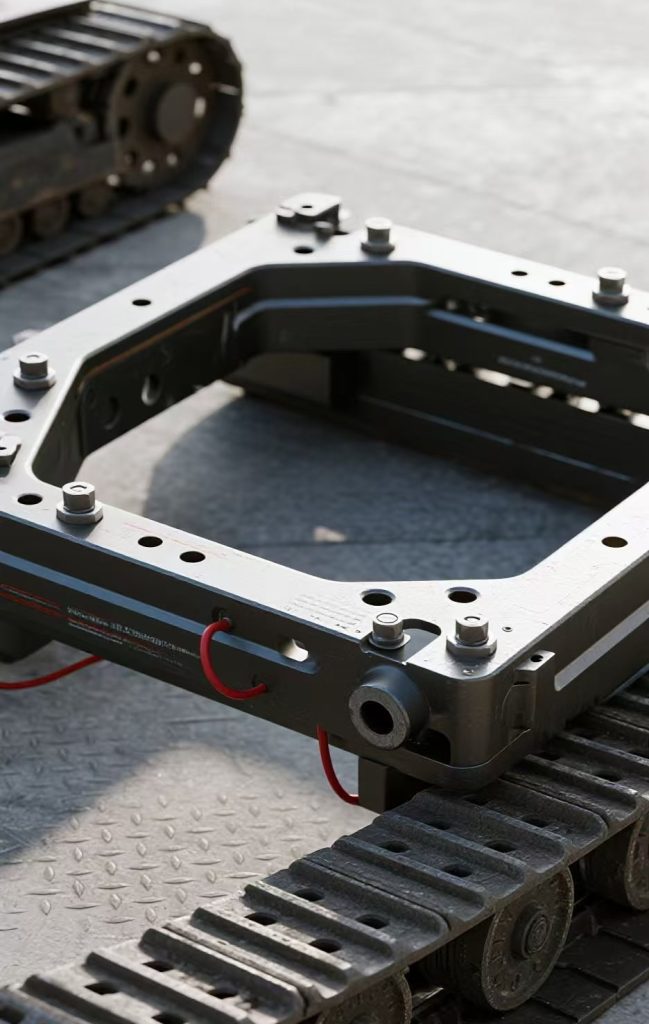
How Different Casting Methods Shape Track Frame Quality
Resin Sand Casting and Its Structural Advantages
One of the most common ways to make heavy structure parts like the track frame is through resin sand casting. Chemically linked sand molds keep their shape very accurately while metal is poured into them. This makes casts with exact wall widths, clean internal openings, and a uniform surface finish. This numerical stability directly means better load distribution across the structure and less stress buildup at key parts for a track frame that is constantly touching the ground and being loaded with shocks.
Lost Foam Casting for Complex Geometries
When a track frame design has complicated internal shapes or weight-reduction pockets that would be hard to make with traditional mold methods, lost foam casting is a great way to make it happen. The foam pattern evaporates during filling, leaving a hole that is a perfect copy of the original design. This method allows for close limits on dimensions and near-net-shape production, which cuts down on the need for extra cutting. When a customer provides specific engineering plans for a customizable track frame application, lost foam casting gives makers more freedom to match complex design needs correctly.
How Casting Choice Affects Internal Material Integrity
In addition to the accuracy of the dimensions, the casting method affects the track frame‘s interior soundness by affecting the porosity, grain structure, and leftover stress inside the casting. When used correctly, the resin sand and lost foam methods make casts that have good interior density and the same material qualities all the way through the piece. When combined with the right heat treatment after casting, this internal stability makes sure that the track frame can withstand repeated impact and bending loads without getting fatigue cracks where stress builds up over time.
Why Inspection and Process Control Determine Track Frame Reliability
Dimensional Inspection After Casting
If a track frame looks good at first glance but has secret size differences, it will cause problems when it is put together or when it is first put into service. It is important to do a careful review of the part’s dimensions after casting, making sure that it fits the plan perfectly before starting any other work on it. This includes checking for key hole locations, mounting face flatness, and general structural alignment. At Huan-Tai, every track frame casting goes through a series of checking steps that find any problems early on. This keeps parts that don’t meet standards from moving through the production process and getting to the customer.
Heat Treatment and Anti-Rust Surface Processing
When metal solidifies, it adds pressure to the inside of raw casts. Without the right heat treatment, a track frame could become unstable in its dimensions or crack when it’s put through its paces. These pressures are taken away by the heat treatment method, which also improves the mechanical qualities and makes the grain structure more uniform. After heat treatment, an anti-rust surface treatment keeps the track frame from rusting while it is being stored, shipped, and first used. This is especially important for machines that will be used in wet, dirty, or chemically harsh conditions. When these treatments are used together, they greatly lower the chances of size mismatch and surface wear that can damage or jam matching chassis parts.
ISO 9001 Quality Management in Practice
End-of-line checking is not enough to guarantee the quality of a solid part like the track frame. Huan-Tai oversees production with ISO 9001 certification, which sets up written controls at every step, from checking the raw materials and making the molds to casting, heat treatment, inspection, and shipping. This structured quality framework gives overseas buying managers a solid reason to trust that every order will come with parts that match their plans and work as planned, even if they can’t check them in person.
How Custom Drawing Design Supports Track Frame Procurement
Working from Customer Drawings
Catalog parts can’t always be used in track frame uses that need non-standard sizes or fitting arrangements that are specific to the tools being used. Huan-Tai offers custom drawing design, so customers can either send in their own engineering plans or work with the technical team to come up with specs that meet their needs. This is especially helpful for machinery repair shops that need to find new track frames for pieces of equipment because the original part is no longer available from the OEM. It’s also helpful for equipment designers who need parts that are made to fit their own specific structure designs.
Lead Time Considerations for Custom Parts
There are several steps that go into making a custom track frame: reviewing and confirming the drawings, making the pattern or molding, casting, heat treating, inspecting, and finishing. Lead times depend on how complicated the part is, how many rounds of changes need to be made to the drawings, and other process-specific factors. Customers are asked to send in fully finished models as soon as possible so that there is less back and forth and planning for production can go on without any problems. Lead times are usually doable for simple new parts. For more complicated custom designs, you should expect a longer run and plan for it.
Matching Material to Application Requirements
Base materials may need to be different for track frames that are used with different kinds of tools and in different kinds of settings. Because it is strong, tough, and easy to make, cast steel is often used in general building uses. It is possible to change the material that is used to fit the load and wear conditions of a tougher setting with a lot of contact or smooth wear. As part of the custom development process, Huan-Tai’s expert team looks over what the customer wants and suggests the right material specs. This makes sure that the finished track frame is suitable for the situations it will be used in.
Conclusion
The casting method is one of the most important parts of a track frame’s performance. It affects the accuracy of the dimensions, the purity of the materials inside, and the structure’s long-term dependability. When you combine resin sand and lost foam casting with controlled heat treatment, anti-rust processing, and inspections that follow ISO 9001 rules, you get track frames that always work well in tough engineering and mining conditions. When looking for custom or new track frames, customers must make sure that the seller they choose has both the technical know-how and strict process control.
FAQ
What kinds of casting are used to make track frames?
The main ways are resin sand casting and lost foam casting. Both are good at making heavy structure parts because they are accurate in size and keep the material’s stability inside.
Q: Can handmade drawings be used to make track frames?
Yes, Huan-Tai can do custom drawing design, which includes non-standard sizes and equipment-specific layouts for both OEM makers and replacement part uses.
Why is it important for a cast track frame to be heated?
Heat treatment lowers stresses inside the casting, smooths out the grain structure, and boosts the material’s dynamic qualities. These all help the structure last longer even when it is loaded and unloaded many times.
How long does it take to make a track frame that is just right for me?
Lead times depend on how complicated the plan is and how many rounds of approval are needed for the drawings. Simple parts can be made in a fair amount of time, but unique patterns that are more complicated may take longer to make.
What quality standards does Huan-Tai use for its track frame production?
Production is overseen by ISO 9001 certification, and each stage of production is inspected in writing to make sure that the dimensions are met and that the quality of each part is always the same.
Partner With Huan-Tai for Reliable Track Frame Supply
The Xian Huan-Tai Technology and Development Co., Ltd. has been making special, non-standard mechanical parts for mining and industrial uses for more than 30 years. From the time the raw materials come in until the final review, our professional production team is in charge of quality. Meanwhile, our expert team works directly with your plans to make sure the products meet your performance requirements. We want to hear from you if you need a reliable track frame supplier who has the process skills and service drive to achieve every time. Email us at inquiry@huan-tai.org.
References
- Beeley, P. R. (2001). Foundry Technology (2nd ed.). Butterworth-Heinemann.
- Campbell, J. (2015). Complete Casting Handbook: Metal Casting Processes, Metallurgy, Techniques and Design (2nd ed.). Butterworth-Heinemann.
- Stefanescu, D. M. (2015). Science and Engineering of Casting Solidification (3rd ed.). Springer.
- Heine, R. W., Loper, C. R., & Rosenthal, P. C. (1967). Principles of Metal Casting (2nd ed.). McGraw-Hill.
- Li, X., & Wang, F. (2019). “Structural integrity assessment of cast steel undercarriage components for heavy construction equipment.” Journal of Materials Processing Technology, 271, 345–358.
- Zhang, Y., & Chen, H. (2021). “Dimensional accuracy and mechanical performance of resin sand cast structural frames in mining machinery applications.” International Journal of Cast Metals Research, 34(2), 88–101.
